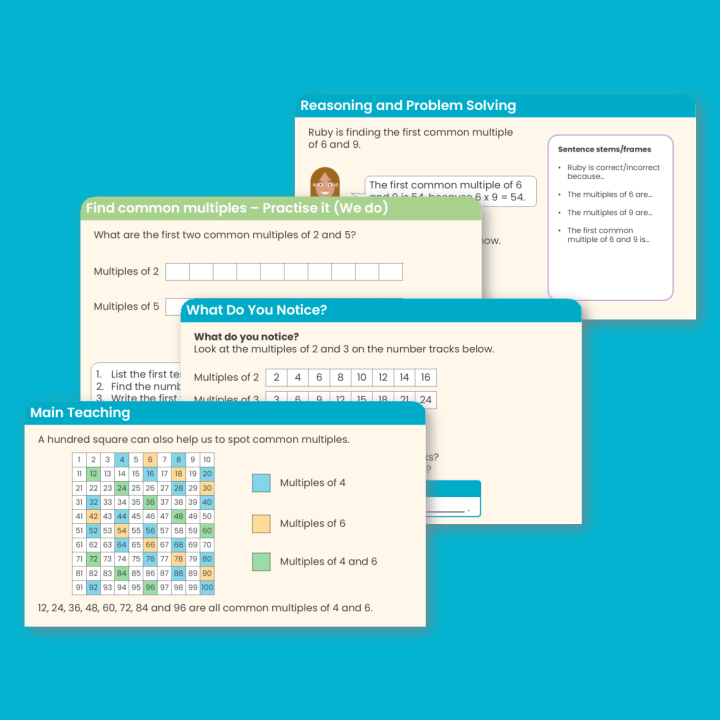
The Year 5 Common Multiples PowerPoint guides both teachers and children through the lesson, including use of the varied fluency, reasoning and problem solving, deeper reasoning and scaffolded resources. Key learning information about this step:
Key Vocabulary
multiple: A product of a whole number multiplied by another number. For example: multiples of 10 are the products of numbers multiplied by 10.
factor: Numbers we can multiply together to get another number. For example: 2 and 3 are factors of 6 because 2 x 3 = 6.
common multiple: A multiple shared by two or more numbers.
systematically: Working in an organised way.
Venn diagram: A way of sorting a group of different things. It allows us to sort a group of data into two or three circles or shapes that overlap in the middle. Each circle or shape follows a given rule, so any numbers or objects placed in the overlapping part follow both rules.
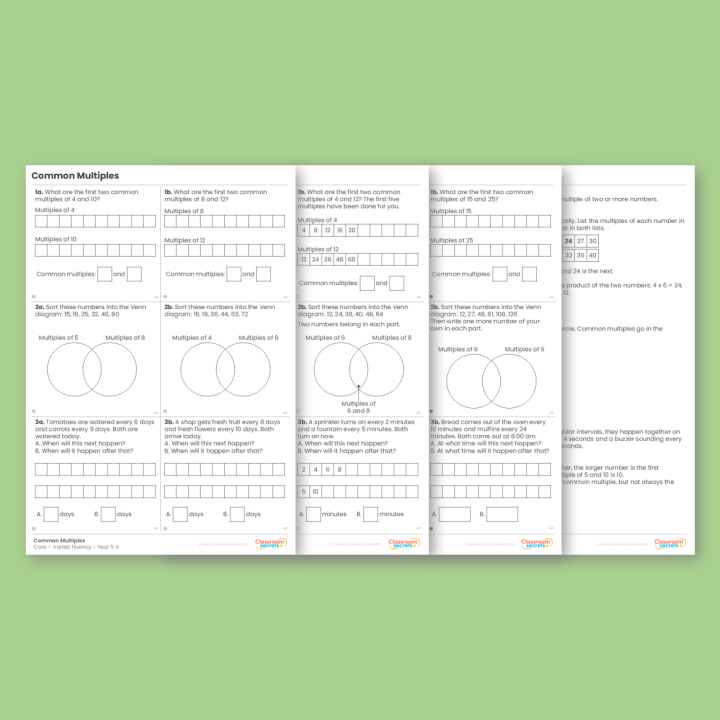
Varied Fluency
Knowledge Organiser
• Designed to support all children via key information and examples.
Scaffolded Examples
• Listing multiples on number tracks; sorting numbers into a Venn diagram.
Support
• Q1: Find the first two common multiples of a pair of numbers up to 12. One number is a multiple of the other; first five multiples of both numbers already given.
• Q2: Sort multiples into a Venn diagram. Hint given about placement of numbers; middle of diagram labelled.
• Q3: Solve repeating-event problems within known times tables. Some multiples given.
Core
• Q1: Find the first two common multiples of a pair of numbers up to 12 on blank tracks.
• Q2: Sort multiples into a Venn diagram.
• Q3: Solve repeating-event problems with common multiples. Multiples to be listed on a number track.
Stretch
• Q1: Find the first two common multiples, counting in 12s, 15s, 16s and 25s.
• Q2: Sort multiples into a Venn diagram. Add one more multiple to each diagram section.
• Q3: Solve repeating-event problems with common multiples involving time. Times of new events must be calculated; multiples go beyond known facts.
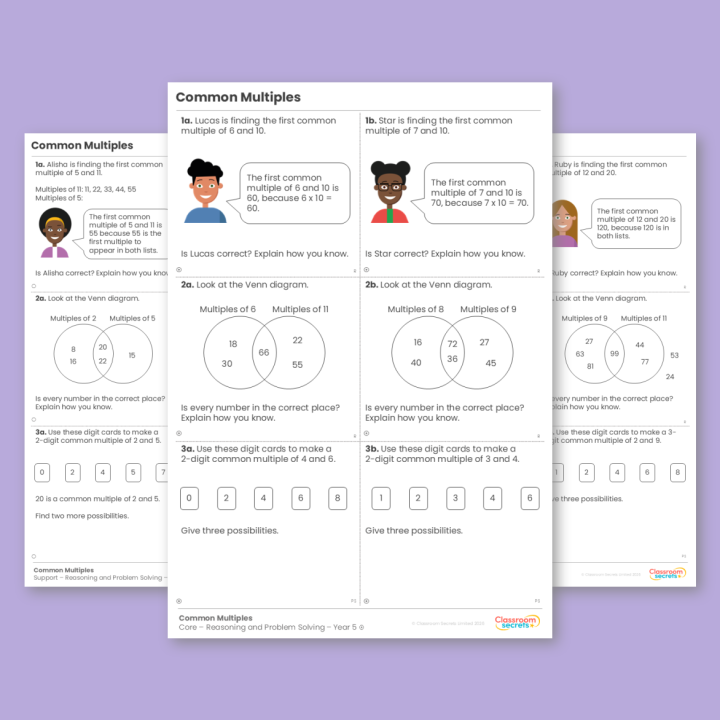
Reasoning and Problem Solving
Support
• Q1: Reasoning – explain a first common multiple claim; multiples given.
• Q2: Reasoning – check whether multiples have been correctly placed in a Venn diagram. Familiar times tables.
• Q3: Problem Solving – make 2-digit common multiples from digit cards. One number given as a model; find two more.
Core
• Q1: Reasoning – explain a first common multiple claim based on the product.
• Q2: Reasoning – check whether multiples have been correctly placed in a Venn diagram. Times tables up to 12 x 12.
• Q3: Problem Solving – make 2-digit common multiples from digit cards.
Stretch
• Q1: Reasoning – explain a claim about the first number in both lists.
• Q2: Reasoning – check whether multiples have been correctly placed in a Venn diagram. Some numbers placed outside the diagram.
• Q3: Problem Solving – make 3-digit common multiples from digit cards drawing on known facts.
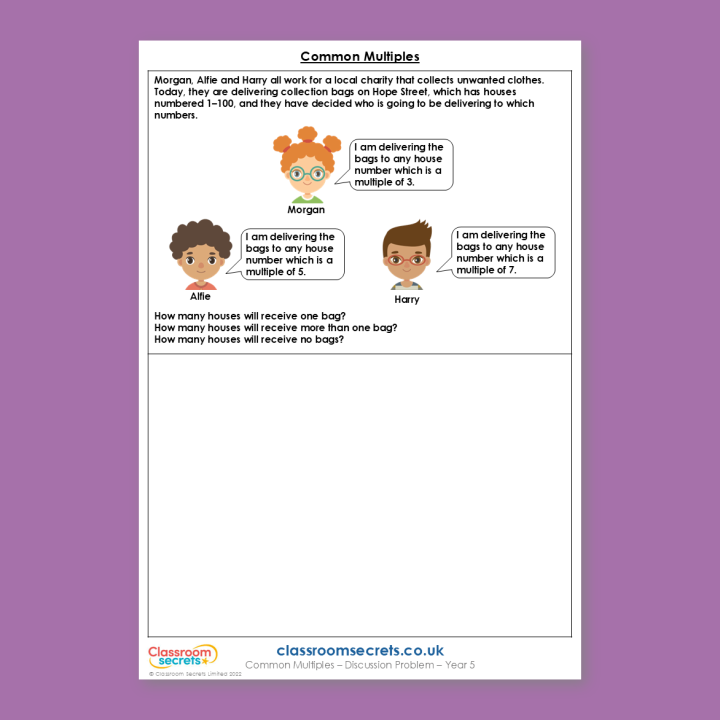
Deeper Reasoning
The question in this set focuses on problem solving with common multiples to deepen understanding in identifying common multiples and solving problems involving multiplication and division, including using their knowledge of multiples.