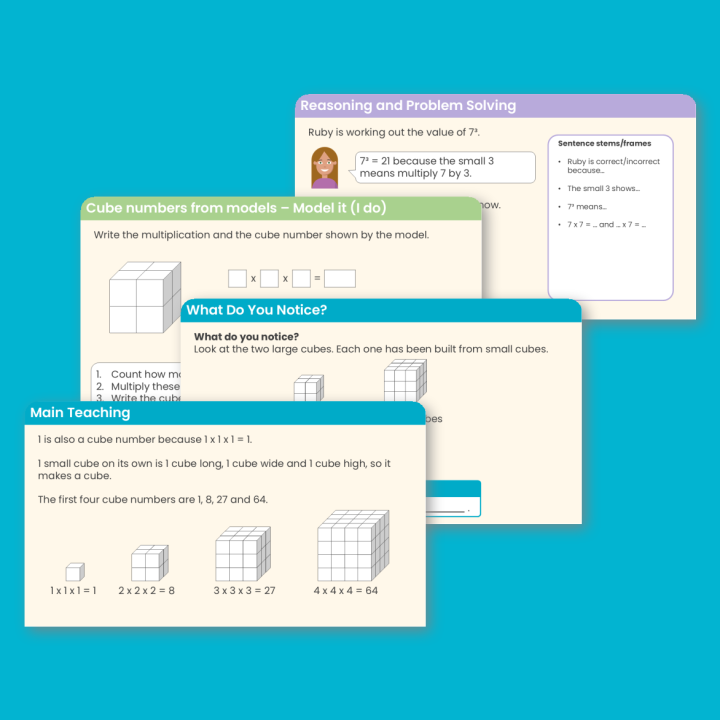
The Year 5 Cube Numbers PowerPoint guides both teachers and children through the lesson, including use of the varied fluency, reasoning and problem solving, deeper reasoning and scaffolded resources. Key learning information about this step:
Key Vocabulary
product: The answer of multiplying two or more numbers together. For example: 30 is the product of 6 x 5.
square number: The product of a number multiplied by itself. For example: 9 = 3 x 3.
cube number: The product of a number multiplied by itself and then by itself again. For example: 8 = 2 x 2 x 2.
3D shape: A shape with three dimensions, usually described as length, width and height.
Varied Fluency
Knowledge Organiser
• Designed to support all children via key information and examples.
Scaffolded Examples
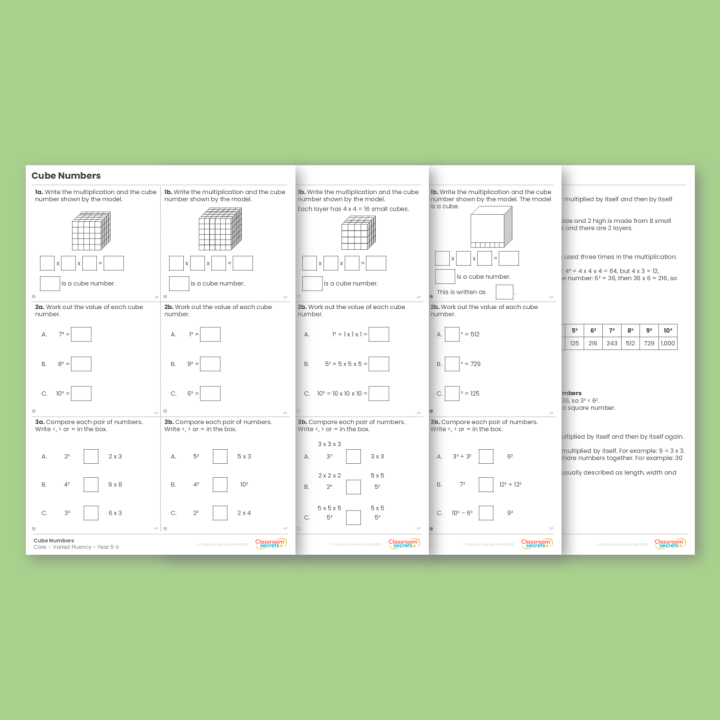
• Comparing shapes by looking, estimating with a reference square, then checking a covering.
Support
• Q1: Write what a cube model shows; small cubes in each layer given.
• Q2: Calculate cube numbers up to 10³; multiplication written out.
• Q3: Compare cube numbers with squares or multiplications; working given.
Core
• Q1: Write what a cube model of up to 6 x 6 x 6 shows.
• Q2: Calculate cube numbers up to 10³.
• Q3: Compare cube numbers with squares or multiplications.
Stretch
• Q1: Work out the cube number from a model where only one edge is shown, then write it using a small 3.
• Q2: Find the number that has been cubed, up to 10³.
• Q3: Compare sums and differences of cube and square numbers.
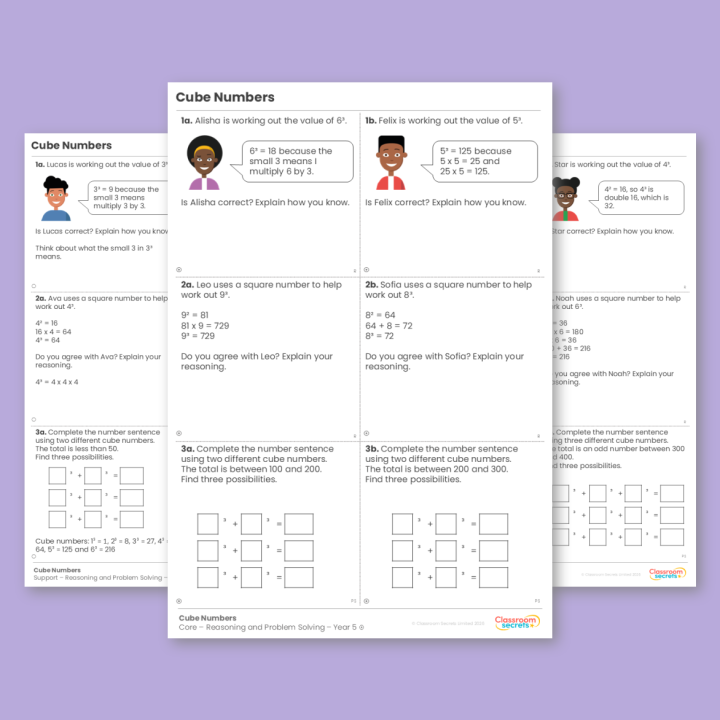
Reasoning and Problem Solving
Support
• Q1: Reasoning – explain whether a character has cubed 2 or 3 correctly; hints given.
• Q2: Reasoning – explain whether a character has used a square number correctly to find a cube; expanded form given.
• Q3: Problem Solving – find two different cube numbers with a total that meets one condition; cubes up to 6³ listed.
Core
• Q1: Reasoning – explain whether a character has cubed 5 or 6 correctly.
• Q2: Reasoning – explain whether a square number has been used correctly to find a cube number; identify the correct operation independently.
• Q3: Problem Solving – find two different cube numbers with a total that meets one condition.
Stretch
• Q1: Reasoning – explain whether a character has used a square number to find a cube correctly.
• Q2: Reasoning – check multi-step working that uses a square to find a cube; spot a calculation error.
• Q3: Problem Solving – find three different cube numbers with a total that meets two conditions.
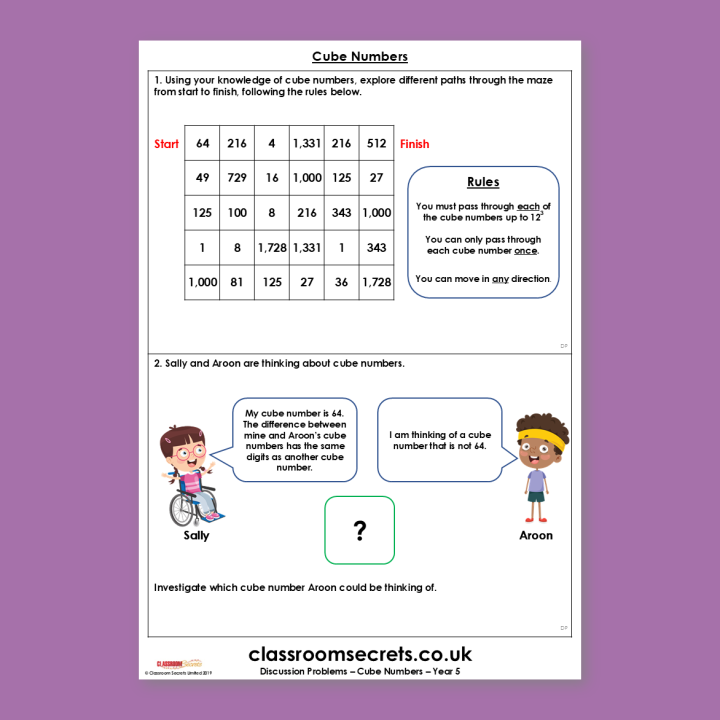
Deeper Reasoning
The questions in this set focus on solving puzzles using a knowledge of cube numbers to deepen understanding of how to recognise and use cube numbers and the notation for cubed.