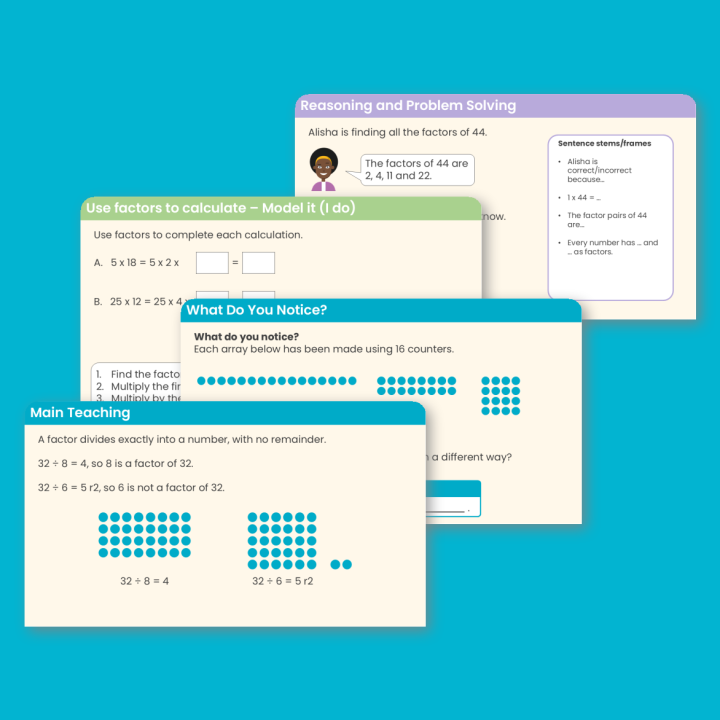
The Year 5 Factors PowerPoint guides both teachers and children through the lesson, including use of the varied fluency, reasoning and problem solving, deeper reasoning and scaffolded resources. Key learning information about this step:
Key Vocabulary
factors: Numbers we can multiply together to get another number. For example: 2 and 3 are factors of 6 because 2 x 3 = 6.
product: The answer of multiplying two or more numbers together. For example: 30 is the product of 6 x 5.
multiple: A product of one number multiplied by another number. For example: multiples of 10 are the products of numbers multiplied by 10.
systematically: Working in an organised way.
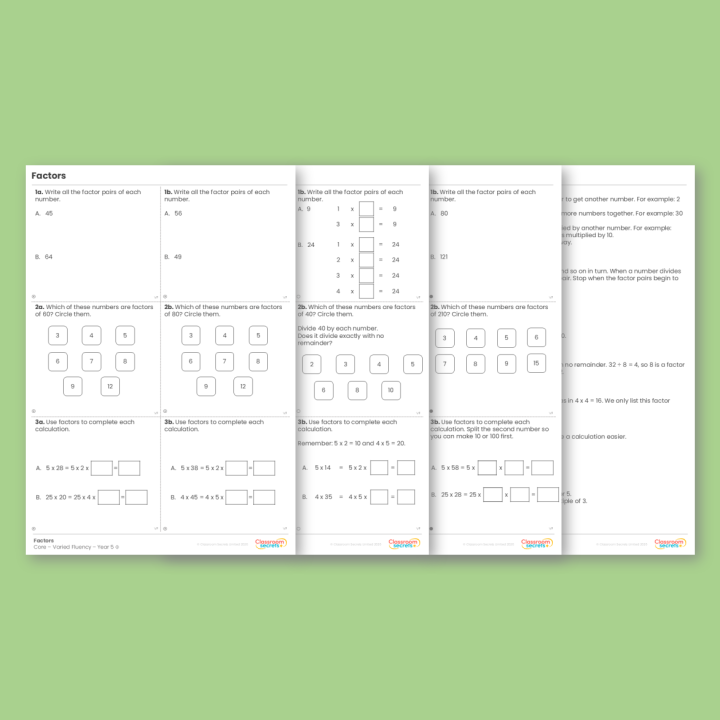
Varied Fluency
Knowledge Organiser
• Designed to support all children via key information and examples.
Scaffolded Examples
• Finding Factor Pairs and Factors
Support
• Q1: Write factor pairs of numbers up to 28; first factors given in rows.
• Q2: Identify factors of 20 and 40; prompt to divide and check remainders.
• Q3: Use factors to multiply; a helpful fact is given and the split is shown.
Core
• Q1: Write all the factor pairs of 2-digit numbers, including a repeated factor.
• Q2: Identify factors of 60 and 80 from eight numbers up to 12.
• Q3: Use factors to multiply by splitting into 5 x 2, 25 x 4 or 4 x 5; split shown.
Stretch
• Q1: Write factor pairs of numbers with up to eight pairs, including a repeated factor.
• Q2: Identify factors of 240 and 210 from 1- and 2-digit numbers.
• Q3: Use factors to multiply; split the second number to make 10 or 100 first.
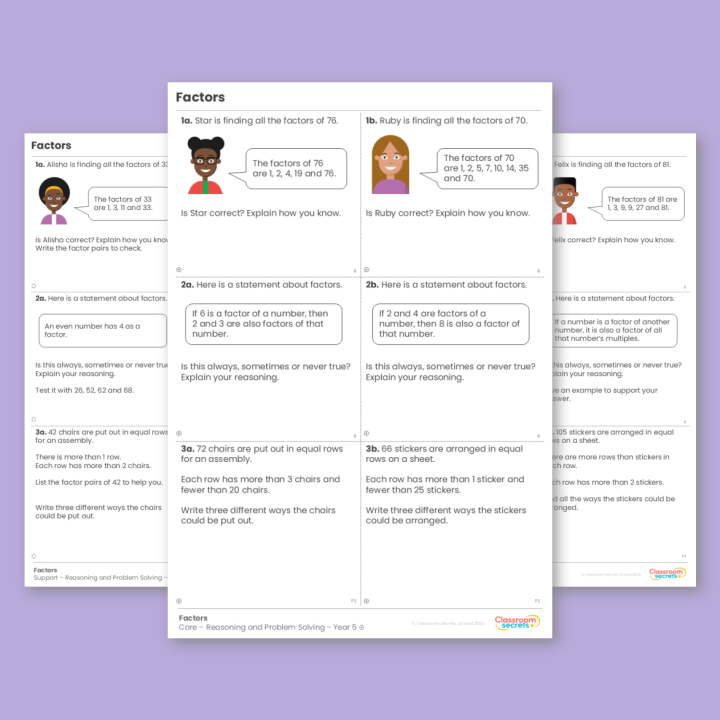
Reasoning and Problem Solving
Support
• Q1: Reasoning – explain whether a character has listed all the factors; two factor pairs, prompt given.
• Q2: Reasoning – decide whether a divisibility statement is always, sometimes or never true; test numbers given.
• Q3: Problem Solving – find equal rows for an amount with two simple conditions; prompt to list factor pairs.
Core
• Q1: Reasoning – explain whether a character has listed all the factors of a number with three or four pairs.
• Q2: Reasoning – decide whether a statement linking two factors is always, sometimes or never true.
• Q3: Problem Solving – find equal rows for an amount where the row size must fall within a range.
Stretch
• Q1: Reasoning – explain whether a character has listed the factors of a number with six pairs or a repeated factor.
• Q2: Reasoning – decide whether a statement about factors and multiples is always, sometimes or never true; give an example.
• Q3: Problem Solving – find all the equal row arrangements of a 2- or 3-digit amount that meet two conditions.
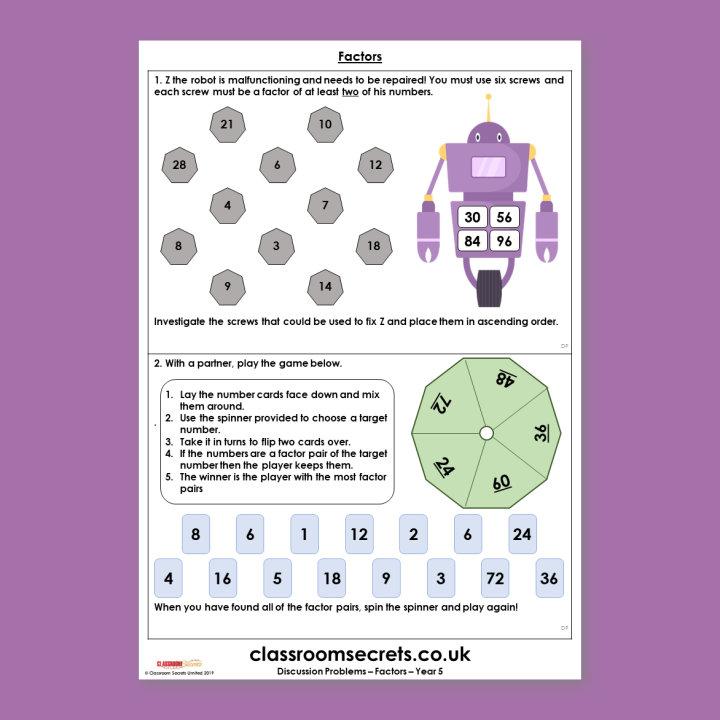
Deeper Reasoning
The questions in this set focus on identifying the correct screws to fix the robot and playing a game with a partner to deepen understanding in identifying factors.