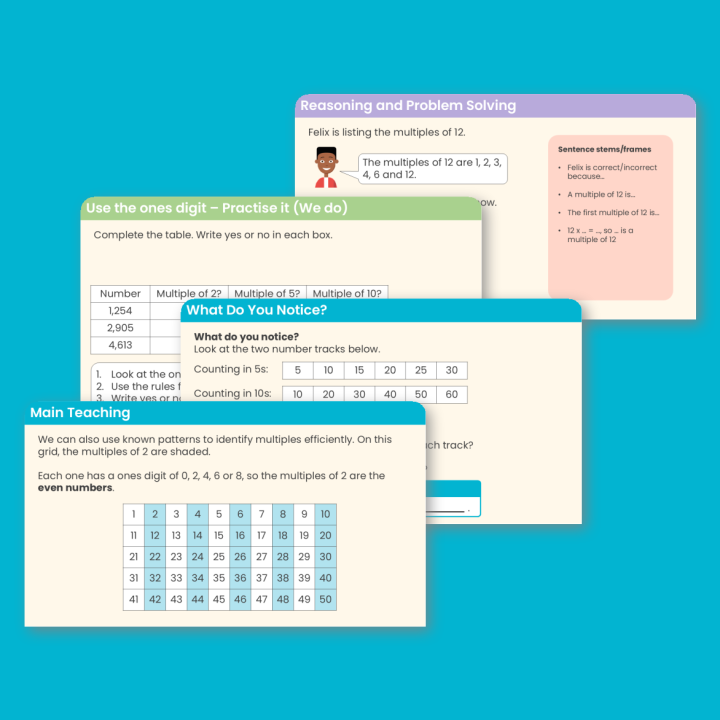
The Year 5 Multiples PowerPoint guides both teachers and children through the lesson, including use of the varied fluency, reasoning and problem solving, deeper reasoning and scaffolded resources. Key learning information about this step:
Key Vocabulary
representation: A number that has been shown in different ways. For example, in numerals, words or using equipment such as Base 10 or a place value chart.
Base 10: A physical resource which represents numbers. The small cubes represent ‘ones’; the rods represent ‘tens’ and are made up of 10 small cubes; the squares represent ‘hundreds’ and are made up of 10 rods; the large cubes represent ‘thousands’ and are made up of 10 squares.
placeholder: 0 is used to hold a place in a number and maintain its place value.
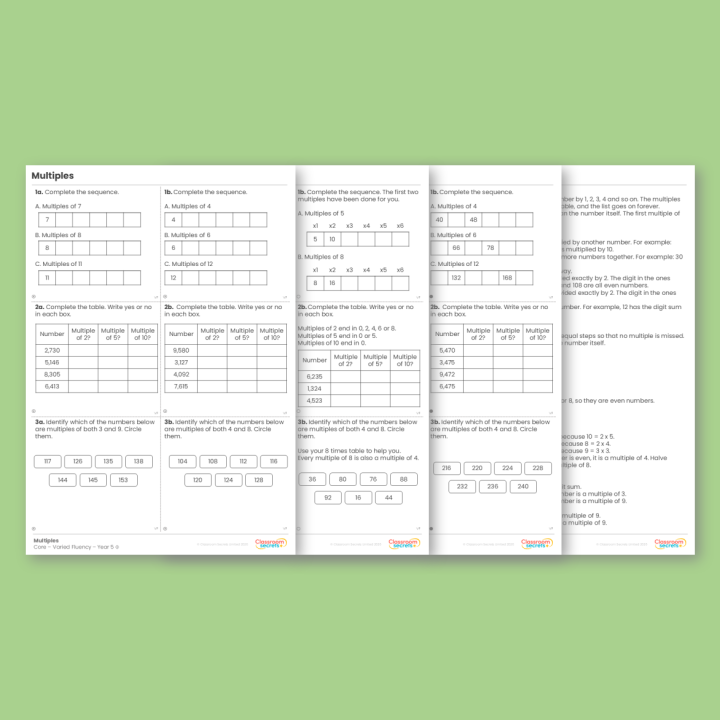
Varied Fluency
Knowledge Organiser
• Designed to support all children via key information and examples.
Scaffolded Examples
• Listing multiples on a number track; completing sentences about the first multiple.
Support
• Q1: List multiples using familiar times tables; first two multiples given.
• Q2: Identify multiples of 2, 5 and 10; 4-digit numbers; rules given.
• Q3: Identify multiples of both numbers; support provided.
Core
• Q1: List multiples using familiar times tables; first multiple given.
• Q2: Identify multiples of 2, 5 and 10; 4-digit numbers with different ones digits.
• Q3: Identify multiples of both numbers; beyond familiar times tables.
Stretch
• Q1: List multiples extending beyond 12th multiple; some numbers given in different positions.
• Q2: Identify multiples of 2, 5 and 10; 4-digit numbers with similar endings.
• Q3: Identify multiples of both numbers; apply the digit sum and halving/divisibility strategies to distinguish carefully chosen numbers.
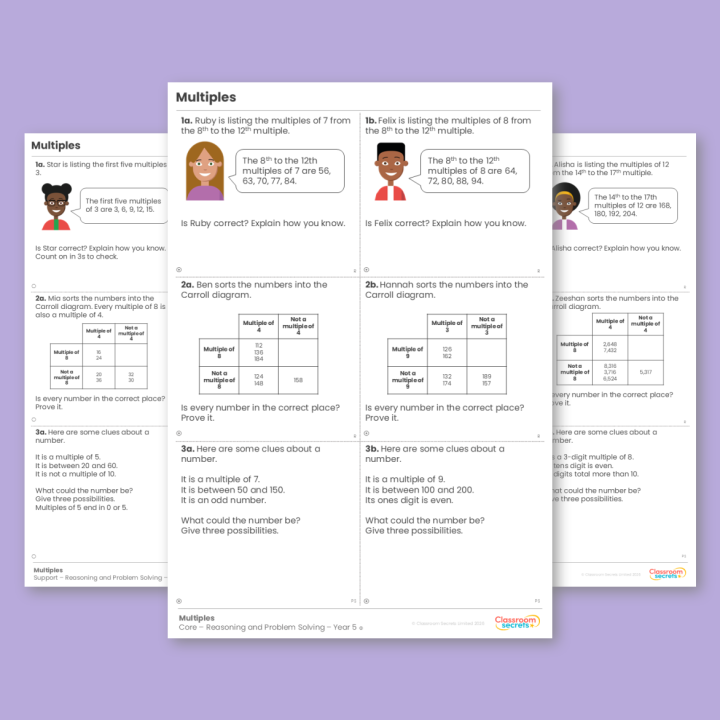
Reasoning and Problem Solving
Support
• Q1: Reasoning - explain whether familiar multiples are correct; support given.
• Q2: Reasoning – identify a sorting mistake using familiar multiples; rule given.
• Q3: Problem Solving – find possible numbers from simple clues using familiar multiples; clue to support systematic searching.
Core
• Q1: Reasoning – explain whether multiples up to the 12th multiple are correct; no prompt given.
• Q2: Reasoning – identify a sorting mistake; 3-digit multiples; choose an appropriate checking strategy.
• Q3: Problem Solving – find possible numbers by combining three clues; working with multiples beyond familiar times table facts.
Stretch
• Q1: Reasoning - explain whether multiples in specified positions beyond the 12th multiple are correct.
• Q2: Reasoning – identify and justify a sorting mistake; explain the relationship between the multiples and why one category must remain empty.
• Q3: Problem Solving – find 3-digit numbers to satisfy multiple conditions; use systematic reasoning to check clues.
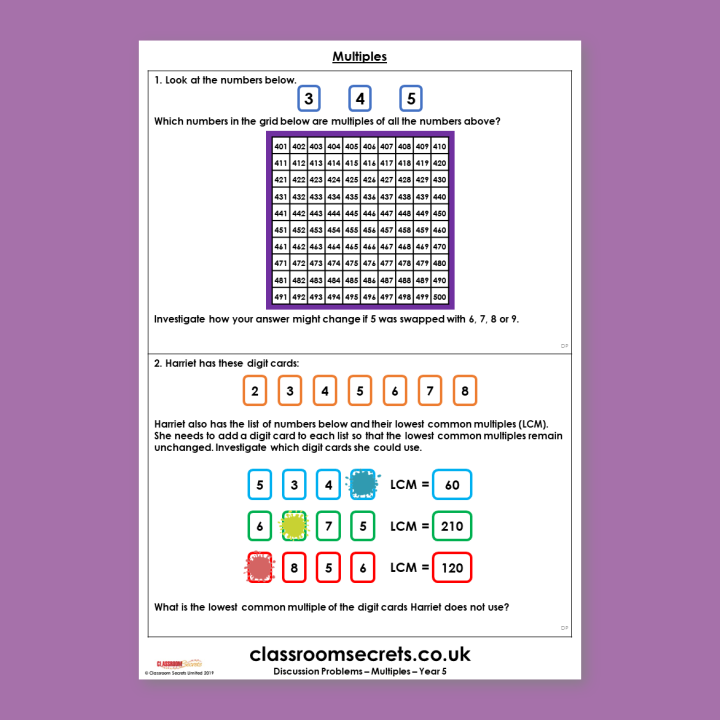
Deeper Reasoning
The questions in this set focus on problem solving with multiples to deepen understanding in identifying multiples and solving problems involving multiplication and division, including using their knowledge of multiples.