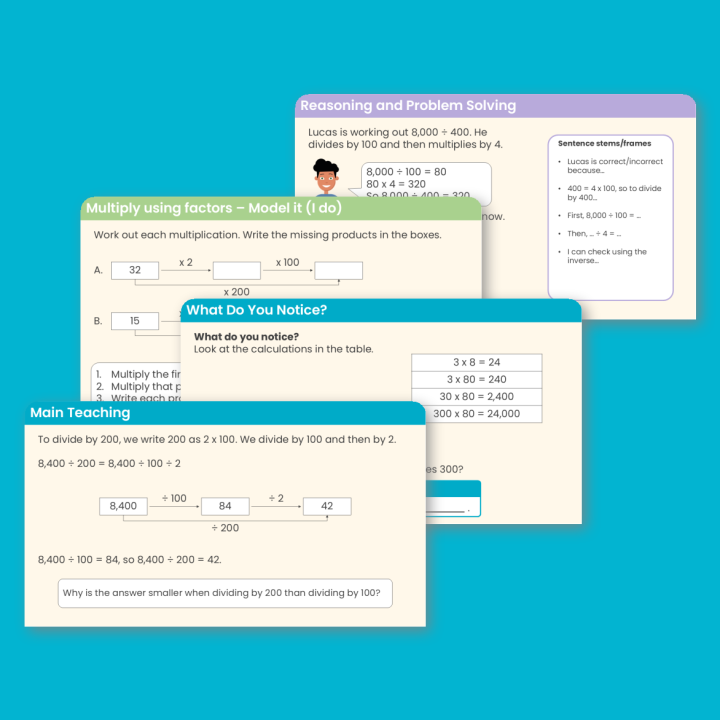
The Year 5 Multiples of 10, 100 and 1,000 PowerPoint guides both teachers and children through the lesson, including use of the varied fluency, reasoning and problem solving, deeper reasoning and scaffolded resources. Key learning information about this step:
Key Vocabulary
multiple: A product of one number multiplied by another number. For example: multiples of 10 are the products of numbers multiplied by 10.
factors: Numbers we can multiply together to get another number. For example: 2 and 3 are factors of 6 because 2 x 3 = 6.
product: The answer of multiplying two or more numbers together. For example: 30 is the product of 6 x 5.
commutative: Calculations which have the same answer no matter what order the numbers are in. Only addition and multiplication are commutative. For example: 2 x 6 = 12 and 6 x 2 = 12 and 5 + 4 = 9 and 4 + 5 = 9.
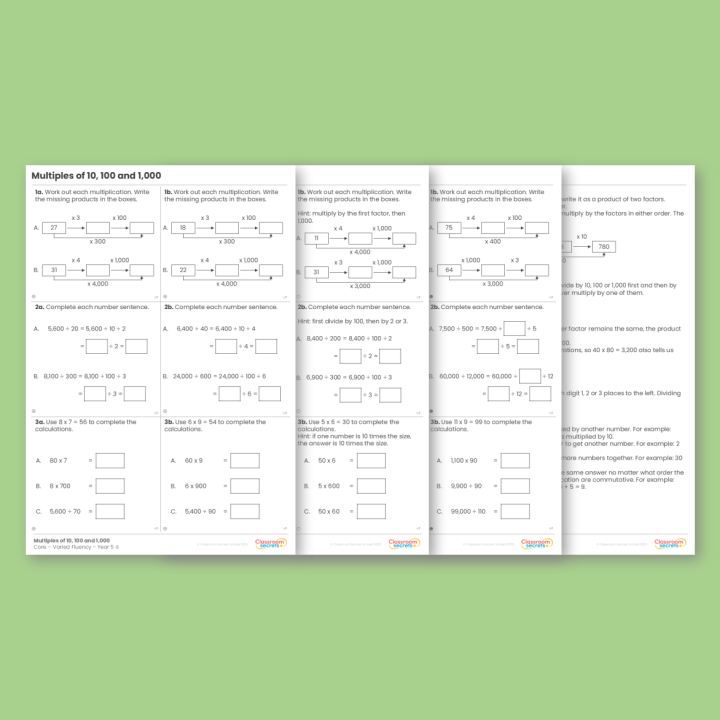
Varied Fluency
Knowledge Organiser
• Designed to support all children via key information and examples.
Scaffolded Examples
• Multiplying and dividing by 30 and 200 in steps, using sentence stems.
Support
• Q1: Multiply 2-digit numbers by multiples of 1,000 in a chain; hint given.
• Q2: Divide by multiples of 100 in two steps; both factors and a hint given.
• Q3: Use a times tables fact to multiply by multiples of 10 and 100; hint given.
Core
• Q1: Multiply 2-digit numbers by multiples of 100 or 1,000 in a chain.
• Q2: Divide by multiples of 10 or 100 in two steps; both factors given.
• Q3: Use a times tables fact with multiples of 10, 100 or 1,000; one division.
Stretch
• Q1: Multiply 2-digit numbers by multiples of 100 or 1,000 using factor chains, including factors presented in different orders.
• Q2: Divide by multiples of 10, 100 or 1,000; find the missing 10, 100 or 1,000.
• Q3: Use a times tables fact to complete two divisions and one multiplication.
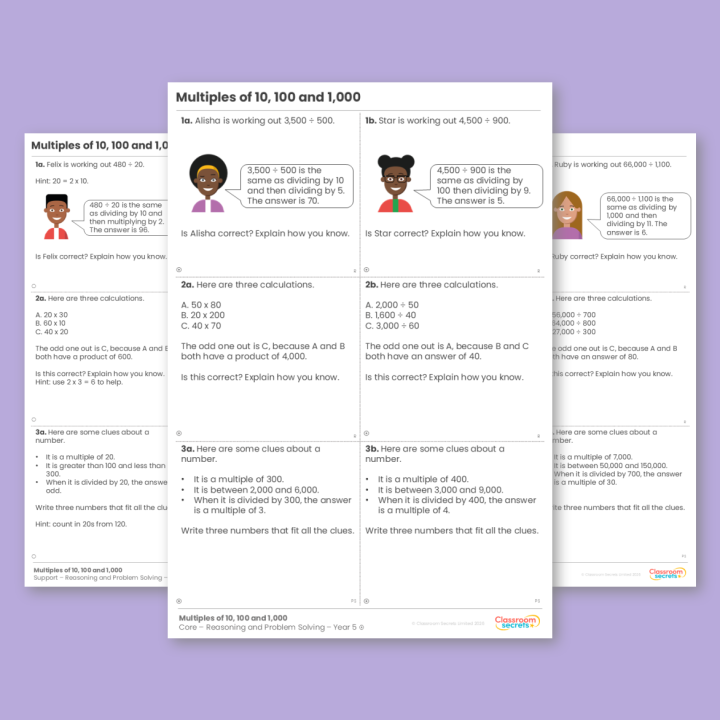
Reasoning and Problem Solving
Support
• Q1: Reasoning – explain whether a character has divided by 20 or 30 correctly in two steps; hints given.
• Q2: Reasoning – decide whether a statement about the odd one out of three calculations with multiples of 10 is correct; hint given.
• Q3: Problem Solving – find a multiple of 20 or 30 that fits three clues, including one about the answer; hint given.
Core
• Q1: Reasoning – explain whether a character has divided by 500 or 900 correctly in two steps.
• Q2: Reasoning – decide whether a statement about the odd one out of three calculations with multiples of 10 and 100 is correct.
• Q3: Problem Solving – find a multiple of 300 or 400 that fits three clues, including one about the answer.
Stretch
• Q1: Reasoning – explain whether a character has divided by 800 or 1,100 correctly, including dividing by the factors in either order.
• Q2: Reasoning – decide whether a statement about the odd one out of three calculations with multiples of 10, 100 and 1,000 is correct.
• Q3: Problem Solving – find a 5- or 6-digit multiple of 600 or 7,000 that fits three clues, including one about an answer.
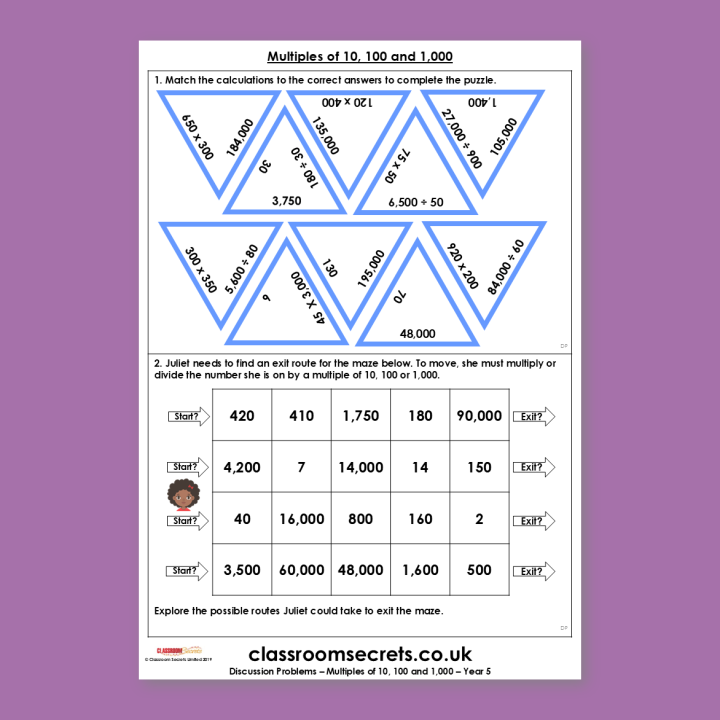
Deeper Reasoning
The questions in this set focus on solving a matching puzzle and investigating ways to move through a maze of numbers to deepen understanding of how to solve problems involving multiplication and division including using knowledge of factors and multiples.