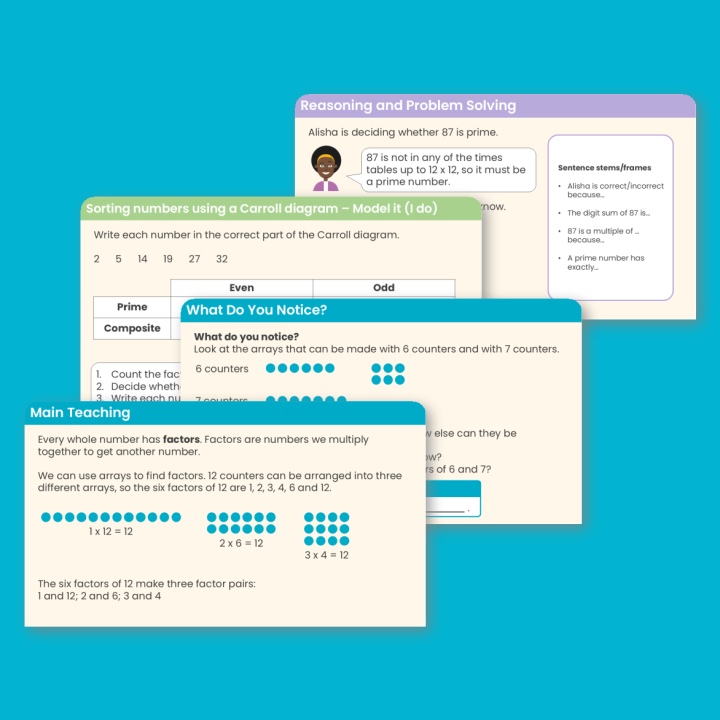
The Year 5 Prime Numbers PowerPoint guides both teachers and children through the lesson, including use of the varied fluency, reasoning and problem solving, deeper reasoning and scaffolded resources. Key learning information about this step:
Key Vocabulary
factors: Numbers we can multiply together to get another number. For example: 2 and 3 are factors of 6 because 2 x 3 = 6.
prime numbers: Whole numbers greater than 1 that can only be divided exactly by themselves and 1. For example: 19.
composite numbers: Whole numbers that can be made by multiplying other whole numbers. 6 is a composite number because it can be made by multiplying 3 by 2.
prime factor: A number that is a prime number and that can be multiplied to give the original number. For example: 3 and 5 are prime factors of 15 as they are prime numbers and can be multiplied to equal 15.
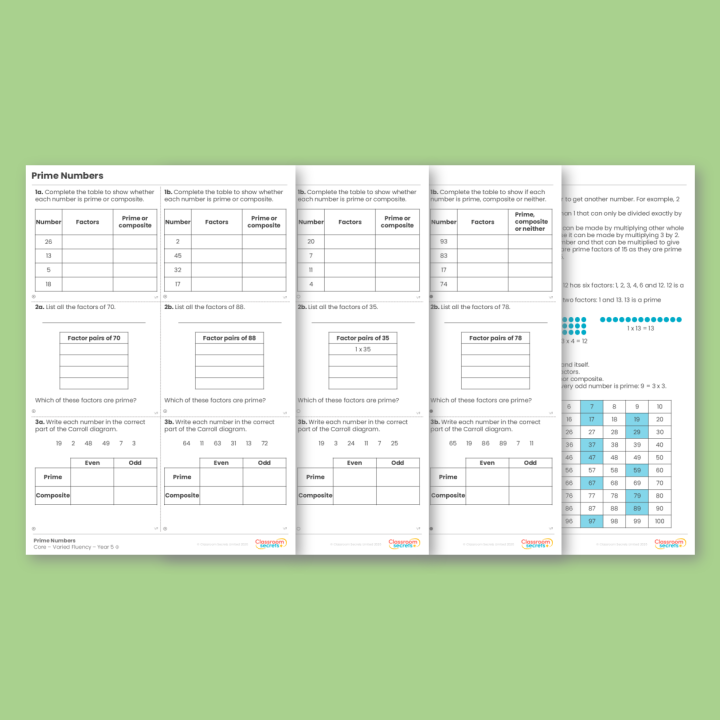
Varied Fluency
Knowledge Organiser
• Designed to support all children via key information and examples.
Scaffolded Examples H3
• Using arrays to find the factors of 14, 16 and 13, then deciding if each is prime or composite.
Support
• Q1: Decide if numbers up to 20 are prime or composite; familiar facts used.
• Q2: Find factors and prime factors of a number with two factor pairs; one given.
• Q3: Sort numbers below 40 into a Carroll diagram; familiar facts used.
Core
• Q1: Decide if numbers up to 50 are prime or composite.
• Q2: Find the factors and prime factors of a number with four factor pairs.
• Q3: Sort numbers into a Carroll diagram; composites use facts up to 12 x 12.
Stretch
• Q1: Decide if numbers up to 99 are prime, composite or neither; includes 1.
• Q2: Find the factors and prime factors of a number with a prime factor above 12.
• Q3: Sort numbers into a Carroll diagram; some composites go beyond 12 x 12.
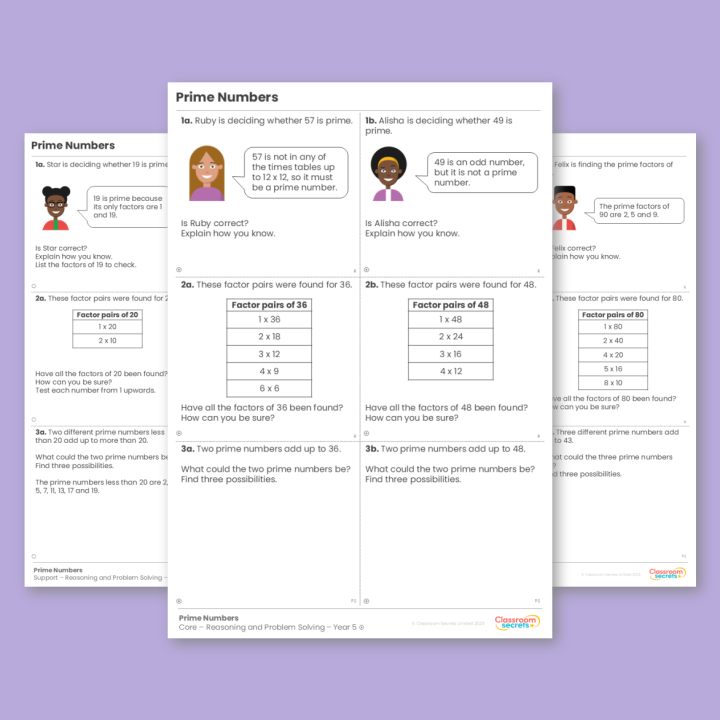
Reasoning and Problem Solving
Support
• Q1: Reasoning – explain whether a character is correct about a number less than 20 being prime; hints given.
• Q2: Reasoning – decide whether all the factors of a number up to 20 have been found; hint given.
• Q3: Problem Solving – find two different primes less than 20 whose total meets a condition; primes listed.
Core
• Q1: Reasoning – explain whether a character is correct about a number being prime, using knowledge up to 12 x 12.
• Q2: Reasoning – decide whether all the factors of a number up to 50 have been found.
• Q3: Problem Solving – find two prime numbers whose total meets a condition.
Stretch
• Q1: Reasoning – explain whether a character is correct about a number beyond 12 x 12 being prime, or about prime factors.
• Q2: Reasoning – decide whether all the factors of a number up to 90 have been found.
• Q3: Problem Solving – find three prime numbers whose total meets a condition.
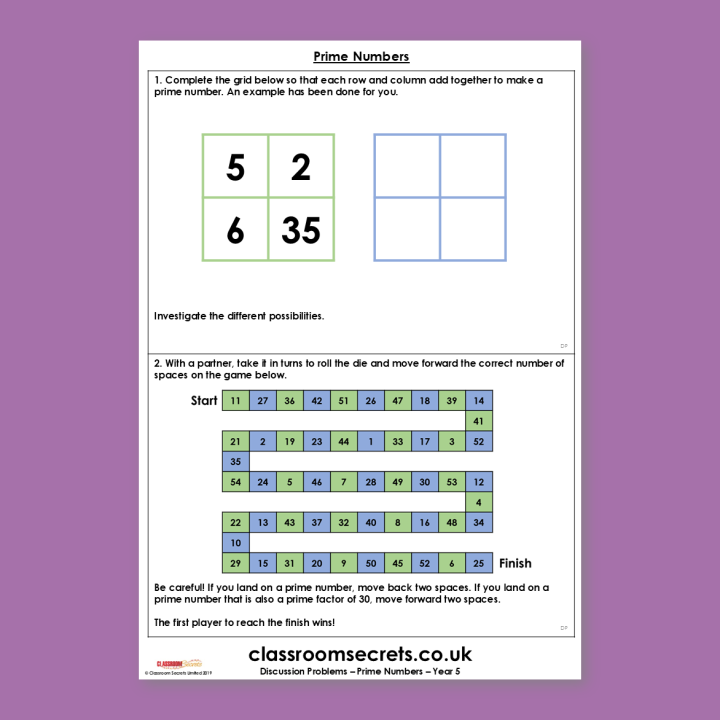
Deeper Reasoning
The questions in this set focus on solving puzzles using a knowledge of prime numbers to deepen understanding of prime numbers, prime factors and composite (non-prime) numbers.