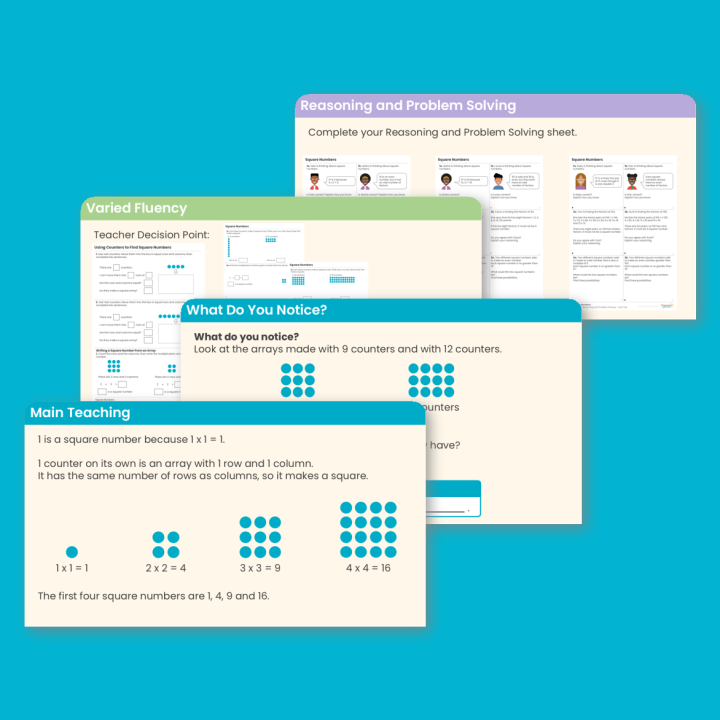
The Year 5 Square Numbers PowerPoint guides both teachers and children through the lesson, including use of the varied fluency, reasoning and problem solving, deeper reasoning and scaffolded resources. Key learning information about this step:
Key Vocabulary
arrays: A visual representation of a multiplication. For example: 3 rows of 2 counters shows 3 x 2.
product: The answer of multiplying two or more numbers together. For example: 30 is the product of 6 x 5.
square number: The product of a number multiplied by itself. For example: 9 = 3 x 3.
factors: Numbers we can multiply together to get another number. For example: 2 and 3 are factors of 6 because 2 x 3 = 6.
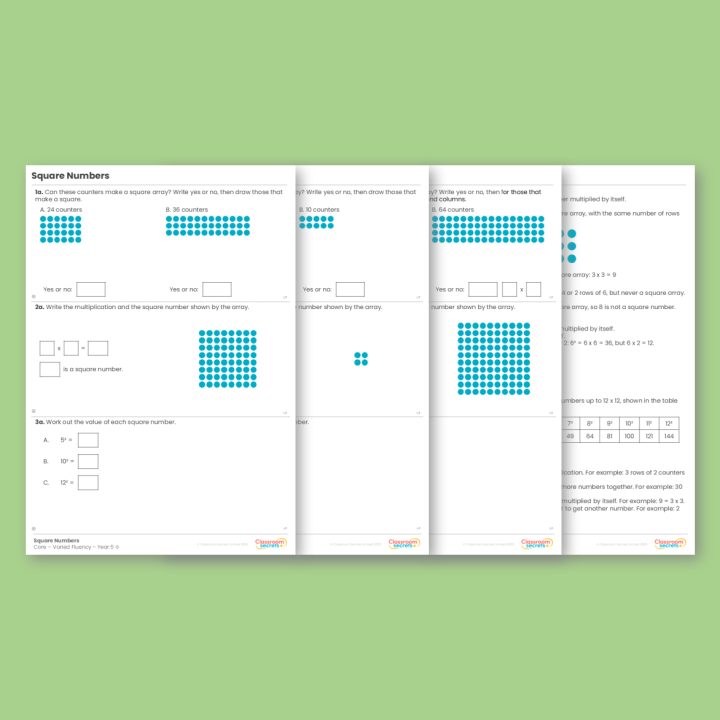
Varied Fluency
Knowledge Organiser
• Designed to support all children via key information and examples.
Scaffolded Examples
• Moving counters into equal rows and columns to decide whether they make a square; writing the square numbers shown by arrays.
Support
• Q1: Decide whether up to 16 counters can be rearranged into a square array.
• Q2: Write the multiplication shown by an array; number of rows given.
• Q3: Calculate square numbers up to 12²; multiplication given.
Core
• Q1: Decide whether counters make a square array; one set needs rearranging.
• Q2: Write the multiplication shown by an array.
• Q3: Calculate square numbers up to 12².
Stretch
• Q1: Decide whether counters make a square array; give its rows and columns.
• Q2: Write the multiplication and squared notation shown by an array.
• Q3: Calculate square numbers up to 12², including finding a number that has been squared.
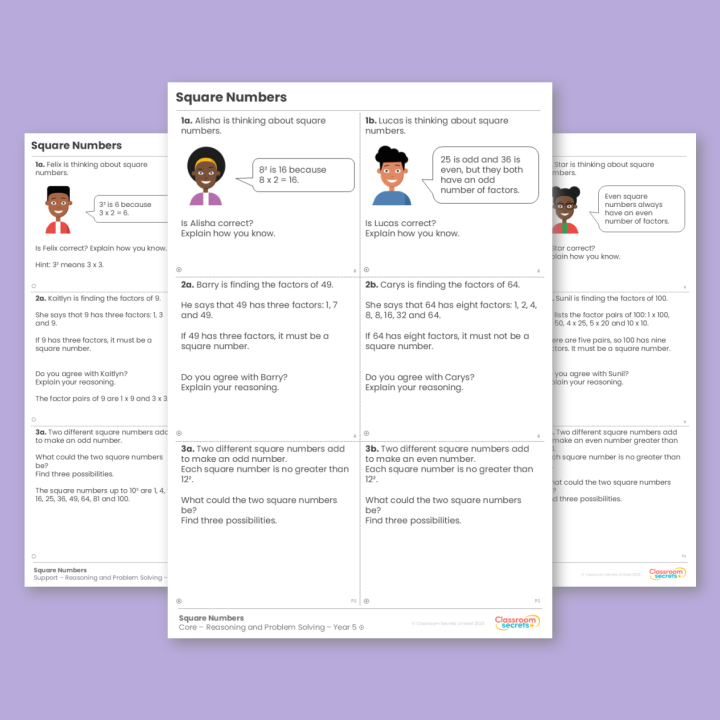
Reasoning and Problem Solving
Support
• Q1: Reasoning – explain claims about squaring a number that gives a one-digit product and the factors of a square number; hints given.
• Q2: Reasoning – check a conclusion drawn from a factor list; factor pairs given.
• Q3: Problem Solving – find two square numbers that satisfy one condition; squares up to 10² listed.
Core
• Q1: Reasoning – explain claims about squaring a number and the factors of an odd and an even square.
• Q2: Reasoning – check a conclusion drawn from a factor list.
• Q3: Problem Solving – find two square numbers up to 12² that satisfy one condition.
Stretch
• Q1: Reasoning – compare the squares of a number and its double; test a general claim about factors.
• Q2: Reasoning – count factors from factor pairs to check a conclusion.
• Q3: Problem Solving – find two square numbers up to 12² that satisfy two conditions.
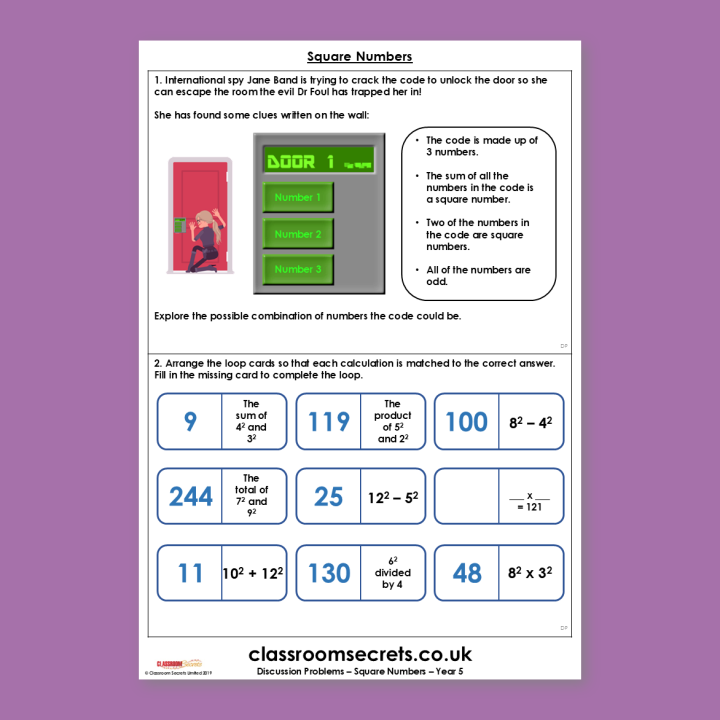
Deeper Reasoning
The questions in this set focus on solving puzzles using a knowledge of square numbers to deepen understanding of how to recognise and use square numbers and the notation for squared (²).