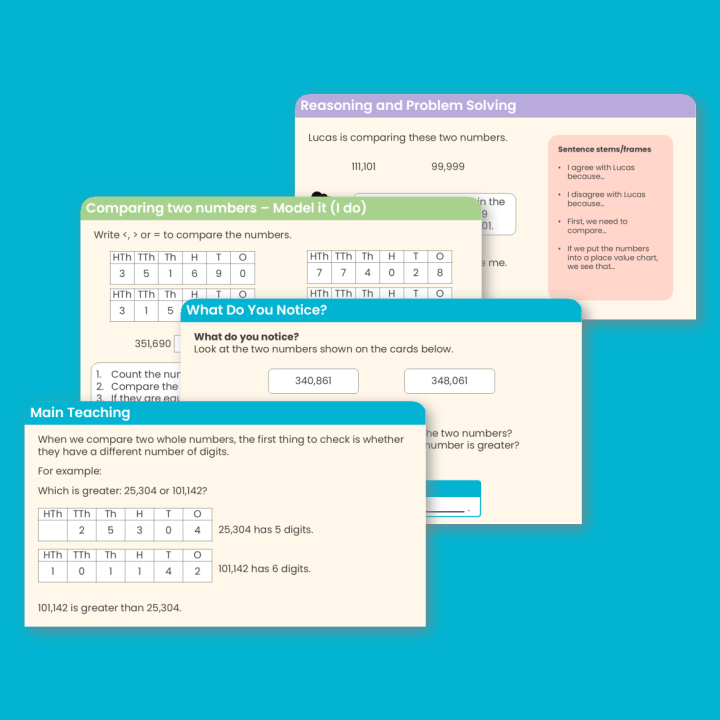
The Year 5 Compare and Order Numbers to 1,000,000 PowerPoint guides both teachers and children through the lesson, including use of the varied fluency, reasoning and problem solving, deeper reasoning and scaffolded resources. Key learning information about this step:
Key Vocabulary
> < =: Comparison symbols used to represent more than (>), less than (<) and equal to (=).
number lines: A horizontal or vertical line which has numbers placed at equal points. Number lines can be used to show either positive or negative numbers. Most number lines begin at 0.
ascending order: When values or quantities have been arranged in size from the smallest to the greatest.
descending order: When values or quantities have been arranged in size from the greatest to the smallest.
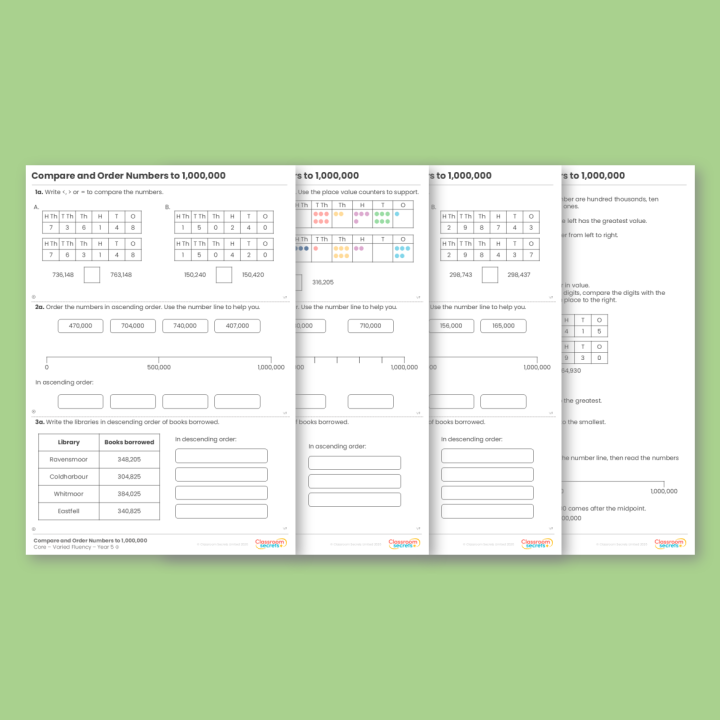
Varied Fluency
Knowledge Organiser
• Designed to support all children via key information and examples.
For the purple sections of the four levels, copy and paste these from the first sheet of the varied fluency resource.
Scaffolded Examples
• Counting digits, comparing the greatest value digits and ordering numbers.
Support
• Q1: Compare a 5-digit and a 6-digit number using <, > and =; place value counters to support.
• Q2: Order three numbers in ascending and descending order; 100,000 divisions marked on number line; 3 digits to order, 5 and 6-digit numbers.
• Q3: Order three libraries by books borrowed in ascending and descending order; 5 and 6-digit numbers.
Core
• Q1: Compare two 6-digit numbers using <, > and =; two pairs of similar numbers.
• Q2: Order four numbers in ascending and descending order; similar numbers.
• Q3: Order four libraries by books borrowed; two pairs of similar numbers.
Stretch
• Q1: Compare two 6-digit numbers using <, > and =; similar numbers rearranged.
• Q2: Order four numbers in ascending and descending order; same digits rearranged.
• Q3: Order four libraries whose totals share the first three digits.
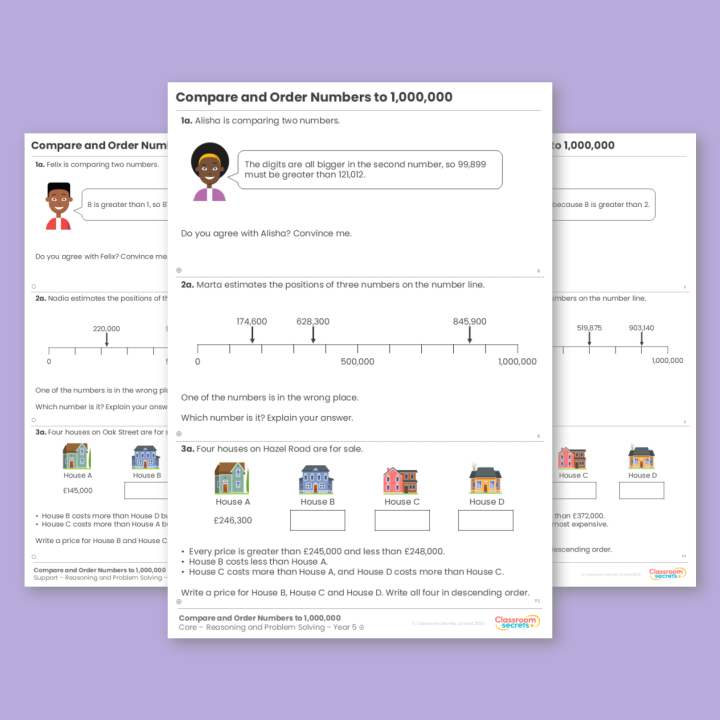
Reasoning and Problem Solving
Support
• Q1: Reasoning - explaining whether a comparison of a 5-digit and a 6-digit number is correct.
• Q2: Reasoning - spotting a misplaced number on a number line; different multiples of 100,000 and 10,000.
• Q3: Problem Solving - ordering house prices on one street; two prices are given and two more are chosen to fit the clues.
Core
• Q1: Reasoning - explaining whether a comparison of a 5-digit and a 6-digit number is correct; the 5-digit number has larger digits.
• Q2: Reasoning - spotting a misplaced number on a number line; different multiples of 100,000, 10,000, 1,000 and 100
• Q3: Problem Solving - ordering house prices on one street; one price is given and three more are chosen to fit the clues.
Stretch
• Q1: Reasoning - explaining whether a comparison of two 6-digit numbers is correct; the numbers match until the tens.
• Q2: Reasoning - spotting a misplaced number on a number line; different multiples of 100,000, 10,000, 1,000, 100, 10 and 1.
• Q3: Problem Solving - ordering house prices on one street; no prices are given and all four share the same first three digits.
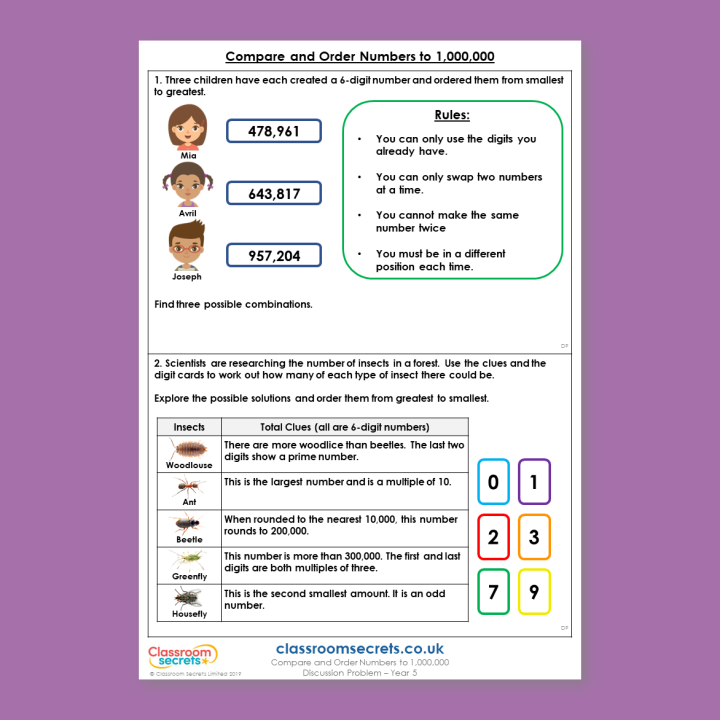
Deeper Reasoning
The questions in this set focus on problem solving with 6-digit numbers to deepen understanding in reading, writing, ordering and comparing numbers to at least 1,000,000.