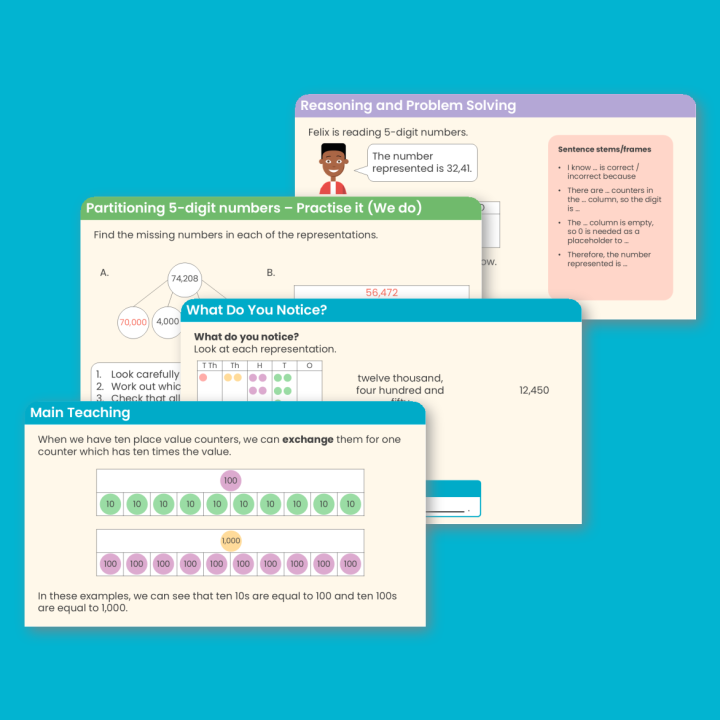
The Year 5 Numbers to 10,000 PowerPoint guides both teachers and children through the lesson, including use of the varied fluency, reasoning and problem solving, deeper reasoning and scaffolded resources. Key learning information about this step:
Key Vocabulary
place value chart: Used to identify the value of the digits that make up a number.
partitioning: The splitting of a number into different parts. For example: the number 547 can be partitioned into 500, 40 and 7.
placeholder: 0 is used to hold a place in a number and maintain its place value.
representation: A number that has been shown in different ways. For example, in numerals, words or using equipment such as Base 10 or a place value chart.
exchange: When a digit is taken from one place value column and placed in another.
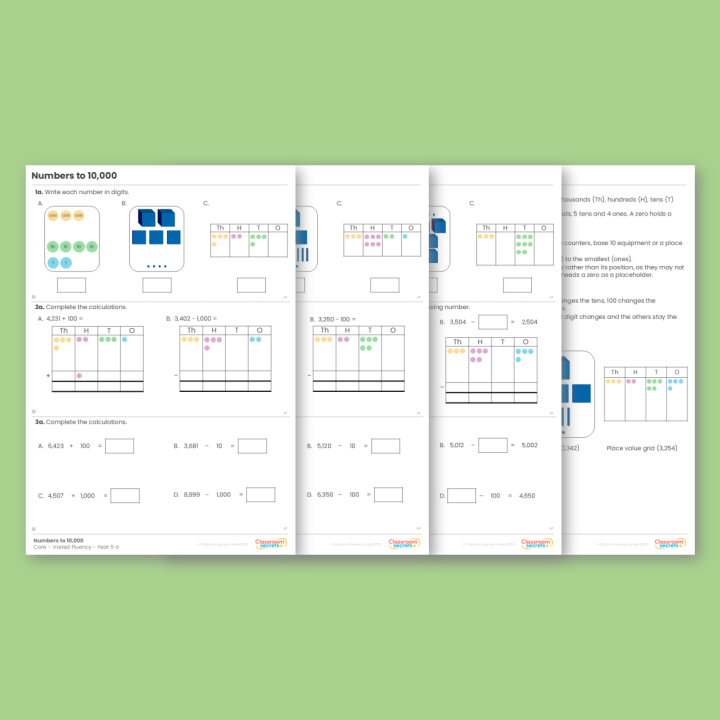
Varied Fluency
Knowledge Organiser
• Designed to support all children via key information and examples.
Scaffolded Examples
• Practice reading 4-digit numbers and adding or subtracting 10, 100 and 1,000, using sentence stems and a place value grid.
Support
• Q1 – Read 4-digit numbers (no placeholders).
• Q2 – Add and subtract 10 and 100 on a place value grid (placeholder in ones).
• Q3 – Add and subtract 10 and 100 mentally.
Core
• Q1 – Read 4-digit numbers (with placeholders).
• Q2 – Add and subtract 100 and 1,000 on a place value grid (placeholders in different columns).
• Q3 – Add and subtract 10, 100 and 1,000 mentally.
Stretch
• Q1 – Read 4-digit numbers from unsorted representations (one or two placeholders).
• Q2 – Find the missing number added or subtracted, using a grid.
• Q3 – Add and subtract 10, 100 and 1,000 mentally. Missing numbers in different places.
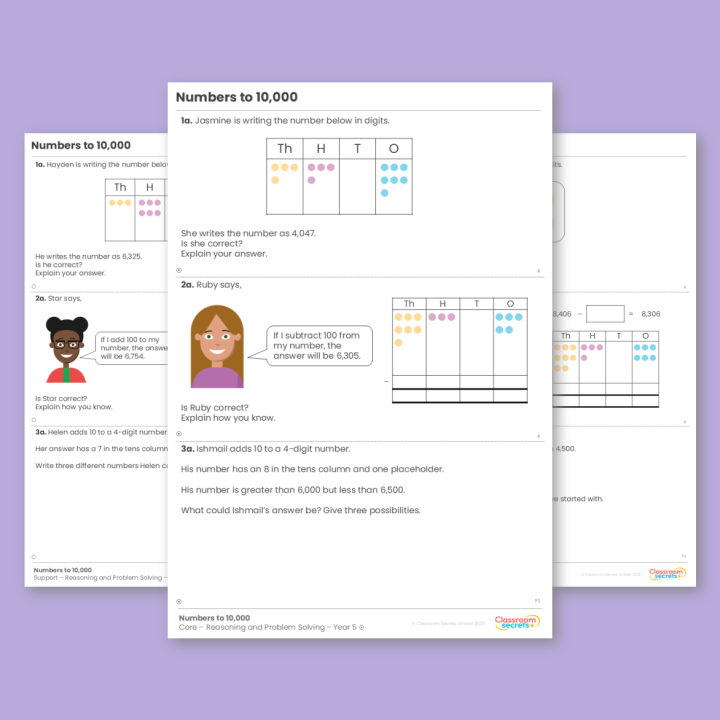
Reasoning and Problem Solving
Support
• Q1: Reasoning - deciding whether the numbers represented have been written correctly. No placeholders.
• Q2: Reasoning - spotting and explaining an error in a calculation. No placeholders
• Q3: Problem Solving - finding possible starting numbers for a given result. No placeholders and one condition.
Core
• Q1: Reasoning - deciding whether the numbers represented have been written correctly. With placeholders.
• Q2: Reasoning - spotting and explaining an error in a calculation. With placeholders.
• Q3: Problem Solving - finding possible starting numbers for a given result. With 1 placeholder and two conditions.
Stretch
• Q1: Reasoning - deciding whether the numbers represented have been written correctly. Unsorted representations with two placeholders.
• Q2: Reasoning - spotting and explaining an error in a missing number calculation. With placeholders.
• Q3: Problem Solving - finding possible starting numbers for a given result. Conditions applied to both the starting number and the answer. With placeholders and three conditions.
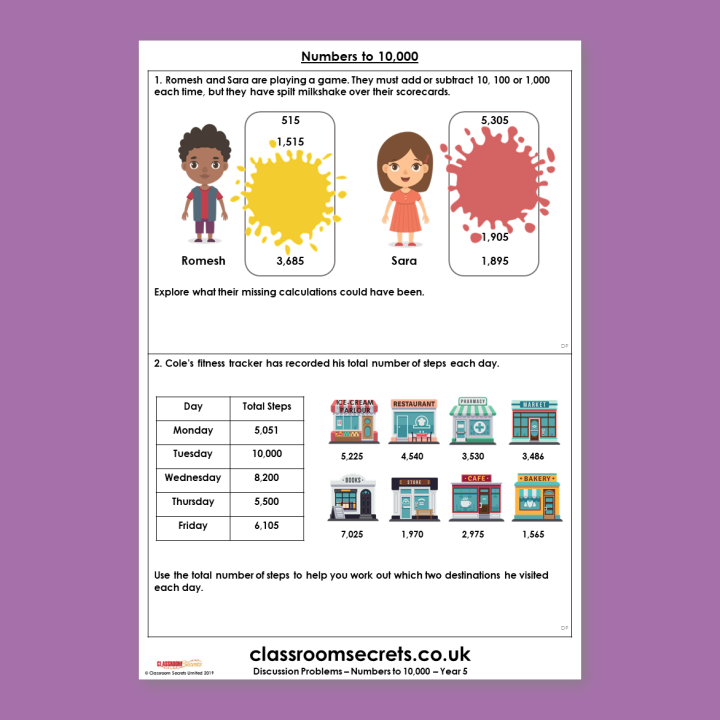
Deeper Reasoning
addition and subtraction of 10, 100 and 1,000 with numbers up to 10,000 to deepen understanding in reading, writing and knowing the value of digits in numbers up to 10,000, and adding or subtracting 10, 100 or 1,000.