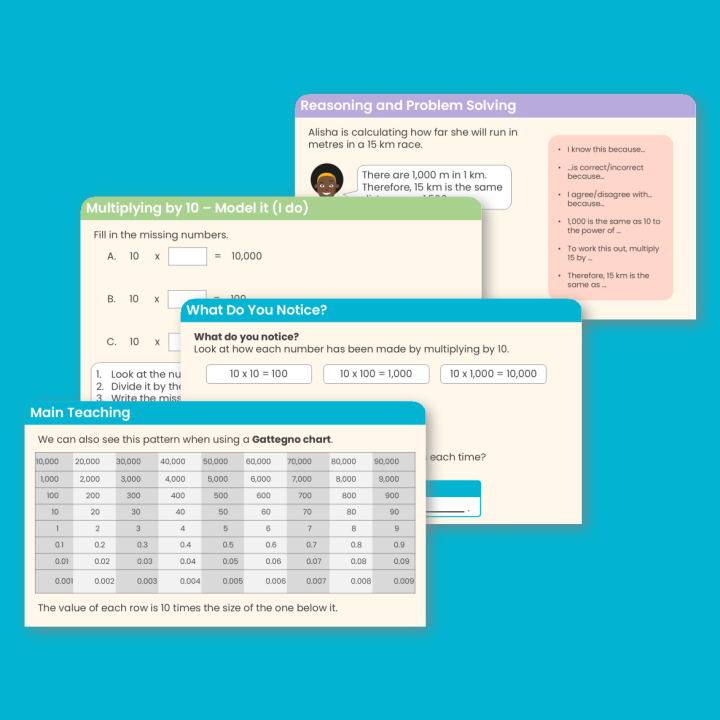
The Year 5 Powers of 10 PowerPoint guides both teachers and children through the lesson, including use of the varied fluency, reasoning and problem solving, deeper reasoning and scaffolded resources. Key learning information about this step:
Key Vocabulary
representation: A number that has been shown in different ways. For example, in numerals, words or using equipment such as Base 10 or a place value chart.
place value chart: Used to identify the value of the digits that make up a number.
Gattegno chart: A type of place value chart designed to recognise patterns in the way that we count and our number structure.
powers of 10: When ten is multiplied by itself a certain number of times (when the power is a positive integer). For example: 10,000 means 10 x 10 x 10 x 10 (10 to the power of 4).
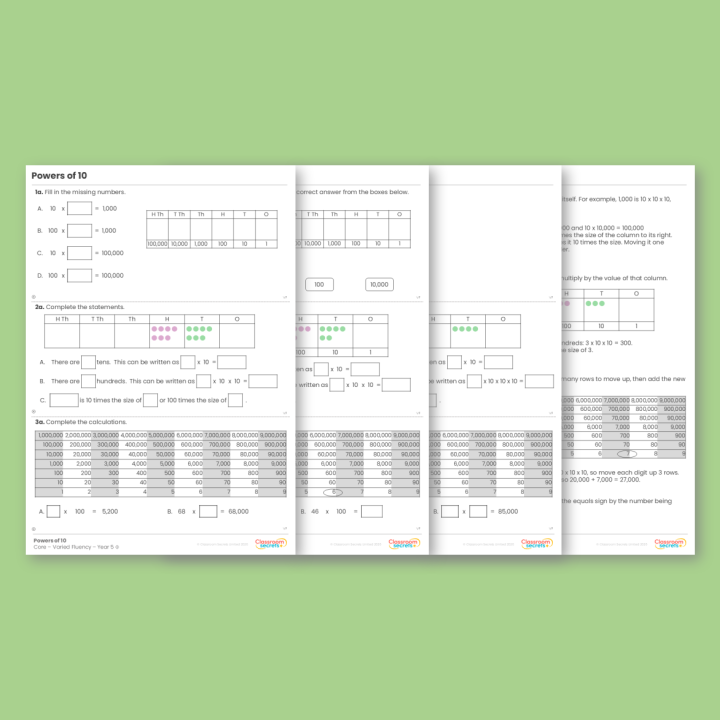
Varied Fluency
Knowledge Organiser
• Designed to support all children via key information and examples.
For the purple sections of the four levels, copy and paste these from the first sheet of the varied fluency resource.
Scaffolded Examples
• Modelled steps for finding a missing factor when multiplying by a power of 10, then reading place value counters to complete times the size statements.
Support
• Q1: Missing numbers; multiplier is 10; number bank and blank place value chart.
• Q2: Counters in adjacent columns; x 10 and x 100. Values given on place value chart.
• Q3: Multiply a 2-digit number by 10 and 100; answer missing.
Core
• Q1: Missing numbers; multiplier varies (10 or 100), blank place value chart
• Q2: Counters in adjacent columns; making links using x 10 and x 100.
• Q3: Multiply a 2-digit number by 10, 100 or 1,000; missing numbers vary in position.
Stretch
• Q1: Missing numbers in different places, multipliers vary; products on both sides.
• Q2: Counters in non-adjacent columns; making links using x 10 and x 1,000.
• Q3: Multiply a 2-digit number by 10, 100, 1,000 or 10,000; missing two numbers with answer always given.
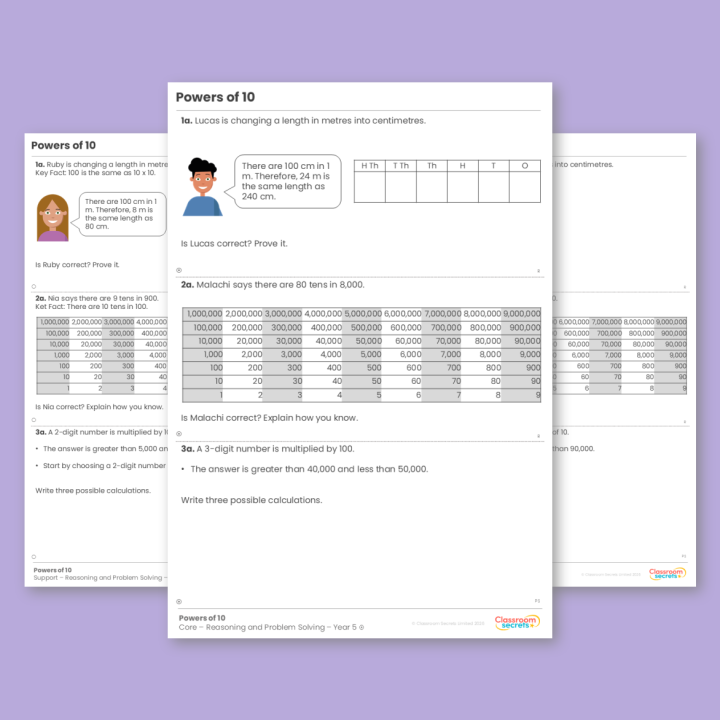
Reasoning and Problem Solving
Support
• Q1: Reasoning - explaining whether a measurement has been converted correctly using a power of 10, key fact and place value chart given to support.
• Q2: Reasoning - explaining whether a statement about how many tens there are in a 3-digit number is correct.
• Q3: Problem Solving - finding calculations where a 2-digit number is multiplied by a given power of 10; range given for answers.
Core
• Q1: Reasoning - explaining whether a measurement has been converted correctly using a power of 10; place value chart to support
• Q2: Reasoning - explaining whether a statement about how many tens or hundreds there are in a 4- or 5-digit number is correct.
• Q3: Problem Solving - finding calculations where a 3-digit number is multiplied by a given power of 10; range given for answers.
Stretch
• Q1: Reasoning - explaining whether a measurement has been converted correctly using two powers of 10.
• Q2: Reasoning - explaining whether a statement about how many hundreds there are in a 5-digit number is correct.
• Q3: Problem Solving - finding calculations where the power of 10 is not given; range given for answers.
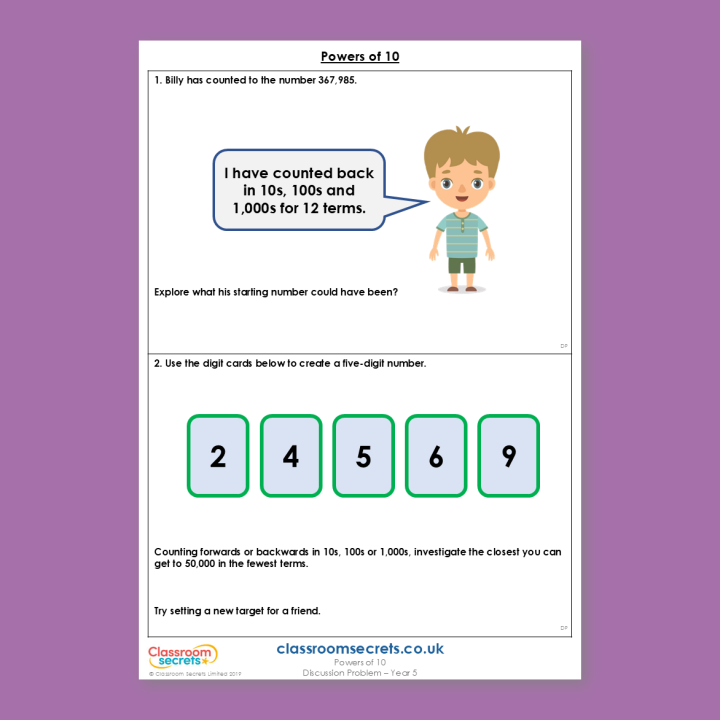
Deeper Reasoning
The questions in this set focus on exploring possible target numbers and investigating what a starting number could have been to deepen understanding in counting forwards or backwards in steps of powers of 10 for any given number up to 1,000,000.