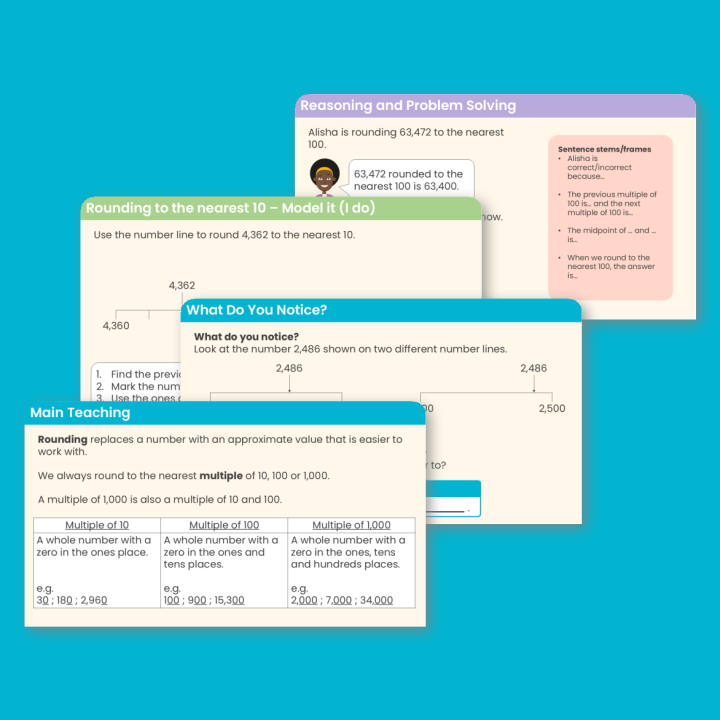
The Year 5 Round to the Nearest 10, 100 or 1,000 PowerPoint guides both teachers and children through the lesson, including use of the varied fluency, reasoning and problem solving, deeper reasoning and scaffolded resources. Key learning information about this step:
Key Vocabulary
rounding: When a number is replaced with an approximated value. Numbers are often rounded to the nearest 10, 100 or 1,000.
multiple: A product of one number multiplied by another number. For example: multiples of 10 are the products of numbers multiplied by 10.
midpoint: The point on a number line that is exactly halfway between the start and end values.
number lines: A horizontal or vertical line which has numbers placed at equal points. Number lines can be used to show either positive or negative numbers. Most number lines begin at 0.
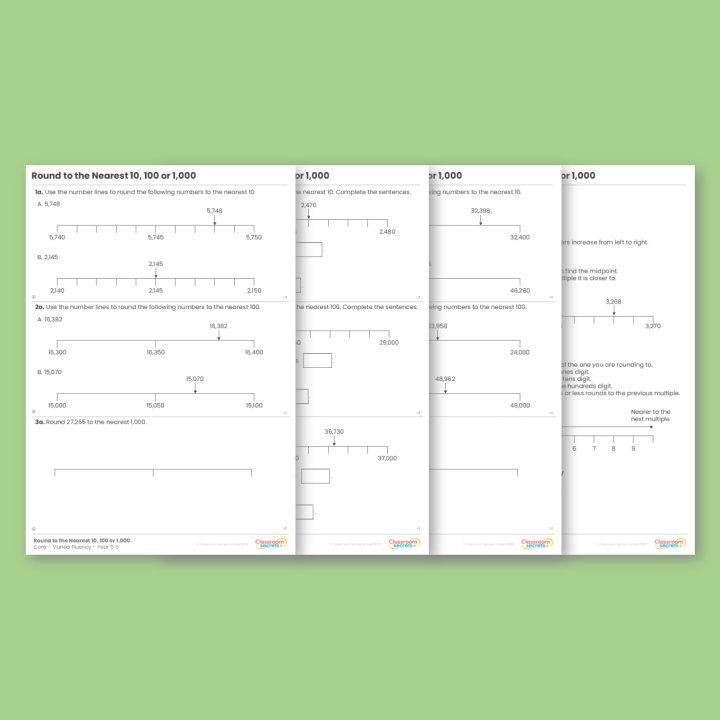
Varied Fluency
Knowledge Organiser
• Designed to support all children via key information and examples.
Scaffolded Examples
• Finding the previous and next multiples, finding the midpoint and rounding to the nearest 10 and 100 on a number line.
Support
• Q1: Round a 4-digit number to the nearest 10; division lines shown; midpoint labelled; stem sentences included.
• Q2: Round a 5-digit number to the nearest 100; one number line; division lines shown; midpoint labelled; stem sentences included.
• Q3: Round a 5-digit number to the nearest 1,000; division lines shown; midpoint labelled; stem sentences included.
Core
• Q1: Round 4-digit numbers to the nearest 10; midpoint labelled; division lines shown.
• Q2: Round 5-digit numbers to the nearest 100; midpoint labelled; no other division lines shown.
• Q3: Round 5-digit numbers to the nearest 1,000; start, end and midpoint unlabelled.
Stretch
• Q1: Round 5-digit numbers to the nearest 10; start and end multiple only.
• Q2: Round 5-digit numbers to the nearest 100; start and end multiple only.
• Q3: Round 5-digit numbers to the nearest 1,000; start, end and midpoint unlabelled; no midpoint marking.
Reasoning and Problem Solving
Support
• Q1: Reasoning - explaining whether a 4-digit number has been rounded to the nearest 10 or 100 correctly; previous and next multiples are given on a number line.
• Q2: Reasoning - spotting a 4-digit number rounded to the wrong degree of accuracy; number lines provided for support; rounding to nearest 10 or 100.
• Q3: Problem Solving – given one clue to work out what the missing digits are; three numbers given; number line to support; rounding to the nearest 1,000.
Core
• Q1: Reasoning - explaining whether a 5-digit number has been rounded to the nearest 10 or 100 correctly.
• Q2: Reasoning - spotting a 5-digit number rounded to the wrong degree of accuracy; rounding to nearest 10 or 100.
• Q3: Problem Solving - given two clues to work out what the missing digits are; three numbers given rounding to the nearest 1,000 and nearest 100.
Stretch
• Q1: Reasoning - explaining whether a 5-digit number has been rounded to the nearest 10 or 100 correctly; bridge into the next 10,000.
• Q2: Reasoning - spotting a 5-digit number rounded to the wrong degree of accuracy where the numbers cross a boundary.
• Q3: Problem Solving - given three clues to work out what the missing digits are; no numbers given; rounding to the nearest 10, 100 and 1,000.
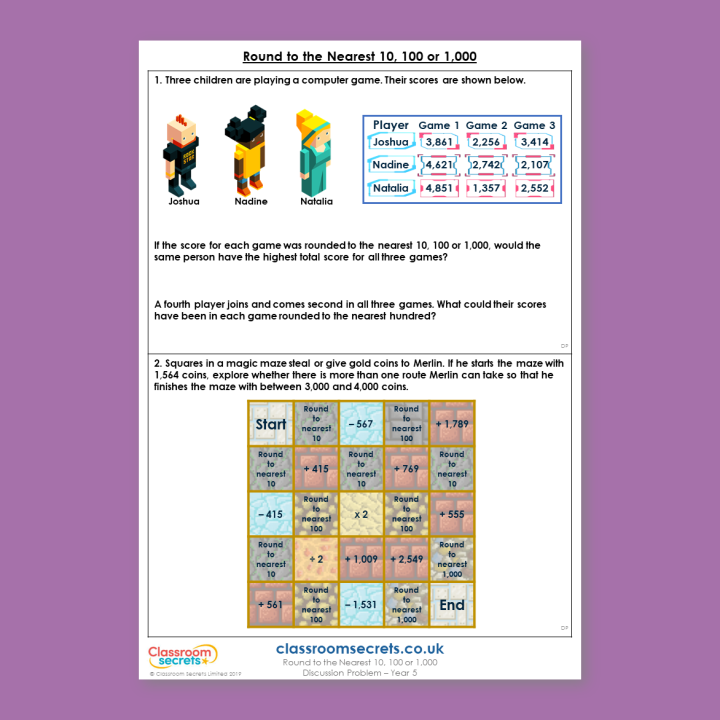
Deeper Reasoning
The questions in this set focus on problem solving using game scenarios to deepen understanding in rounding any number up to 1,000,000 to the nearest 10, 100 or 1,000.