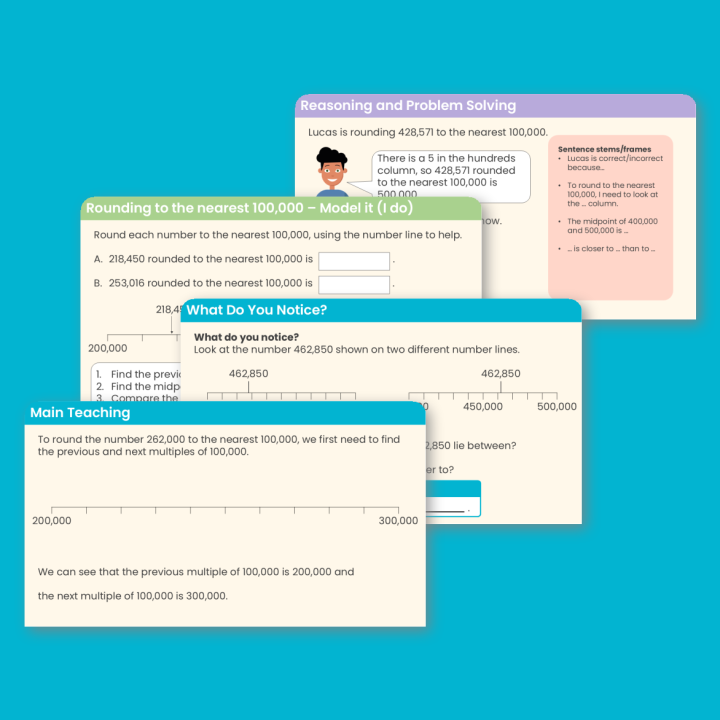
The Year 5 Round within 1,000,000 PowerPoint guides both teachers and children through the lesson, including use of the varied fluency, reasoning and problem solving, deeper reasoning and scaffolded resources. Key learning information about this step:
Key Vocabulary
rounding: When a number is replaced with an approximated value. Numbers are often rounded to the nearest 10, 100, 1,000, 10,000 or 100,000.
multiple: A product of one number multiplied by another number. For example: multiples of 10 are the products of numbers multiplied by 10.
midpoint: The point on a number line that is exactly halfway between the start and end values.
estimate: To make a sensible guess at what the answer could be. You usually estimate the answer by rounding the numbers to make the calculation easier. Another word for estimate is approximate.
powers of 10: When ten is multiplied by itself a certain number of times (when the power is a positive integer). For example: 10,000 means 10 x 10 x 10 x 10 (10 to the power of 4).
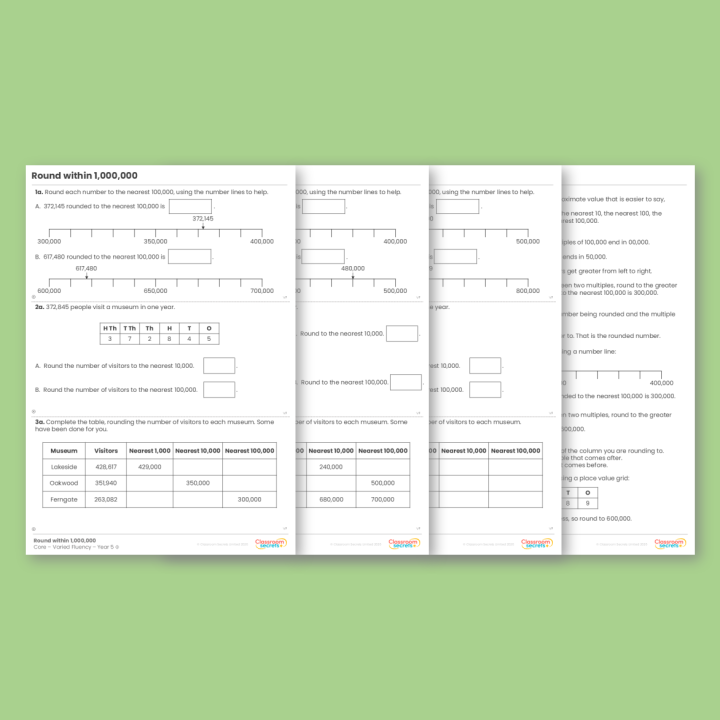
Varied Fluency
Knowledge Organiser
• Designed to support all children via key information and examples.
Scaffolded Examples
• Finding the multiples and midpoint, then rounding to the nearest 100,000.
Support
• Q1: Round two 6-digit multiples of 10,000 to the nearest 100,000; midpoints labelled.
• Q2: Round a number to the nearest 10,000 and 100,000; place value grids given for each question.
• Q3: Round to the nearest 1,000, 10,000 and 100,000; trailing zeros; chart partly completed.
Core
• Q1: Round two 6-digit numbers to the nearest 100,000; midpoints labelled.
• Q2: Round a number to the nearest 10,000 and 100,000; place value grid given.
• Q3: Round three 6-digit numbers to the nearest 1,000, 10,000 and 100,000; three given.
Stretch
• Q1: Round two 6-digit numbers to the nearest 100,000; end multiples only.
• Q2: Round a number to the nearest 10,000 and 100,000; boundary digits.
• Q3: Round to the nearest 1,000, 10,000 and 100,000; boundary digits; blank chart.
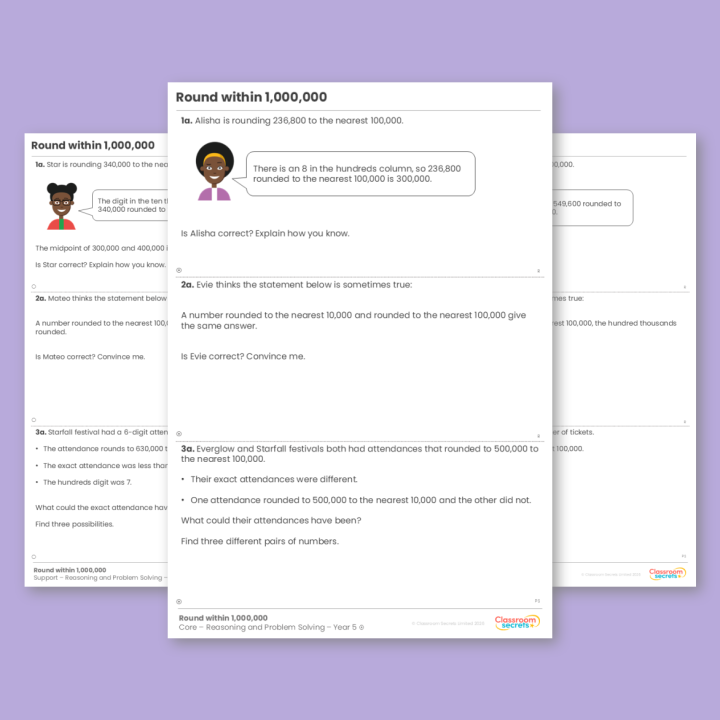
Reasoning and Problem Solving
Support
• Q1: Reasoning - explaining whether a 6-digit number has been rounded to the nearest 100,000 correctly; the midpoint is given.
• Q2: Reasoning - deciding whether a statement about multiples of 100,000 is always, sometimes or never true.
• Q3: Problem Solving - finding 6-digit attendances from three clues; a multiple of 10,000, a boundary digit and a given hundreds digit.
Core
• Q1: Reasoning - explaining whether a 6-digit number has been rounded to the nearest 100,000 correctly.
• Q2: Reasoning - deciding whether a statement about a rounded answer is always, sometimes or never true.
• Q3: Problem Solving - finding pairs of attendances sharing a multiple of 100,000; one must round to it to the nearest 10,000, the other must not.
Stretch
• Q1: Reasoning - explaining whether a 6-digit number has been rounded to the nearest 100,000 correctly; numbers sit close to a midpoint or exactly halfway.
• Q2: Reasoning - deciding whether a statement about the effect of rounding is always, sometimes or never true.
• Q3: Problem Solving - finding three attendances that share a multiple of 100,000 but give three different multiples of 10,000.
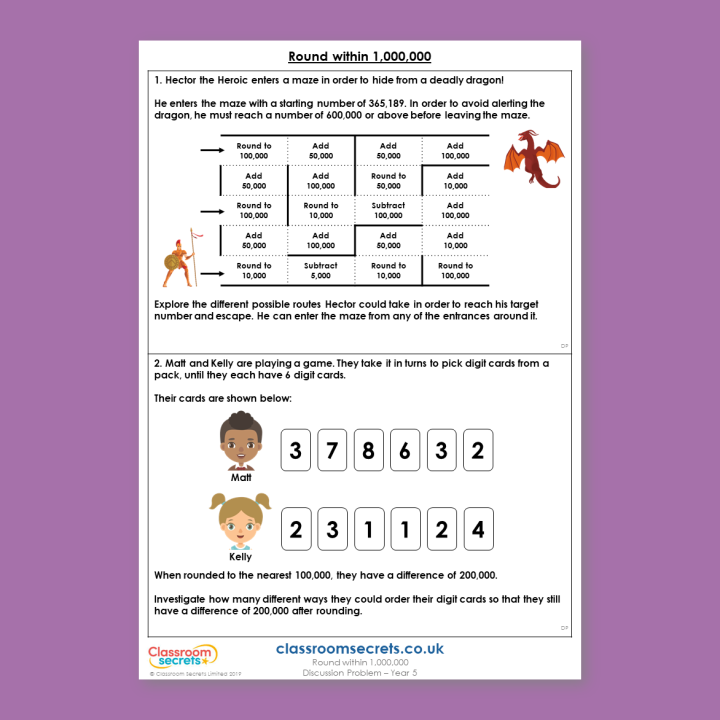
Deeper Reasoning
The questions in this set focus on problem solving and investigating rounding within 1,000,000 to deepen understanding in rounding any number up to 1,000,000 to the nearest 10, 100, 1,000, 10,000 and 100,000.