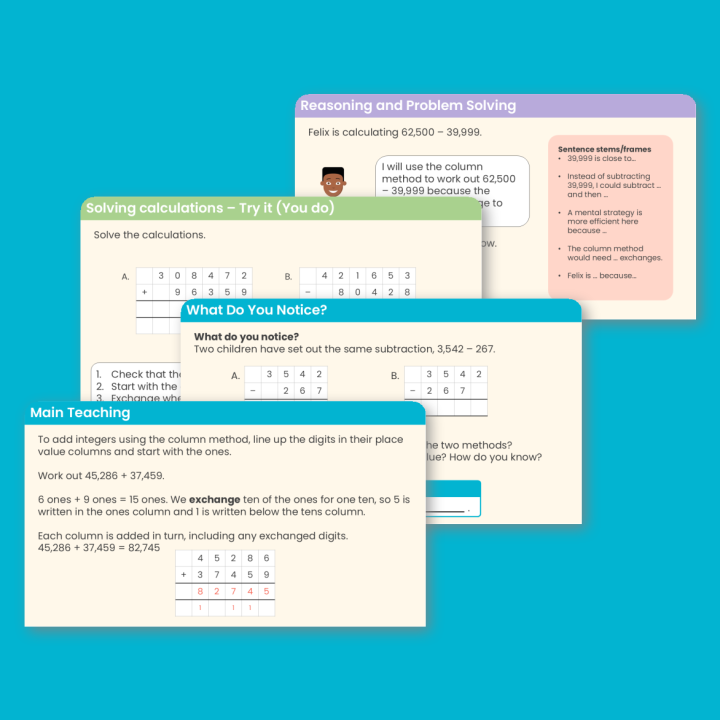
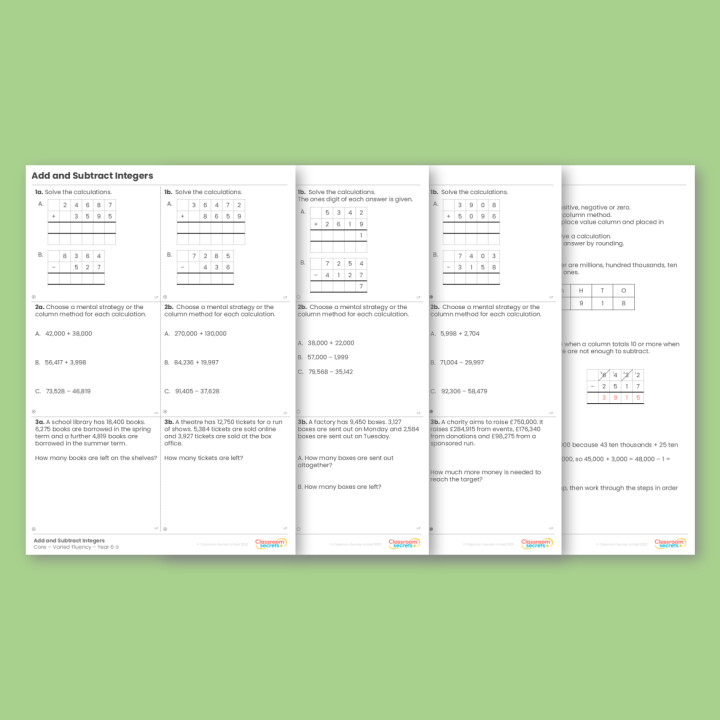
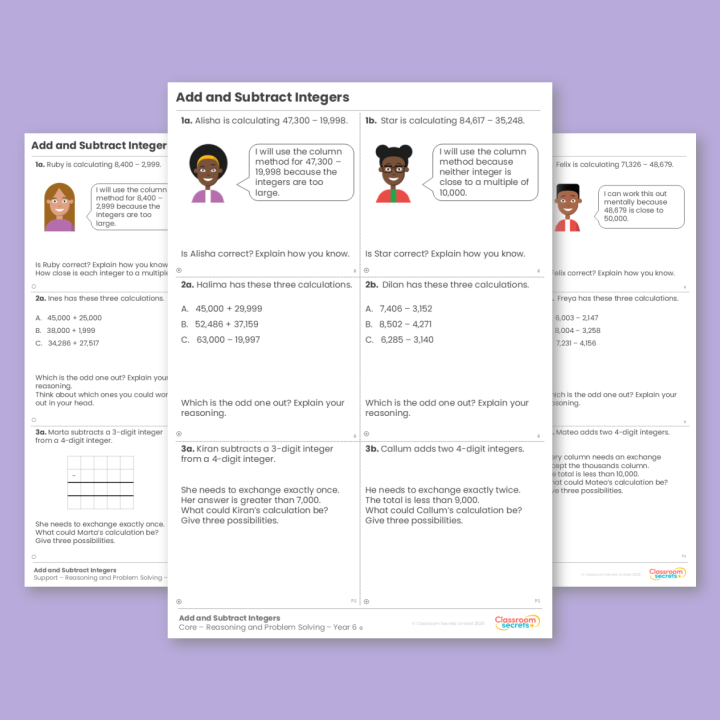
The Year 6 Add and Subtract Integers PowerPoint guides both teachers and children through the lesson, including use of the varied fluency, reasoning and problem solving, deeper reasoning and scaffolded resources. Key learning information about this step:
Key Vocabulary
integers: Whole numbers, which can be positive, negative or zero.
formal written method: This is also known as the column method for addition, subtraction and multiplication. For division, this may also be known as the bus stop method.
exchange: When a digit is taken from one place value column and placed in another.
efficient: To choose the best method to solve a calculation. Sometimes a mental method can be quicker than a written one if there are no exchanges.
estimate: To make a sensible guess at what the answer could be. You usually estimate the answer by rounding the numbers to make the calculation easier. Another word for estimate is approximate.
Varied Fluency
Knowledge Organiser
• Designed to support all children via key information and examples.
Scaffolded Examples
• Scaffolded column addition and subtraction with sentence stems, plus adjusting to a near multiple of 1,000.
Support
• Q1: Column addition and subtraction with one exchange and the ones digit given. Same number of digits in each calculation.
• Q2: Choose a mental or column method; the mental ones are clear at a glance.
• Q3: A two-step word problem, split into two parts.
Core
• Q1: Column addition and subtraction with more than one exchange and different numbers of digits.
• Q2: Choose a mental or column method; one number can be adjusted.
• Q3: A two-step word problem.
Stretch
• Q1: Column addition and subtraction exchanging through a placeholder zero.
• Q2: Choose a mental or column method; both numbers can be adjusted.
• Q3: A three-step word problem.
Reasoning and Problem Solving
Support
• Q1: Reasoning - explain whether a character has chosen an efficient method of calculation. Prompt given to scaffold answer.
• Q2: Reasoning - find the odd one out from three calculations. Prompt given to scaffold answer.
• Q3: Problem Solving - find a calculation that needs exactly one exchange.
Core
• Q1: Reasoning - explain whether a character has chosen an efficient method of calculation.
• Q2: Reasoning - find the odd one out from three calculations. Two calculations can be done easily through mental methods.
• Q3: Problem Solving - find a calculation that needs a given number of exchanges and a condition on the answer.
Stretch
• Q1: Reasoning - explain whether a character has chosen an efficient method of calculation. Adjustment not immediately recognisable as being solvable through mental methods.
• Q2: Reasoning - find the odd one out from three calculations. Calculations not immediately recognisable as being solvable through mental methods.
• Q3: Problem Solving - find a calculation that meets three conditions, including exchanging through a placeholder zero.
Deeper Reasoning
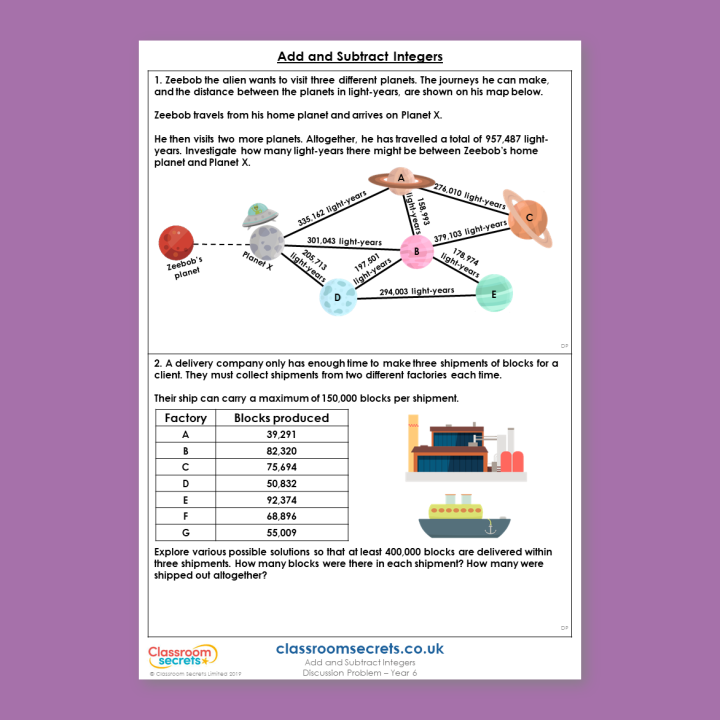
The questions in this set focus on problem solving through adding and subtracting integers to deepen understanding in solving addition and subtraction multi-step problems in contexts, deciding which operations and methods to use and why, and using estimation to check answers to calculations and determine, in the context of a problem, an appropriate degree of accuracy.