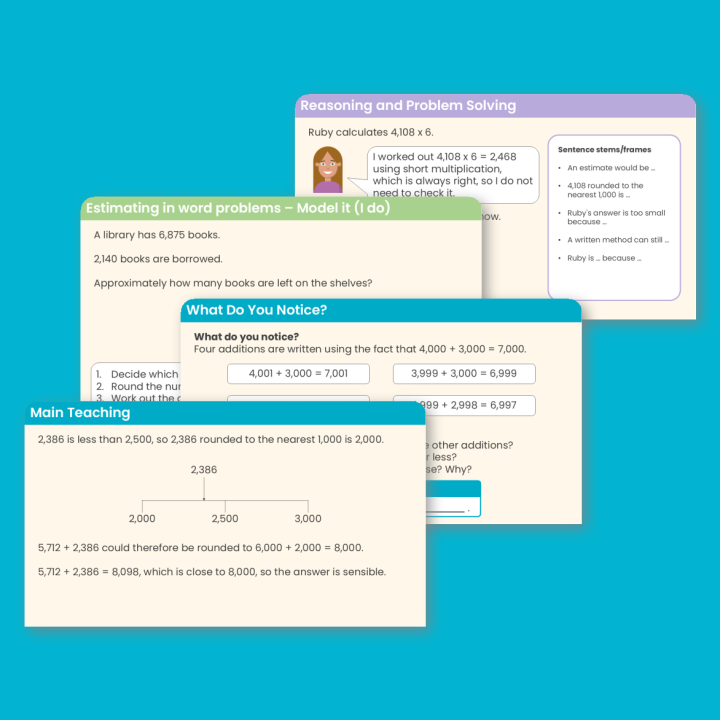
The Year 6 Mental Calculations and Estimation PowerPoint guides both teachers and children through the lesson, including use of the varied fluency, reasoning and problem solving, deeper reasoning and scaffolded resources. Key learning information about this step:
Key Vocabulary
efficient: A method that reaches the correct answer quickly in as few steps as possible.
commutative: Operations that give the same answer no matter what order the numbers are in. Only addition and multiplication are commutative. For example: 2 x 6 = 12 and 6 x 2 = 12, and 5 + 4 = 9 and 4 + 5 = 9.
estimate: To make a sensible guess at what the answer could be. You usually estimate the answer by rounding the numbers to make the calculation easier. Another word for estimate is approximate.
Varied Fluency
Knowledge Organiser
• Designed to support all children via key information and examples.
Scaffolded Examples
• Choosing appropriate mental strategies for different calculations.
Support
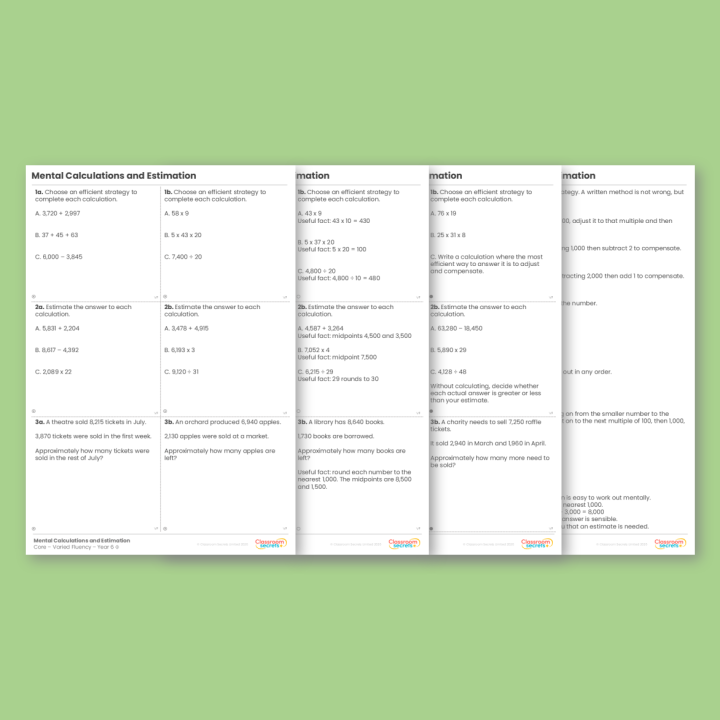
• Q1: Choose an efficient strategy to complete three calculations mentally. Useful fact given for each.
• Q2: Estimate three calculations. 1- or 2-digit multipliers or divisors; facts given.
• Q3: Estimate the answer to a one-step problem in context. Midpoints given.
Core
• Q1: Choose an efficient strategy to complete three calculations mentally.
• Q2: Estimate three calculations. 1- or 2-digit multipliers or divisors.
• Q3: Estimate the answer to a one-step problem in context. No facts given.
Stretch
• Q1: Choose an efficient strategy to complete two calculations mentally and write a calculation for which a given strategy is the most efficient.
• Q2: Estimate three calculations. 2-digit multipliers or divisors; decide without calculating if greater or less.
• Q3: Estimate the answer to a two-step problem in context.
Reasoning and Problem Solving
Support
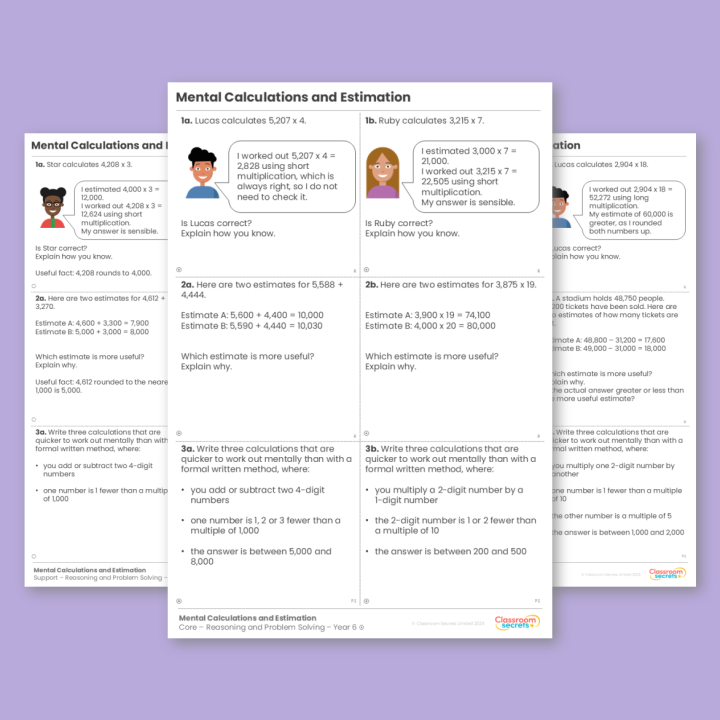
• Q1: Reasoning – explain whether a character needed to check a short multiplication, with useful facts.
• Q2: Reasoning – decide which of two estimates is more useful for calculations, with useful facts.
• Q3: Problem Solving – write calculations that meet two conditions and are quicker to work out mentally than with a formal written method.
Core
• Q1: Reasoning – explain whether a character needed to check a short multiplication.
• Q2: Reasoning – decide which of two estimates is more useful for calculations.
• Q3: Problem Solving – write calculations that meet three conditions and are quicker to work out mentally than with a formal written method.
Stretch
• Q1: Reasoning – explain whether a character needed to check a long multiplication.
• Q2: Reasoning – decide which of two estimates is more useful for word problems; say if the answer is greater or less.
• Q3: Problem Solving – write calculations that meet four conditions and are quicker to work out mentally than with a formal written method.
Deeper Reasoning
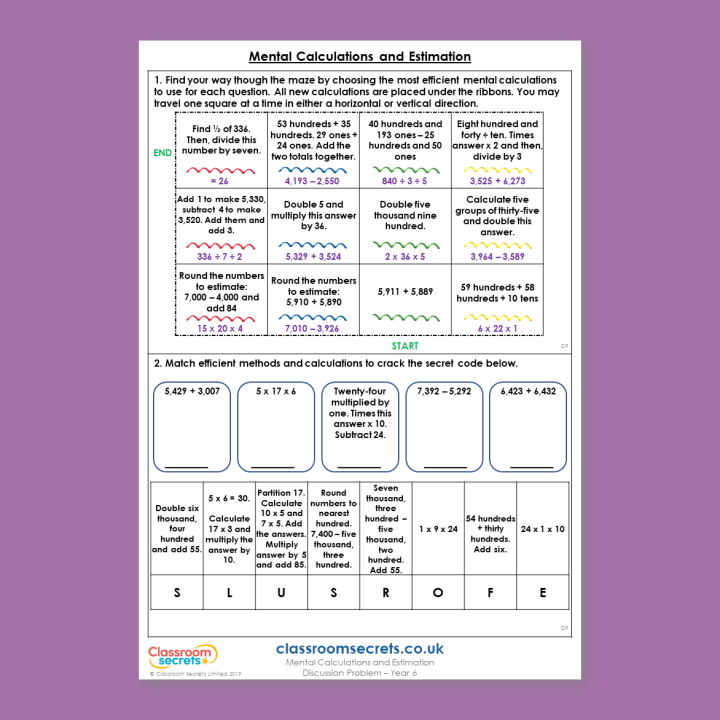
The questions in this set focus on problem solving with estimation to deepen understanding in using estimation to check answers to calculations and determine, in the context of a problem, an appropriate degree of accuracy, and performing mental calculations, including with mixed operations and large numbers.