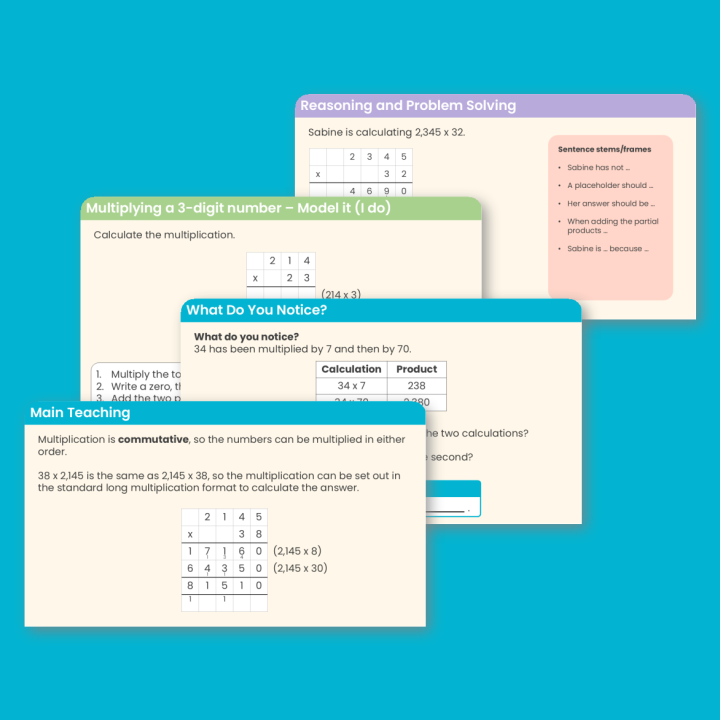
The Year 6 Multiply up to a 4-Digit Number by a 2-Digit Number PowerPoint guides both teachers and children through the lesson, including use of the varied fluency, reasoning and problem solving, deeper reasoning and scaffolded resources. Key learning information about this step:
Key Vocabulary
formal written method: This is also known as the column method for addition, subtraction and multiplication. For division, this may also be known as the bus stop method.
exchange: When a digit is taken from one place value column and placed in another.
product: The answer of multiplying two or more numbers together. For example: 30 is the product of 6 x 5.
long multiplication: A formal method of multiplying a number by another number that is two digits or more.
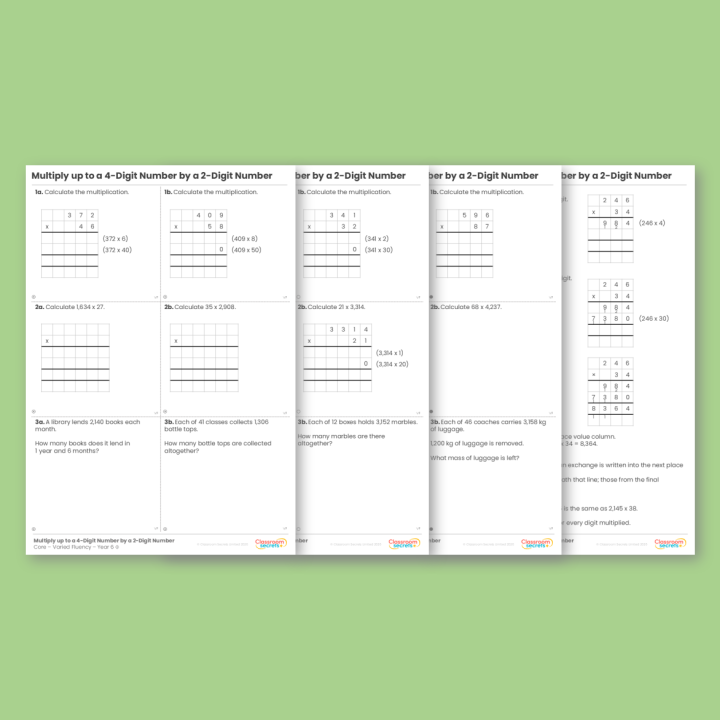
Varied Fluency
Knowledge Organiser
• Designed to support all children via key information and examples.
Scaffolded Examples
• Guided practice with multiplying a 2-digit and then 3-digit number by 2 digits.
Support
• Q1: Complete a calculation using long multiplication (3 digits x 2 digits). Placeholder zero given and each partial product labelled.
• Q2: Complete a calculation using long multiplication (4 digits x 2 digits). Placeholder zero given and each partial product labelled.
• Q3: One-step word problem requiring long multiplication (4 digits x 2 digits). One exchange required.
Core
• Q1: Complete a calculation using long multiplication (3 digits x 2 digits). Each partial product labelled.
• Q2: Complete a calculation using long multiplication (4 digits x 2 digits).
• Q3: One-step word problem requiring long multiplication (4 digits x 2 digits). Two or more exchanges required.
Stretch
• Q1: Complete a calculation using long multiplication (3 digits x 2 digits).
• Q2: Complete a calculation using long multiplication (4 digits x 2 digits). No multiplication grid provided.
• Q3: Two-step word problem requiring long multiplication (4 digits x 2 digits).
Reasoning and Problem Solving
Support
• Q1: Reasoning – explain the mistake made in a calculation (4 digits x 2 digits). No exchanges in multiplication.
• Q2: Reasoning - decide whether a statement about an aspect of a multiplication (3 digits x 2 digits) is always, sometimes or never true.
• Q3: Problem Solving – find a missing digit from a multiplication that will satisfy a statement about the product (4 digits x 2 digits).
Core
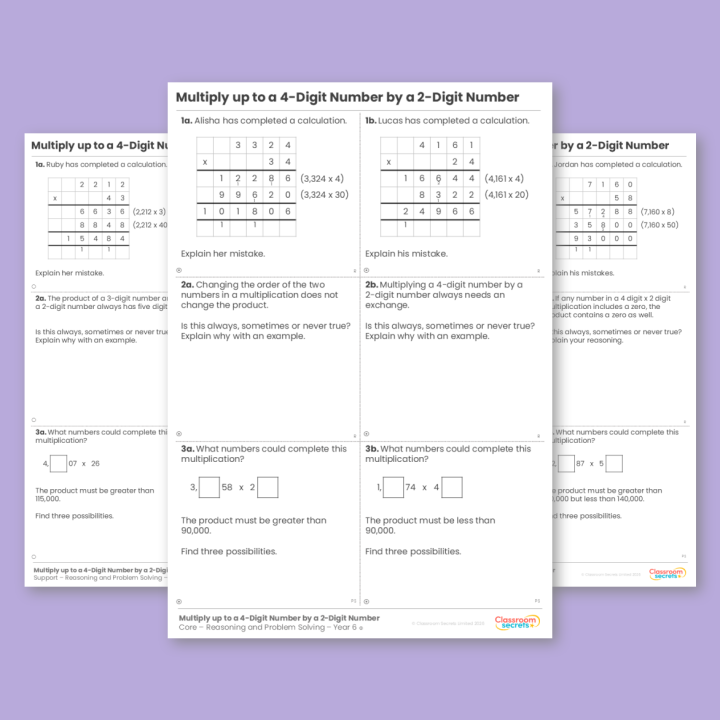
• Q1: Reasoning – explain the mistake made in a calculation (4 digits x 2 digits).
• Q2: Reasoning - decide whether a statement about an aspect of a multiplication (4 digits x 2 digits) is always, sometimes or never true.
• Q3: Problem Solving - find two missing digits from a multiplication that will satisfy a statement about the product (4 digits x 2 digits).
Stretch
• Q1: Reasoning – explain multiple mistake made in a calculation (4 digits x 2 digits).
• Q2: Reasoning - decide whether a statement about two aspects of a multiplication (4 digits x 2 digits) is always, sometimes or never true.
• Q3: Problem Solving - find two missing digits from a multiplication that will satisfy two statements about the product (4 digits x 2 digits).
Deeper Reasoning
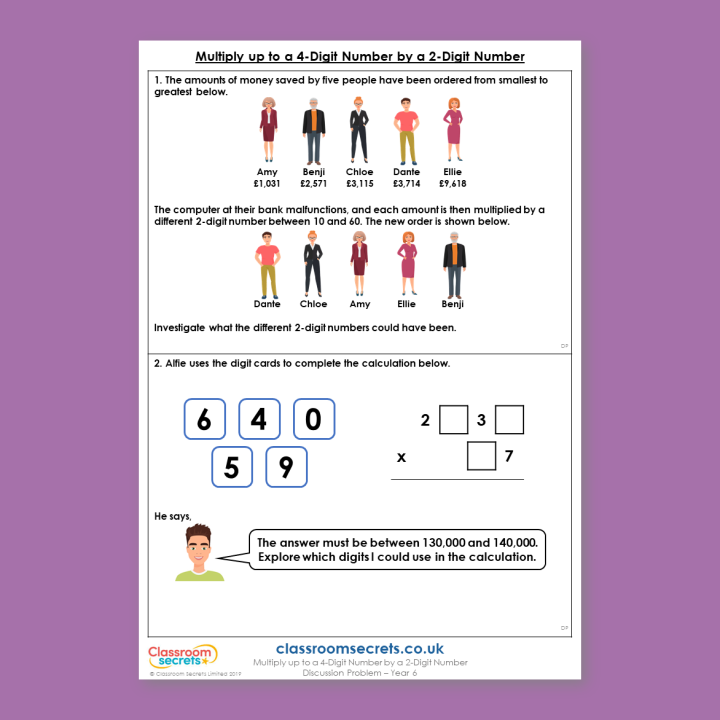
The questions in this set focus on problem solving with multiplications involving 4-digit numbers and 2-digit numbers to deepen understanding in multiplying multi-digit numbers up to 4 digits by a two-digit whole number using the formal written method of long multiplication and solving problems involving addition, subtraction, multiplication and division