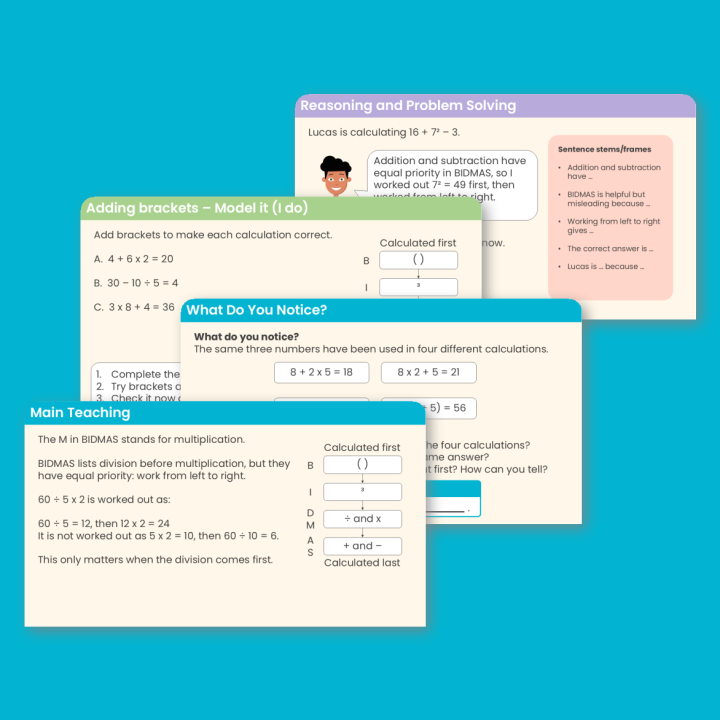
The Year 6 Order of Operations PowerPoint guides both teachers and children through the lesson, including use of the varied fluency, reasoning and problem solving, deeper reasoning and scaffolded resources. Key learning information about this step:
Key Vocabulary
operation: The function required to complete a calculation or problem. The four operations are: addition, subtraction, multiplication and division.
calculation: Determines an amount. It may involve addition, subtraction, multiplication or division, or a combination of these.
brackets: Used in mathematics to show the order in which an operation or calculation should be completed. Anything inside brackets should be completed first.
commutative: Calculations that have the same answer no matter the order of the numbers. Only addition and multiplication are commutative. For example: 2 x 6 = 12 and 6 x 2 = 12, and 5 + 4 = 9 and 4 + 5 = 9.
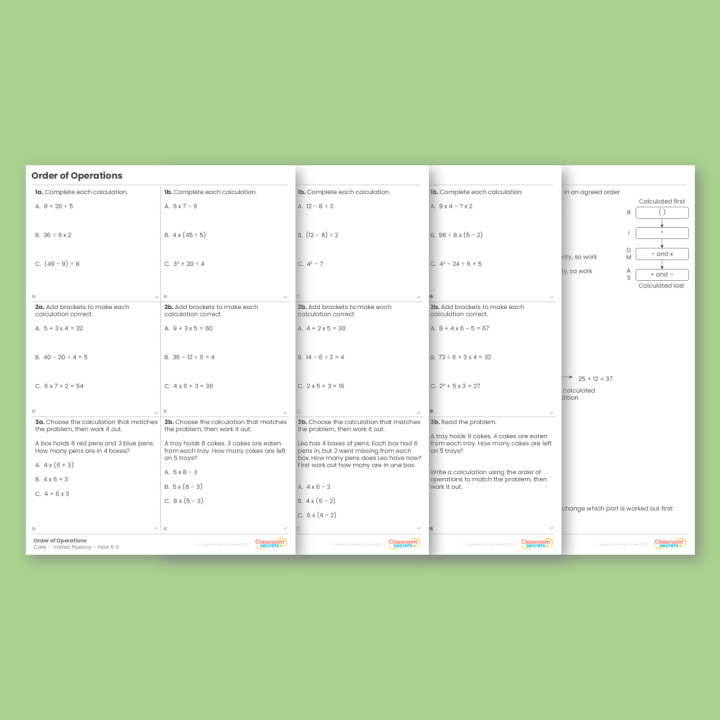
Varied Fluency
Knowledge Organiser
• Designed to support all children via key information and examples.
Scaffolded Examples
• Working out calculations with two operations, one step at a time.
Support
• Q1: Complete three calculations with two operations. Multiplication and division by 2, 5 or 10 to keep focus on order of operations.
• Q2: Add brackets to make three calculations correct. Two operations; multiplication and division by 2, 5 or 10 to keep focus on order of operations.
• Q3: Choose the calculation that matches a word problem. First step given.
Core
• Q1: Complete three calculations with two or three operations. Multiplication and division up to 12 x 12.
• Q2: Add brackets to make three calculations correct. Two operations; multiplication and division up to 12 x 12.
• Q3: Choose the calculation that matches a word problem.
Stretch
• Q1: Complete three calculations with three or four operations. Multiplication and division up to 12 x 12.
• Q2: Add brackets to make three calculations correct. Three operations.
• Q3: Write the calculation to match a word problem, then work it out.
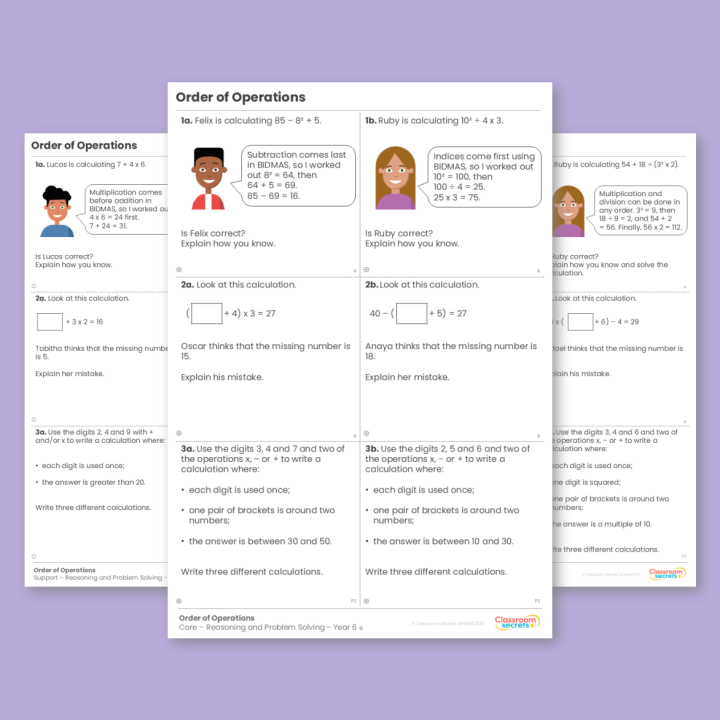
Reasoning and Problem Solving
Support
• Q1: Reasoning – explain whether a character has correctly worked out a calculation with two operations, where one is higher priority according to BIDMAS. Focus on order of operations, no requirement to solve calculation.
• Q2: Reasoning – explain the mistake made when finding a missing number in a calculation involving addition and multiplication or addition and subtraction.
• Q3: Problem Solving – write calculations with three given digits and two operations to satisfy two criteria.
Core
• Q1: Reasoning – explain whether a character has correctly worked out a calculation with three operations, where one is higher priority and the others are of equal priority according to BIDMAS. Focus on order of operations, no requirement to solve calculation.
• Q2: Reasoning – explain the mistake made when finding a missing number in a calculation involving brackets and one other operation.
• Q3: Problem Solving – write calculations with three given digits and two operations chosen from three to satisfy three criteria.
Stretch
• Q1: Reasoning – explain whether a character has correctly worked out a calculation with multiple operations, including ones of same priority according to BIDMAS. Focus on order of operations and then solve calculation.
• Q2: Reasoning – explain the mistake made when finding a missing number in a calculation involving brackets and two other operations.
• Q3: Problem Solving - write calculations with three given digits and two operations chosen from three to satisfy four criteria.
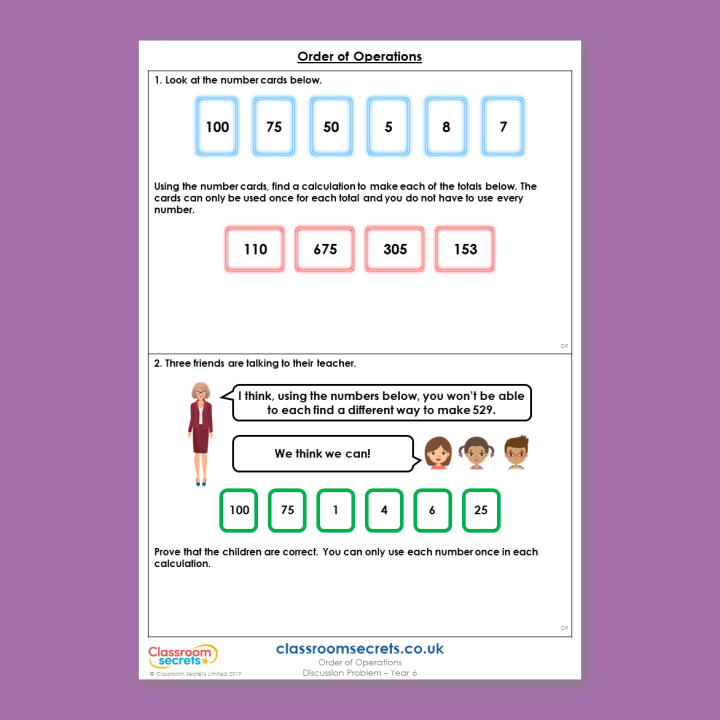
Deeper Reasoning
The questions in this set focus on problem solving with the four operations to deepen understanding in performing mental calculations, including with mixed operations and large numbers, and using their knowledge of the order of operations to carry out calculations involving the four operations.