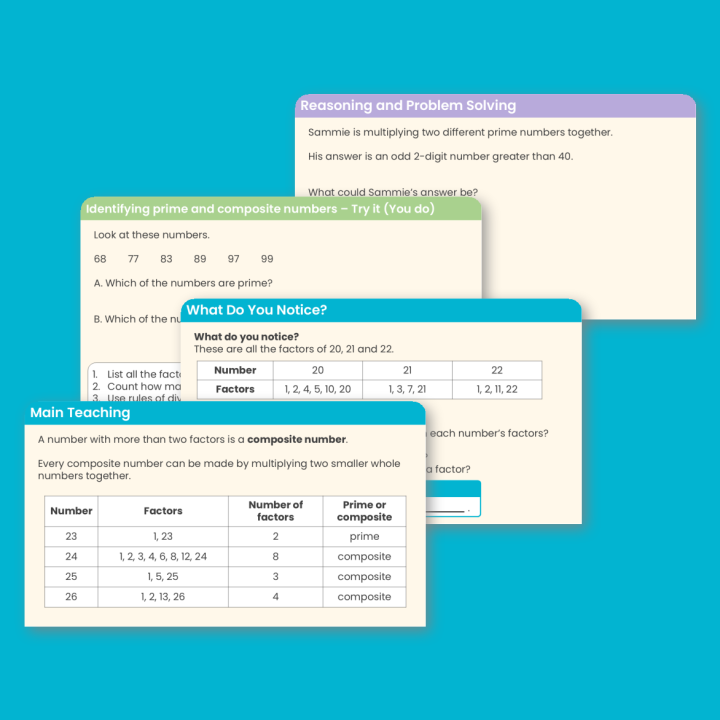
The Year 6 Primes to 100 PowerPoint guides both teachers and children through the lesson, including use of the varied fluency, reasoning and problem solving, deeper reasoning and scaffolded resources. Key learning information about this step:
Key Vocabulary
factors: Numbers we can multiply together to get another number. For example: 2 and 3 are factors of 6 because 2 x 3 = 6.
prime numbers: Whole numbers greater than 1 that can only be divided exactly by themselves and 1. For example: 19.
composite numbers: Whole numbers that can be made by multiplying other whole numbers. 6 is a composite number because it can be made by multiplying 3 by 2.
prime factor: A number that is a prime number and that can be multiplied to give the original number. For example: 3 and 5 are prime factors of 15 as they are prime numbers and can be multiplied to equal 15.
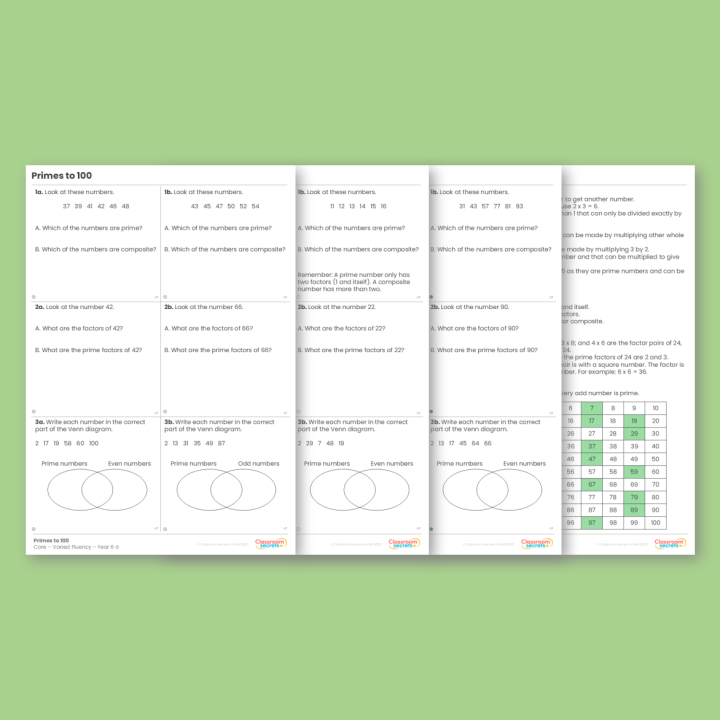
Varied Fluency
Knowledge Organiser
• Designed to support all children via key information and examples.
Scaffolded Examples
• Listing and counting the factors of each number to decide if it is prime, then finding prime factors, with sentence stems.
Support
• Q1: Decide whether given numbers are prime or composite. Hint provided.
• Q2: Find the factors and prime factors of a number. Numbers have fewer factor pairs.
• Q3: Sort numbers into a Venn diagram based on whether they are prime or composite and odd or even. Familiar primes used.
Core
• Q1: Decide whether given numbers are prime or composite.
• Q2: Find the factors and prime factors of a number.
• Q3: Sort numbers into a Venn diagram based on whether they are prime or composite and odd or even.
Stretch
• Q1: Decide whether given numbers are prime or composite. Numbers used that children often mistake for primes.
• Q2: Find the factors and prime factors of a number. Numbers have a larger amount of factor pairs.
• Q3: Sort numbers into a Venn diagram based on whether they are prime or composite and odd or even. Some numbers sit outside the diagram.
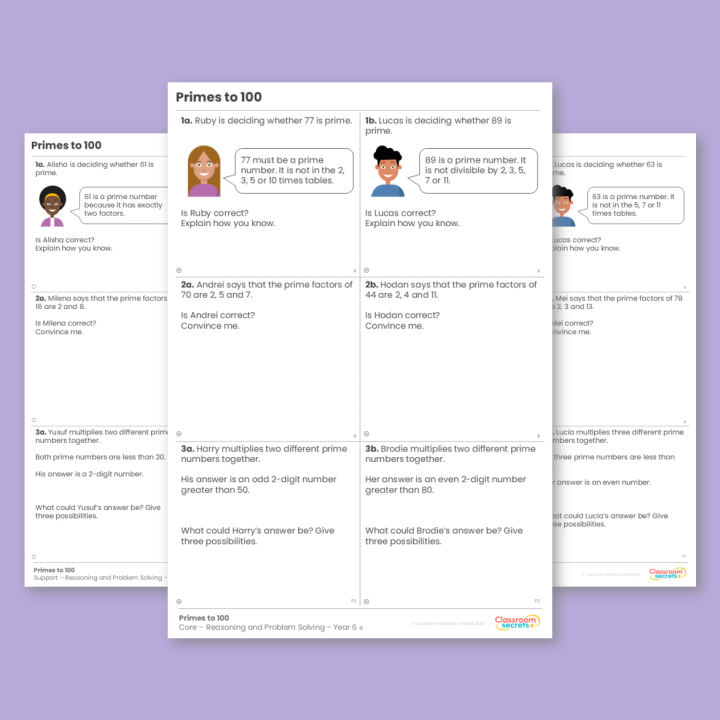
Reasoning and Problem Solving
Support
• Q1: Reasoning - Decide whether the number shown with place value counters matches the stated number. No exchanges; no use of zero as a placeholder.
• Q2: Reasoning - Decide whether the Base 10 shown can represent a given number. No exchanges; no use of zero as a placeholder.
• Q3: Problem Solving - Make three-digit numbers using a set number of place value counters (up to four).
Core
• Q1: Reasoning - Decide whether the number shown with place value counters matches the stated number. No exchanges; use of zero as a placeholder.
• Q2: Reasoning - Decide whether the Base 10 shown can represent a given number. No exchanges; use of zero as a placeholder.
• Q3: Problem Solving - Make three-digit numbers using a set number of place value counters (five or six).
Stretch
• Q1: Reasoning - Decide whether the number shown with place value counters matches the stated number. Exchanging required.
• Q2: Reasoning - Decide whether the Base 10 shown can represent a given number. Exchanging required.
• Q3: Problem Solving - Make three-digit numbers using a set number of place value counters (seven or eight), where each digit must be different.
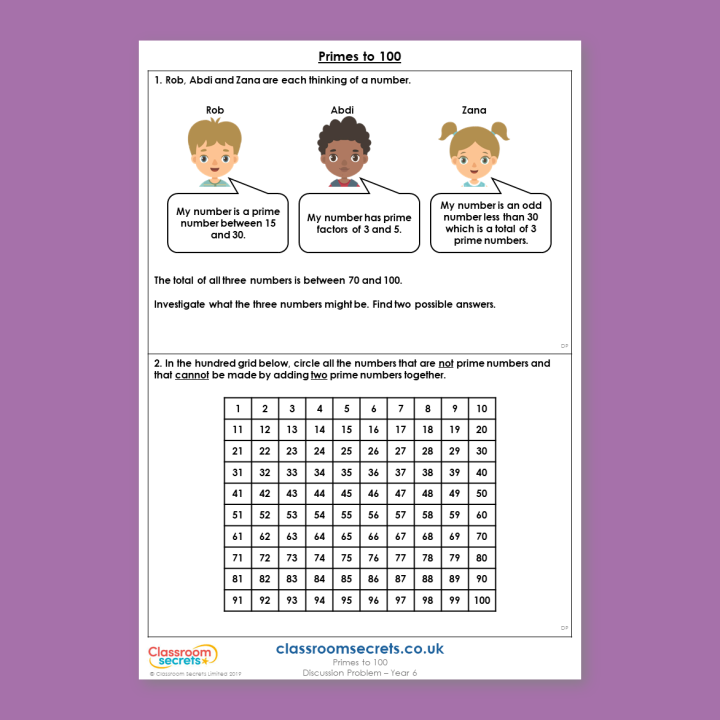
Deeper Reasoning
The questions in this set focus on problem solving with prime number up to 100 to deepen understanding in identifying prime numbers and solving problems involving multiplication and division.