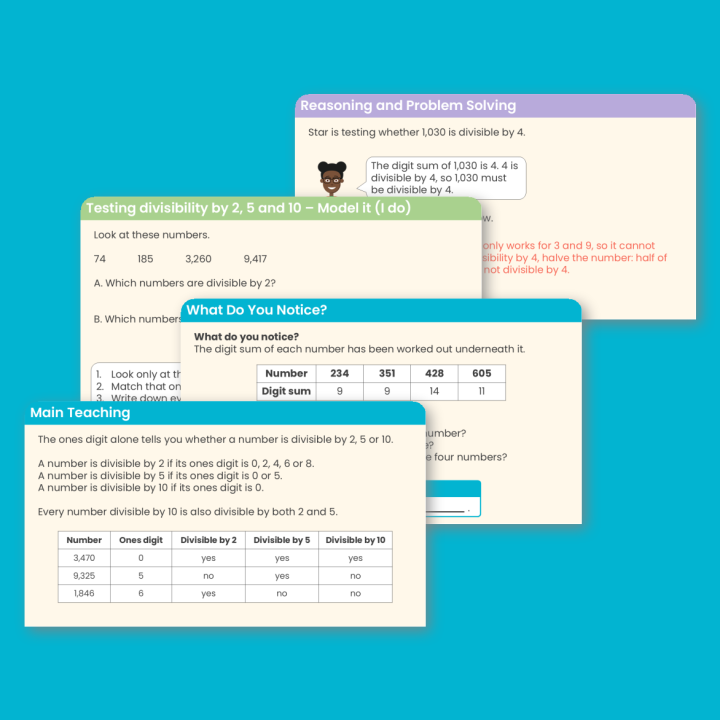
The Year 4 Rules of Divisibility PowerPoint guides both teachers and children through the lesson, including use of the varied fluency, reasoning and problem solving, deeper reasoning and scaffolded resources. Key learning information about this step:
Key Vocabulary
factors: Numbers we can multiply together to get another number. For example: 2 and 3 are factors of 6 because 2 x 3 = 6.
multiple: A product of one number multiplied by another number. For example: multiples of 10 are the products of numbers multiplied by 10.
divisible: A number is divisible by another number if it can be divided by it exactly with no remainder.
digit sum: The total of the digits within a number. For example: 12 has the digit sum of 3 because 1 + 2 = 3.
remainder: The amount left over after a division. For example: 12 ÷ 5 = 2 r2.
Varied Fluency
Knowledge Organiser
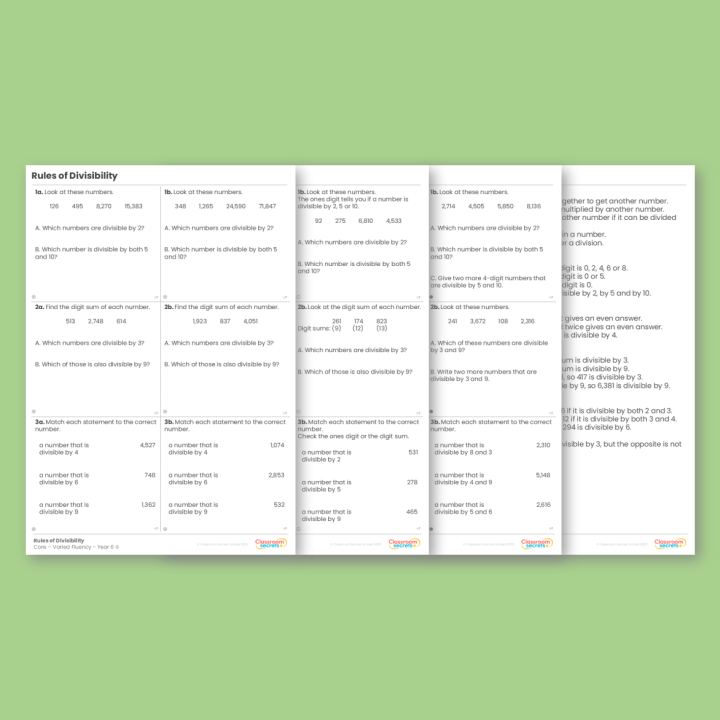
• Designed to support all children via key information and examples.
Scaffolded Examples
• Use the ones digit to test for divisibility by even numbers and 5 and 10, then finding a digit sum to test for divisibility by 3, with sentence stems.
Support
• Q1: Test four numbers for divisibility by 2, 5 and 10, with the rule given.
• Q2: Test three numbers for divisibility by 3 and 9 with the digit sums given.
• Q3: Match three numbers to their rules of divisibility, with a hint given.
Core
• Q1: Test four numbers for divisibility by 2, 5 and 10.
• Q2: Find digit sums to test three numbers for divisibility by 3 and 9.
• Q3: Match three numbers to their rules of divisibility.
Stretch
• Q1: Test four numbers for divisibility by 2, 5 and 10. Give two more 4-digit numbers that meet the criteria.
• Q2: Find digit sums to test three numbers for divisibility by 3 and 9. Give two more 4-digit numbers that meet the criteria.
• Q3: Match three numbers to their rules of divisibility with two divisors.
Reasoning and Problem Solving
Support
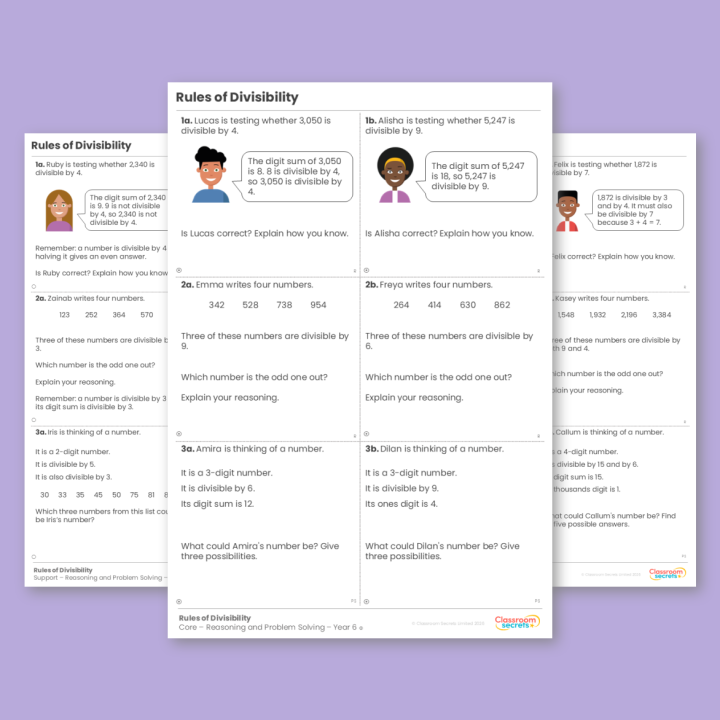
• Q1: Reasoning - explain whether a rule of divisibility has been applied correctly, with hint about the rule given.
• Q2: Reasoning - find the odd one out from four numbers using a rule of divisibility, with hint about the rule given.
• Q3: Problem Solving – find three numbers that fit given conditions about the rules of divisibility. Numbers provided.
Core
• Q1: Reasoning - explain whether a rule of divisibility has been applied correctly.
• Q2: Reasoning - find the odd one out from four numbers using a rule of divisibility.
• Q3: Problem Solving - find three numbers that fit given conditions about the rules of divisibility.
Stretch
• Q1: Reasoning - explain whether two rules of divisibility have been correctly combined.
• Q2: Reasoning - find the odd one out from four numbers using two rules of divisibility.
• Q3: Problem Solving - find three numbers that fit given conditions about the rules of divisibility. Find all possibilities.
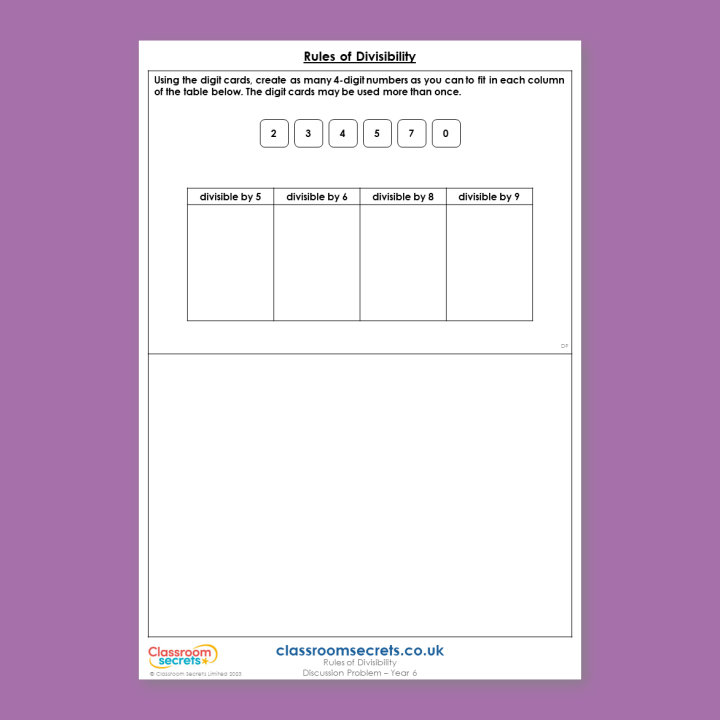
Deeper Reasoning
The questions in this set focus on problem solving with the rules of divisibility to deepen understanding in solving problems involving division.