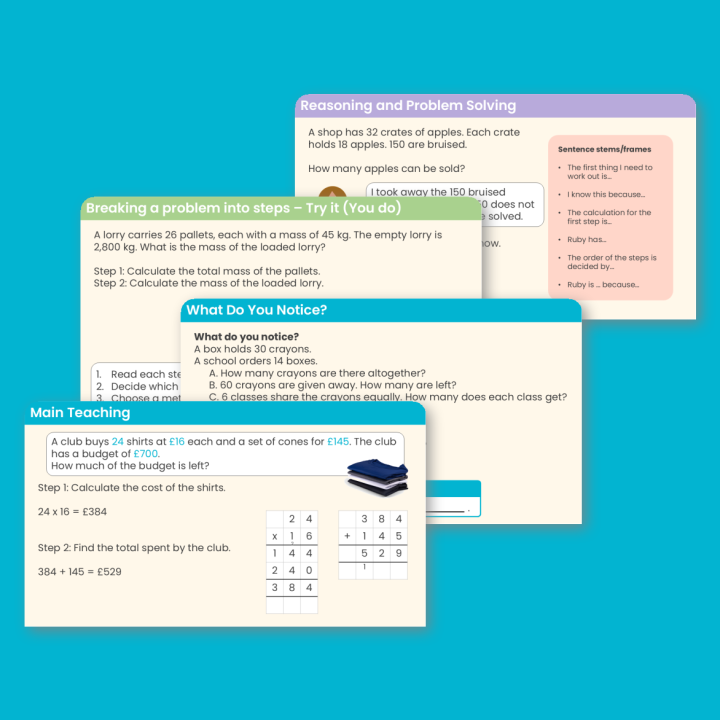
The Year 6 Solve Multi-Step Problems PowerPoint guides both teachers and children through the lesson, including use of the varied fluency, reasoning and problem solving, deeper reasoning and scaffolded resources. Key learning information about this step:
Key Vocabulary
multi-step problems: Maths problems that have more than one step or calculation. An example may include both an addition and a subtraction.
operation: The function required to complete the calculation or problem. The four operations are: addition, subtraction, multiplication and division.
bar models: Show how numbers can be split into different parts, by splitting them into bars or boxes. Bar models can be used to solve a wide variety of calculations, showing the relationship between the whole model and the parts.
efficient: To choose the best method to solve a calculation. Sometimes a mental method can be quicker than a written one if there are no exchanges.
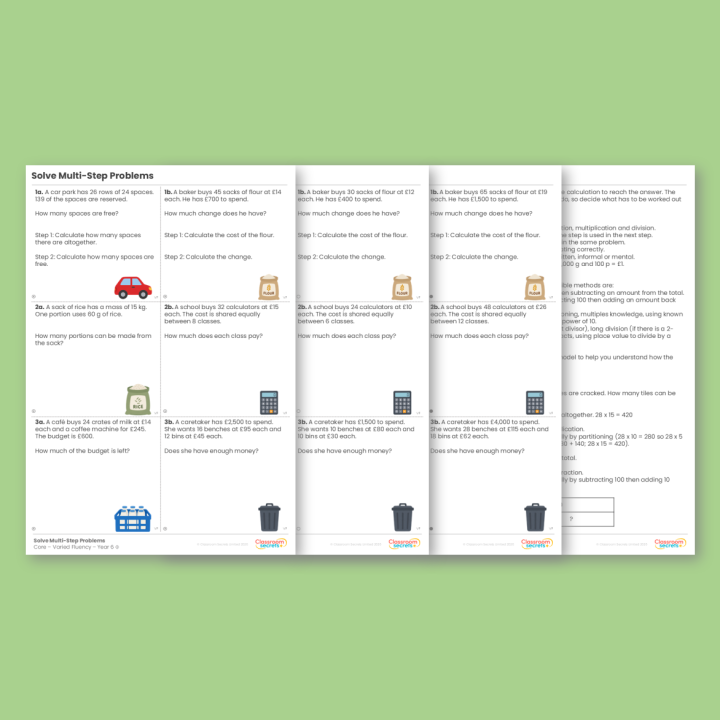
Varied Fluency
Knowledge Organiser
• Designed to support all children via key information and examples.
Scaffolded Examples
• Working through a problem in steps; deciding the operation for each step.
Support
• Q1: Solve a two-step problem. Steps given; simpler numbers.
• Q2: Solve a two-step problem. Operation changes; unit changes; simpler numbers.
• Q3: Solve a three-step problem. Simpler numbers.
Core
• Q1: Solve a two-step problem. Steps given.
• Q2: Solve a two-step problem. Operation changes; unit changes.
• Q3: Solve a three-step problem.
Stretch
• Q1: Solve a two-step problem. Steps given; more challenging numbers.
• Q2: Solve a two-step problem. Operation changes; unit changes; more challenging numbers.
• Q3: Solve a three-step problem. More challenging numbers.
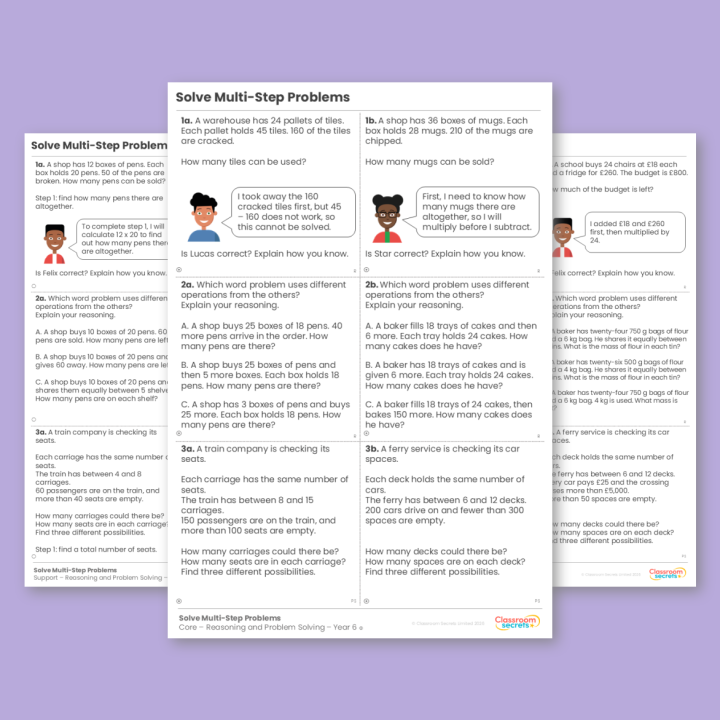
Reasoning and Problem Solving
Support
• Q1: Reasoning – explain whether a character’s method to solve a two-step problem is correct. First step given.
• Q2: Reasoning – decide which of three multi-step problems is the odd one out based on its use of operations, with different operations used in the odd one out.
• Q3: Problem Solving – find possible numbers to satisfy a multi-step problem; first step given.
Core
• Q1: Reasoning – explain whether a character’s method to solve a two-step problem is correct.
• Q2: Reasoning – decide which of three multi-step problems is the odd one out based on its use of operations, with the same operations used in a different order.
• Q3: Problem Solving – find possible numbers to satisfy a multi-step problem with two given conditions.
Stretch
• Q1: Reasoning – explain whether a character’s method to solve a three-step problem is correct.
• Q2: Reasoning – decide which of three multi-step problems is the odd one out based on its use of operations, including conversion between g and kg.
• Q3: Problem Solving – find possible numbers to satisfy a multi-step problem with three given conditions.
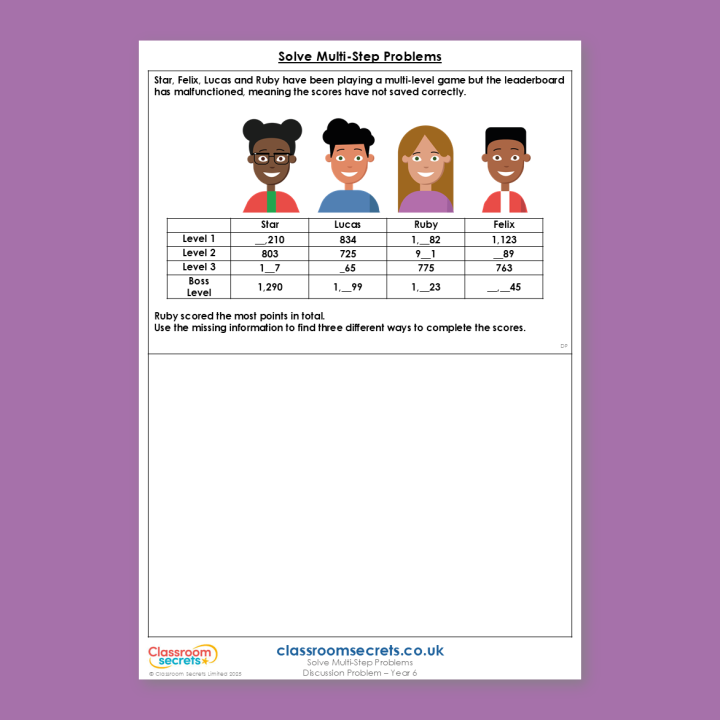
Deeper Reasoning
The question in this set focuses on problem solving with four operations to deepen understanding in solving addition and subtraction multi-step problems in contexts, deciding which operations and methods to use and why, and solving problems involving addition, subtraction, multiplication and division.