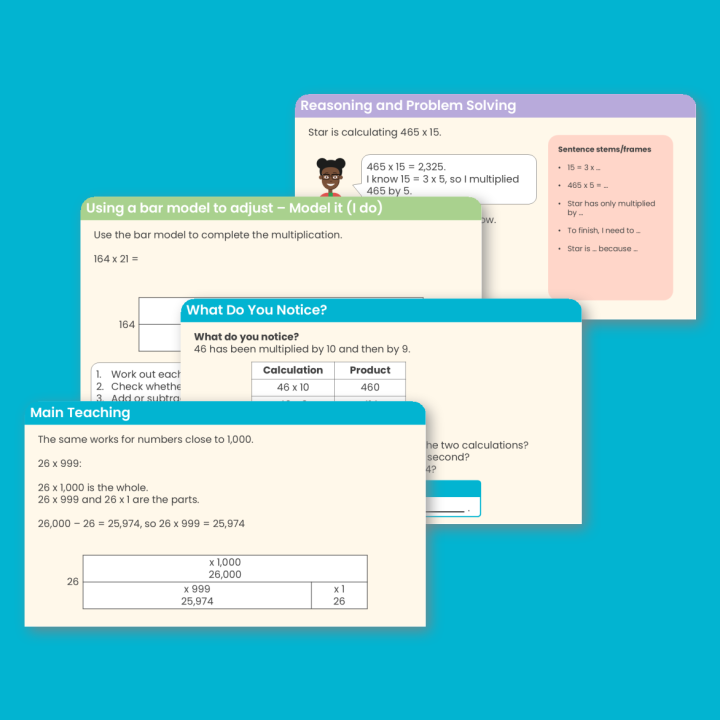
The Year 6 Solve Problems with Multiplication PowerPoint guides both teachers and children through the lesson, including use of the varied fluency, reasoning and problem solving, deeper reasoning and scaffolded resources. Key learning information about this step:
Key Vocabulary
efficient: To choose the best method to solve a calculation. Sometimes a mental method can be quicker than a written one if there are no exchanges.
powers of 10: When ten is multiplied by itself a certain number of times (when the power is a positive integer). For example: 10,000 means 10 x 10 x 10 x 10 (10 to the power of 4).
factors: Numbers we can multiply together to get another number. For example: 2 and 3 are factors of 6 because 2 x 3 = 6.
product: The answer of multiplying two or more numbers together. For example: 30 is the product of 6 x 5.
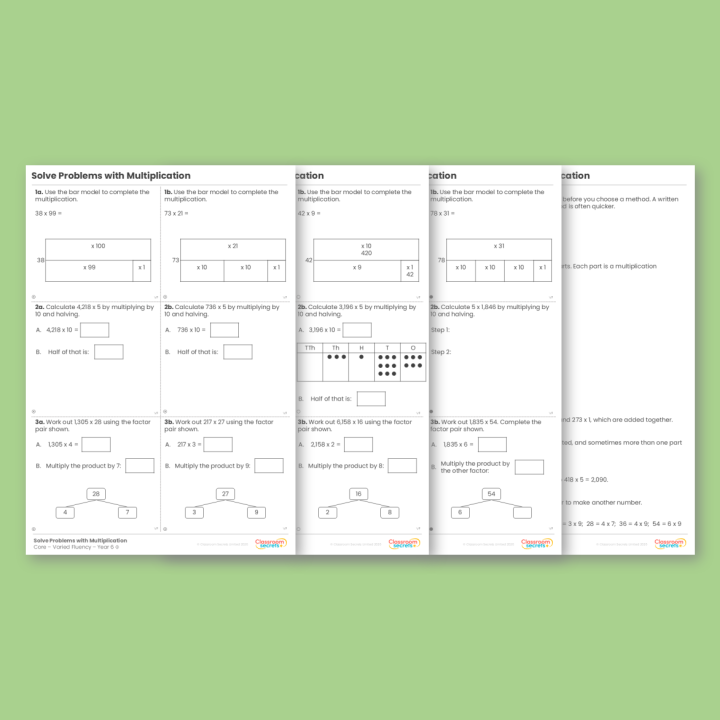
Varied Fluency
Knowledge Organiser
• Designed to support all children via key information and examples.
Scaffolded Examples
• Using a bar model to x10 to adjust for x9 or x11, with sentence stems.
Support
• Q1: Use a bar model to adjust a 2-digit multiplication by 9 or 11. Some parts of the bar model calculation and answer given.
• Q2: Multiply a 3- or 4-digit number by 5 by multiplying by 10 and halving. Place value charts and sentence stems provided.
• Q3: Multiply a 3- or 4-digit number using a factor pair. Factor pair given and includes familiar times tables.
Core
• Q1: Use a bar model to adjust a 2-digit multiplication by 99 or 21. Calculation parts of bar model given.
• Q2: Multiply a 3- or 4-digit number by 5 by multiplying by 10 and halving. Sentence stems provided.
• Q3: Multiply a 3- or 4-digit number using a factor pair. Factor pair given.
Stretch
• Q1: Use a bar model to adjust a 2-digit multiplication by 999 or 31. No parts of bar model given.
• Q2: Multiply a 3- or 4-digit number by 5 by multiplying by 10 and halving. No scaffolds provided.
• Q3: Multiply a 4-digit number using a factor pair. Part of a factor pair given.
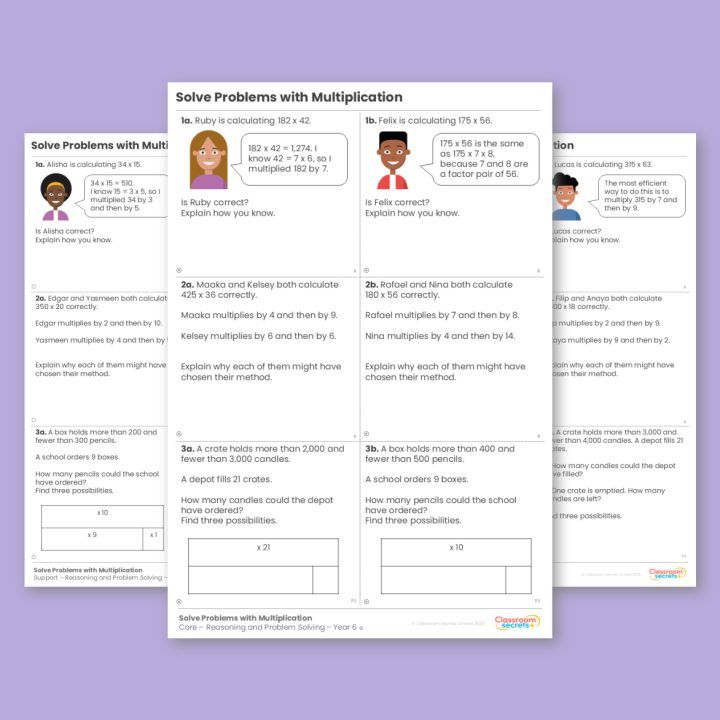
Reasoning and Problem Solving
Support
• Q1: Reasoning - explaining whether a character has used a factor pair correctly to complete a multiplication. Factors are 2, 3, 4 or 5.
• Q2: Reasoning - explaining why two children each chose a different factor pair for the same multiplication, where one route is plainly lighter.
• Q3: Problem Solving - investigating possible answers to a word problem, adjusting to multiply. A bar model is given with every part labelled.
Core
• Q1: Reasoning - explaining whether a character has used a factor pair correctly to complete a multiplication. Any factor pair is used.
• Q2: Reasoning - explaining why two children each chose a different factor pair for the same multiplication, where the advantage is less obvious.
• Q3: Problem Solving - investigating possible answers to a word problem, adjusting to multiply. A bar model is given with only the whole labelled.
Stretch
• Q1: Reasoning - explaining whether a character has used the most efficient factor pair to complete a multiplication.
• Q2: Reasoning - explaining why two children used the same factor pair in a different order, where only the first product separates them.
• Q3: Problem Solving - investigating possible answers to a two-step word problem, adjusting to multiply. No bar model is given.
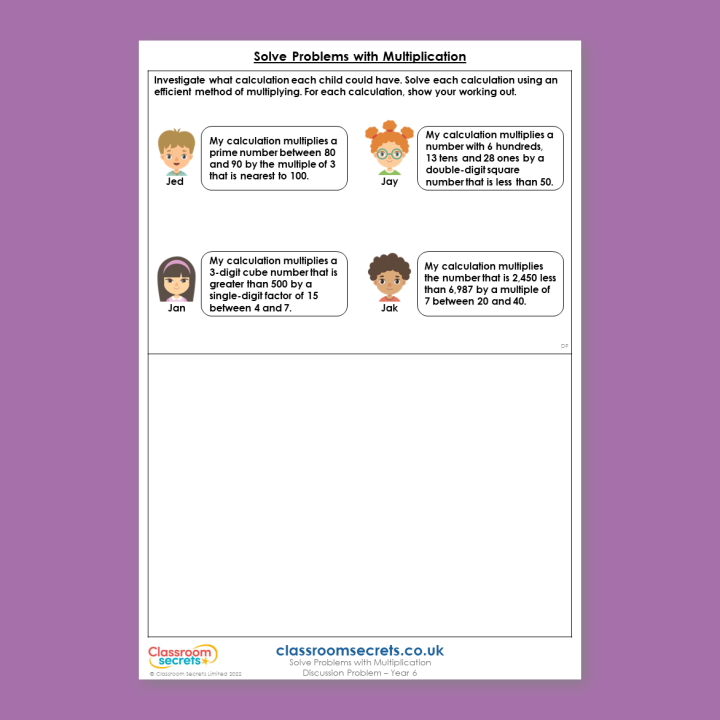
Deeper Reasoning
The question in this set focuses on problem solving with multiplication to deepen understanding in performing mental calculations, including with mixed operations and large numbers and solving problems involving addition, subtraction, multiplication and division.