The Year 6 Square and Cube Numbers PowerPoint guides both teachers and children through the lesson, including use of the varied fluency, reasoning and problem solving, deeper reasoning and scaffolded resources. Key learning information about this step:
Key Vocabulary
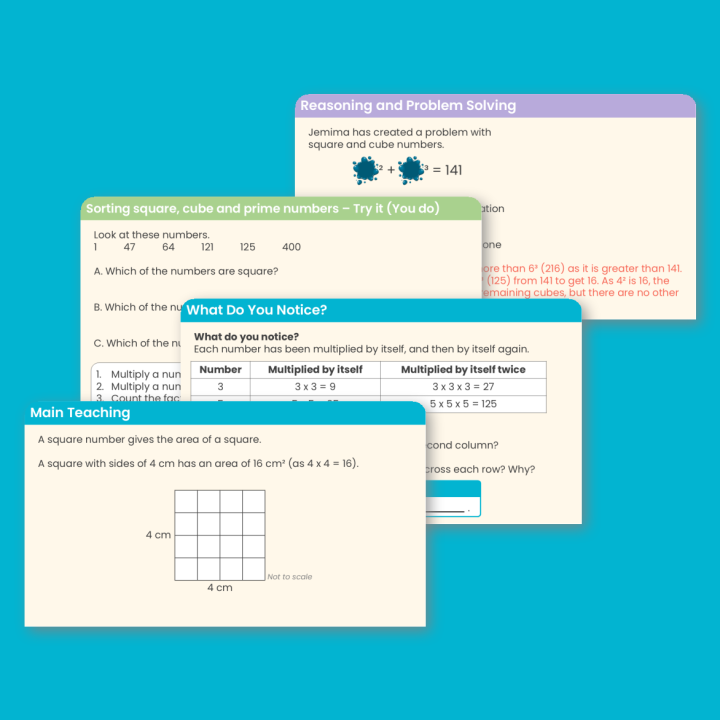
square number: The product of a number multiplied by itself. For example: 9 = (3 x 3).
cube number: The product of a number multiplied by itself and then by itself again. For example: 8 = (2 x 2 x 2).
product: The answer of multiplying two or more numbers together. For example: 30 is the product of 6 x 5.
factors: Numbers we can multiply together to get another number. For example: 2 and 3 are factors of 6 because 2 x 3 = 6.
Varied Fluency
Knowledge Organiser
• Designed to support all children via key information and examples.
Scaffolded Examples
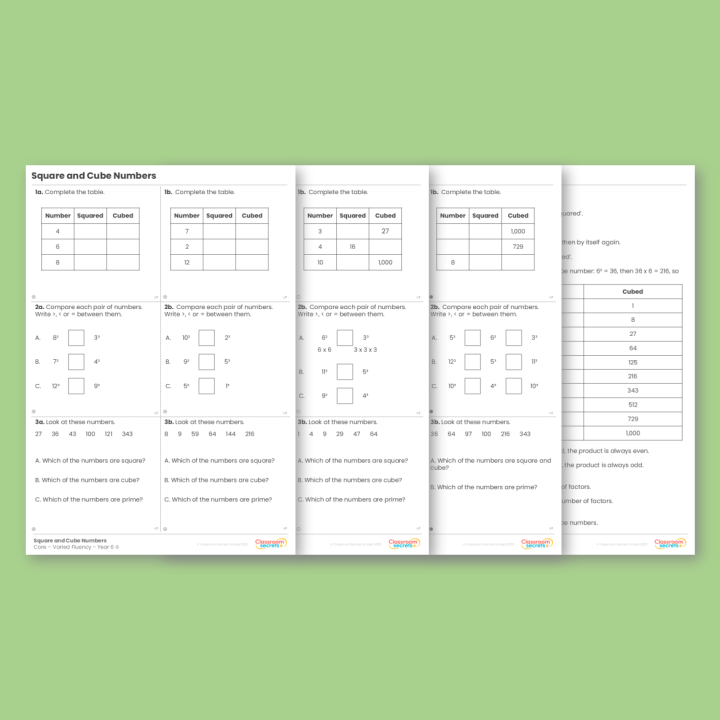
• Completing a table of square and cube numbers for one number at a time, then comparing a square number with a cube number, with sentence stems.
Support
• Q1: Calculate square and cube numbers up to 10³. Start number always given, with some answers given.
• Q2: Compare a square number with a cube number using >, < or =. One statement with expanded form given.
• Q3: Sort numbers into square, cube and prime numbers. Familiar squares and cubes given (up to 12² and 5³).
Core
• Q1: Calculate square and cube numbers up to 10³. Start number always given.
• Q2: Compare a square number with a cube number using >, < or =.
• Q3: Sort numbers into square, cube and prime numbers.
Stretch
• Q1: Calculate square and cube numbers up to 10³. Start number not always given.
• Q2: Compare three square or cube numbers using >, < or =.
• Q3: Sort numbers into square and cube numbers, and into prime numbers.
Reasoning and Problem Solving
Support
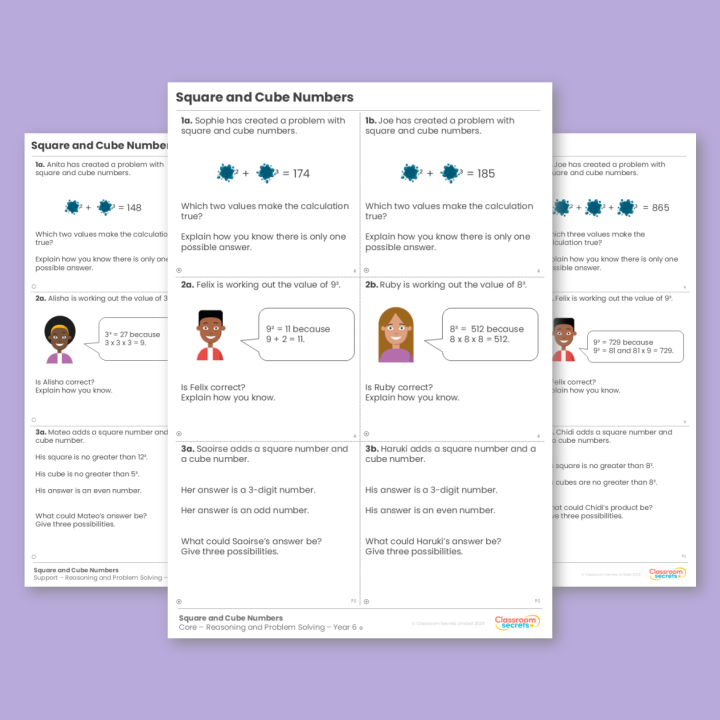
• Q1: Reasoning - Decide whether the number shown with place value counters matches the stated number. No exchanges; no use of zero as a placeholder.
• Q2: Reasoning - Decide whether the Base 10 shown can represent a given number. No exchanges; no use of zero as a placeholder.
• Q3: Problem Solving - Make three-digit numbers using a set number of place value counters (up to four).
Core
• Q1: Reasoning - Decide whether the number shown with place value counters matches the stated number. No exchanges; use of zero as a placeholder.
• Q2: Reasoning - Decide whether the Base 10 shown can represent a given number. No exchanges; use of zero as a placeholder.
• Q3: Problem Solving - Make three-digit numbers using a set number of place value counters (five or six).
Stretch
• Q1: Reasoning - Decide whether the number shown with place value counters matches the stated number. Exchanging required.
• Q2: Reasoning - Decide whether the Base 10 shown can represent a given number. Exchanging required.
• Q3: Problem Solving - Make three-digit numbers using a set number of place value counters (seven or eight), where each digit must be different.
Deeper Reasoning
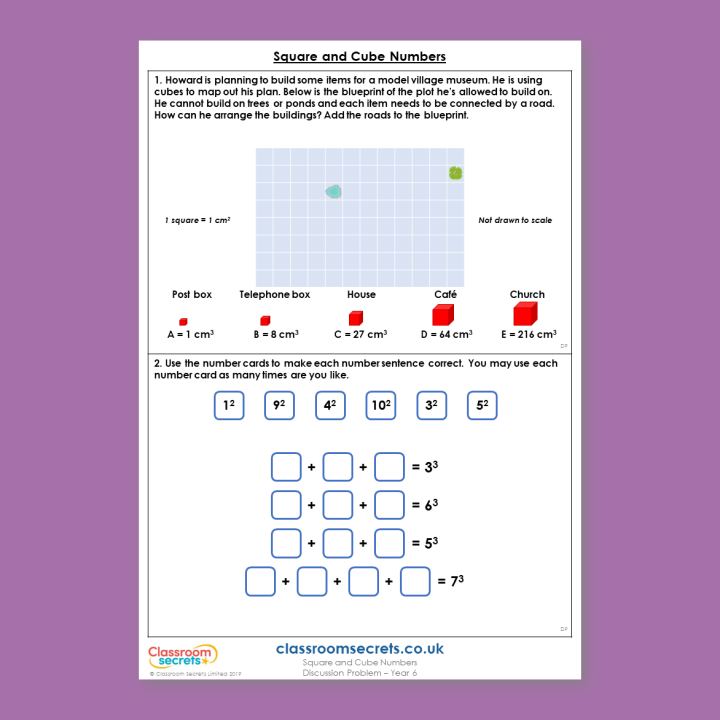
The questions in this set focus on problem solving by addition of square and cube numbers to deepen understanding in solving problems involving addition, subtraction, multiplication and division.