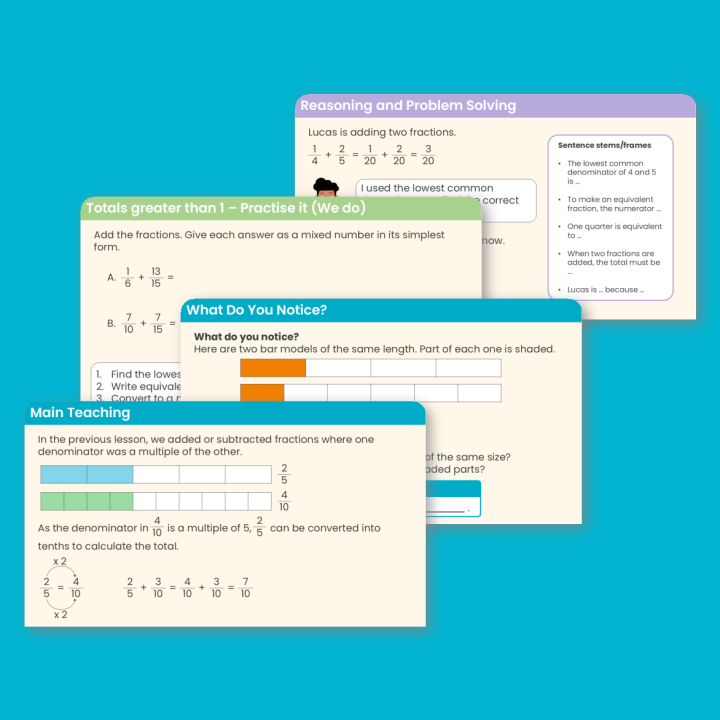
The Year 6 Add and Subtract Any Two Fractions PowerPoint guides both teachers and children through the lesson, including use of the varied fluency, reasoning and problem solving, deeper reasoning and scaffolded resources. Key learning information about this step:
Key Vocabulary
lowest common multiple: The smallest positive number that is a multiple of two or more numbers.
lowest common denominator: The lowest possible denominator that can be shared by two or more fractions.
improper fraction: Fractions where the numerator is greater than the denominator.
mixed number: A number made up of a whole number and a fraction.
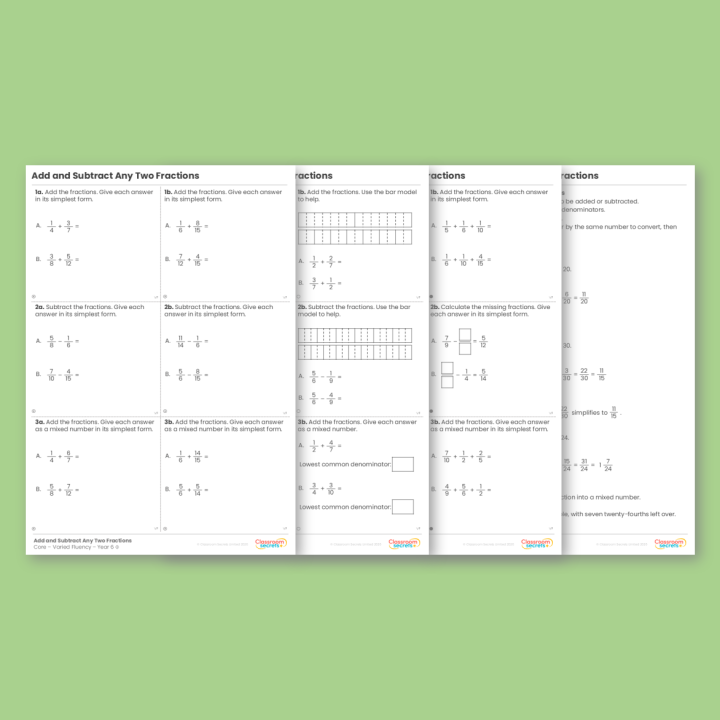
Varied Fluency
Knowledge Organiser
• Designed to support all children via key information and examples.
Scaffolded Examples
• Listing multiples to find the lowest common denominator, then converting.
Support
• Q1: Add two fractions with bar models given.
• Q2: Subtract two fractions with bar models given.
• Q3: Add two fractions to give a mixed number with a prompt to find the lowest common denominator.
Core
• Q1: Add two fractions with different denominators. Some answers simplify.
• Q2: Subtract two fractions with different denominators. Some answers simplify.
• Q3: Add two fractions to give a mixed number. Some answers simplify.
Stretch
• Q1: Add three fractions with different denominators. Some answers simplify.
• Q2: Find a missing fraction in a subtraction with different denominators.
• Q3: Add three fractions to give a mixed number. Some answers simplify.
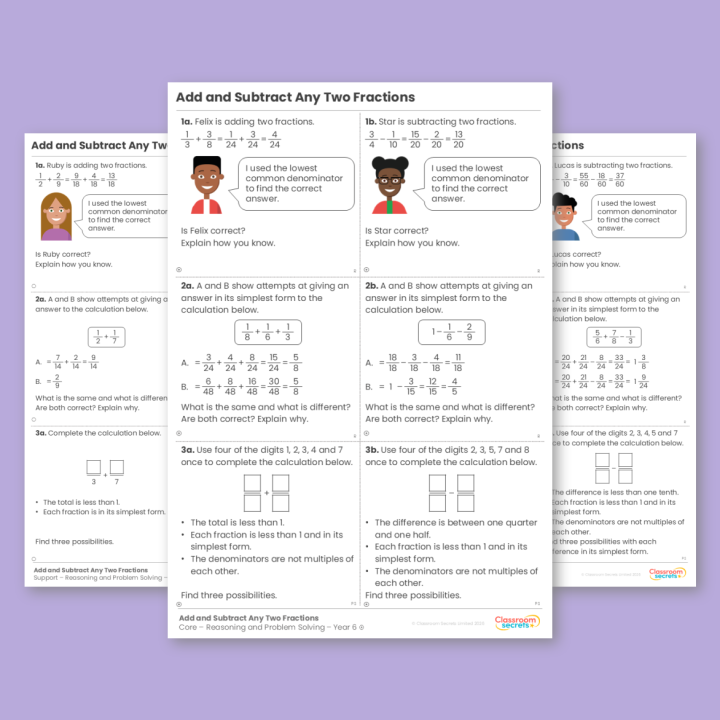
Reasoning and Problem Solving
Support
• Q1: Reasoning – explain whether a character has added or subtracted two fractions correctly by checking the lowest common denominator.
• Q2: Reasoning – compare two methods for adding or subtracting two fractions; decide whether both are correct.
• Q3: Problem Solving – write numerators for given denominators to make a total or difference that meets a condition.
Core
• Q1: Reasoning – explain whether a character has added or subtracted two fractions correctly by checking how both fractions were converted.
• Q2: Reasoning – compare two methods for adding or subtracting three fractions; decide whether both are correct.
• Q3: Problem Solving – choose digits to make an addition or a subtraction of two fractions that meet conditions.
Stretch
• Q1: Reasoning – explain whether a character has added or subtracted two fractions correctly by checking the answer is simplified or a mixed number.
• Q2: Reasoning – compare two methods for adding or subtracting three fractions, using an answer greater than 1; decide whether both are correct.
• Q3: Problem Solving – choose digits to make an addition or a subtraction of two fractions that meet conditions. Including mixed numbers or simplifying.
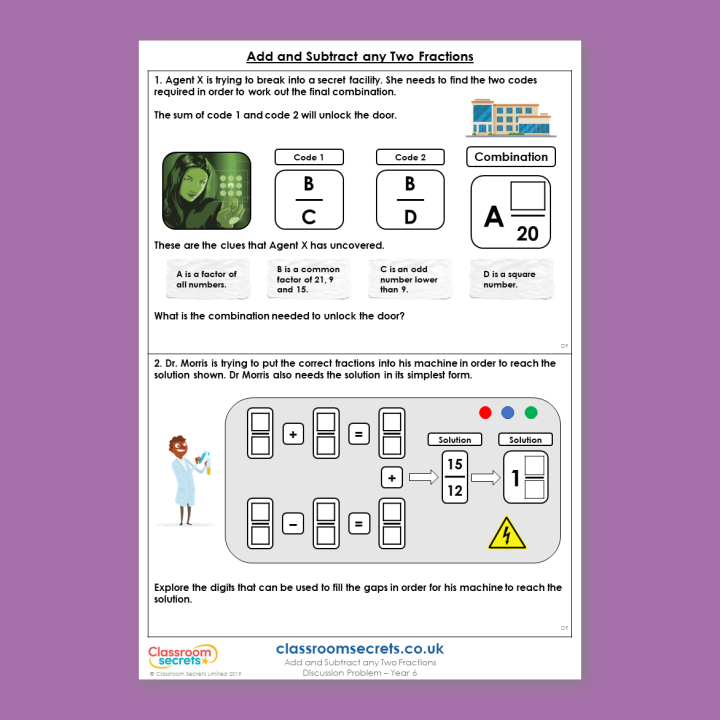
Deeper Reasoning
The questions in this set focus on problem solving with fractions to deepen understanding in adding and subtracting fractions with different denominators and mixed numbers, using the concept of equivalent fractions.