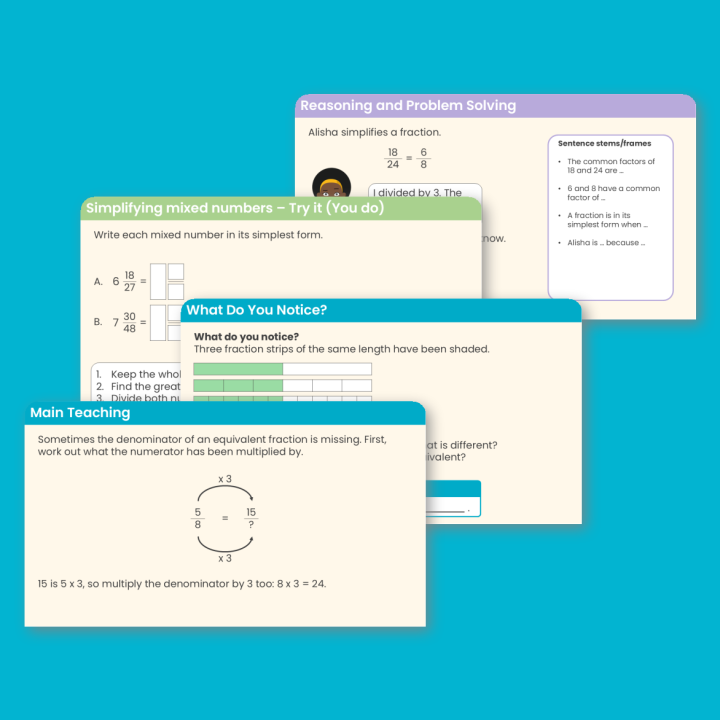
The Year 6 Equivalent Fractions and Simplifying PowerPoint guides both teachers and children through the lesson, including use of the varied fluency, reasoning and problem solving, deeper reasoning and scaffolded resources. Key learning information about this step:
Key Vocabulary
equivalent: Means equal in value. For example: equivalent fractions may use different numerators and denominators but represent the same part of a whole.
common factors: Factors that two or more numbers share. The common factors of 12 and 18 are 1, 2, 3 and 6.
simplified fractions: A fraction is in its simplest form when the only common factor of the numerator and denominator is 1. To find a simplified fraction, the numerator and denominator must be divided by the same number.
Varied Fluency
Knowledge Organiser
• Designed to support all children via key information and examples.
Scaffolded Examples
• Finding missing numerators and denominators by multiplying; simplifying a fraction by dividing by its greatest common factor.
Support
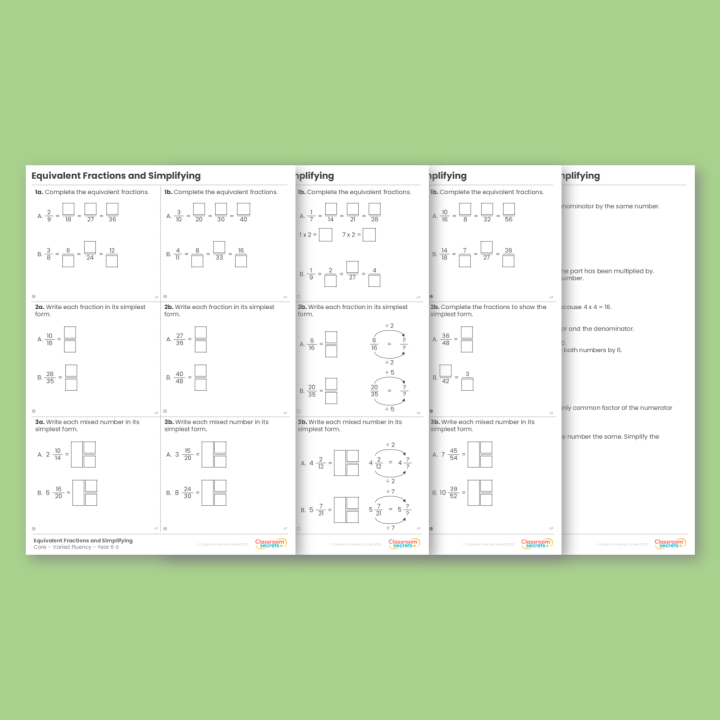
• Q1: Complete linear equivalent fraction chains using unit fractions and prompts.
• Q2: Write fractions in their simplest form using the given greatest common factor.
• Q3: Write mixed numbers in their simplest form using the given greatest common factor.
Core
• Q1: Complete linear equivalent fraction chains using non-unit fractions.
• Q2: Write fractions in their simplest form by identifying the greatest common factor.
• Q3: Write mixed numbers in their simplest form by identifying the greatest common factor of the fractional part. Divisions up to 12 x 12.
Stretch
• Q1: Complete non-linear equivalent fraction chains using multiplication and division.
• Q2: Write fractions in their simplest form. Includes missing numbers in both fractions.
• Q3: Write mixed numbers in their simplest form by identifying the greatest common factor of the fractional part. Divisions may go beyond 12 x 12.
Reasoning and Problem Solving
Support
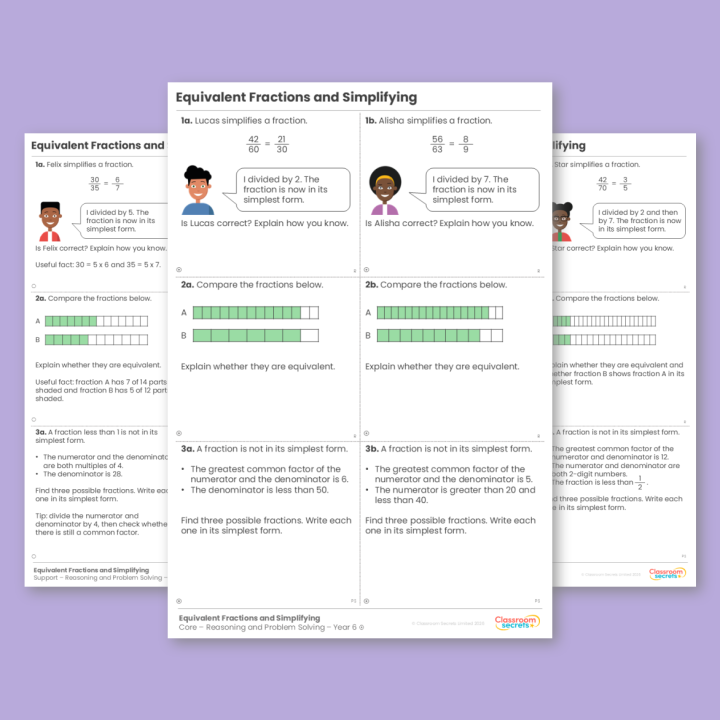
• Q1: Reasoning – explain whether a character has correctly simplified to the simplest form in one step. Useful fact given.
• Q2: Reasoning – compare fraction models and explain whether the fractions are equivalent. Useful facts given.
• Q3: Problem Solving – find fractions that can be simplified using a given denominator and common factor. Tip given.
Core
• Q1: Reasoning – explain whether a character has correctly simplified to the simplest form in one step.
• Q2: Reasoning – compare fraction models and explain whether the fractions are equivalent.
• Q3: Problem Solving – find fractions with a specified greatest common factor and an additional condition.
Stretch
• Q1: Reasoning – explain whether a character has correctly simplified to the simplest form in two steps.
• Q2: Reasoning – compare fraction models and explain whether the fractions are equivalent. Explain whether one shows the other in its simplest form.
• Q3: Problem Solving – find fractions with a specified greatest common factor that satisfy several conditions.
Deeper Reasoning
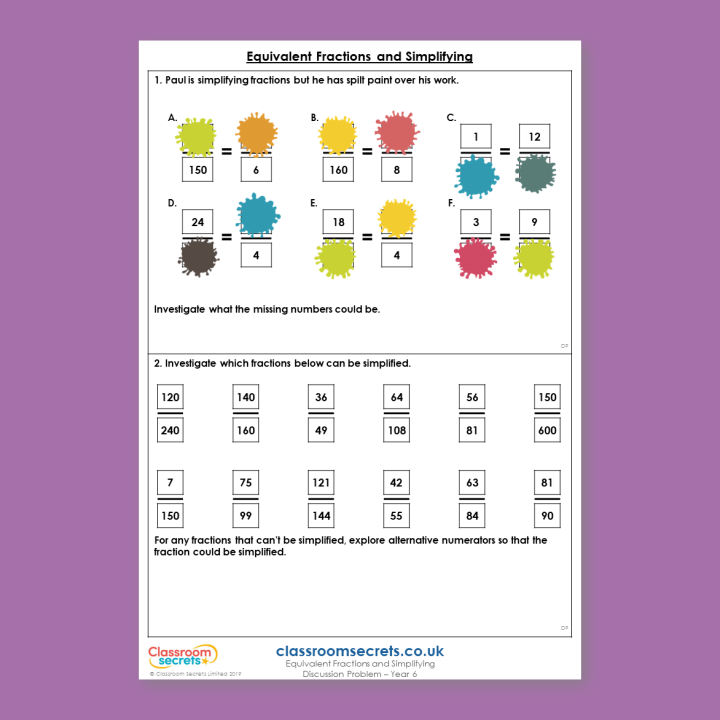
The questions in this set focus on problem solving with equivalent fractions to deepen understanding in using common factors to simplify fractions and finding equivalent fractions.