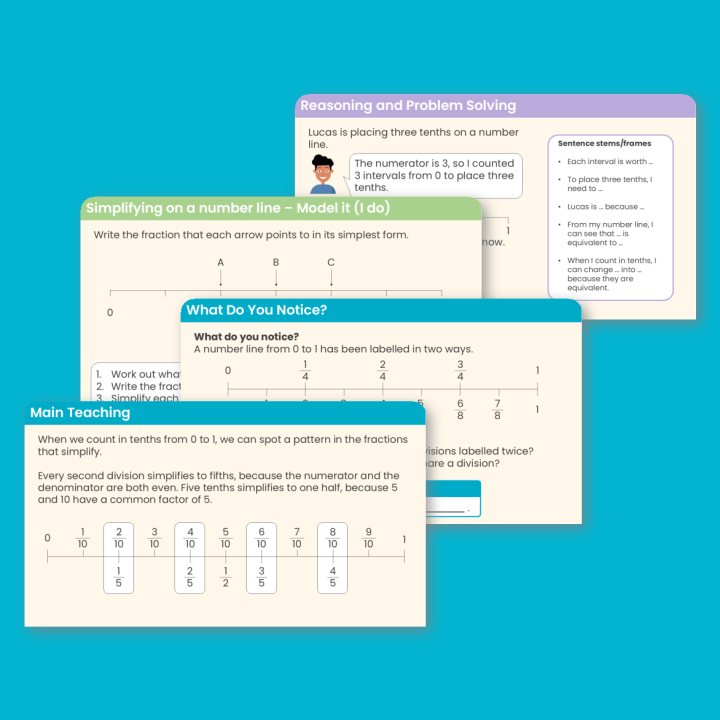
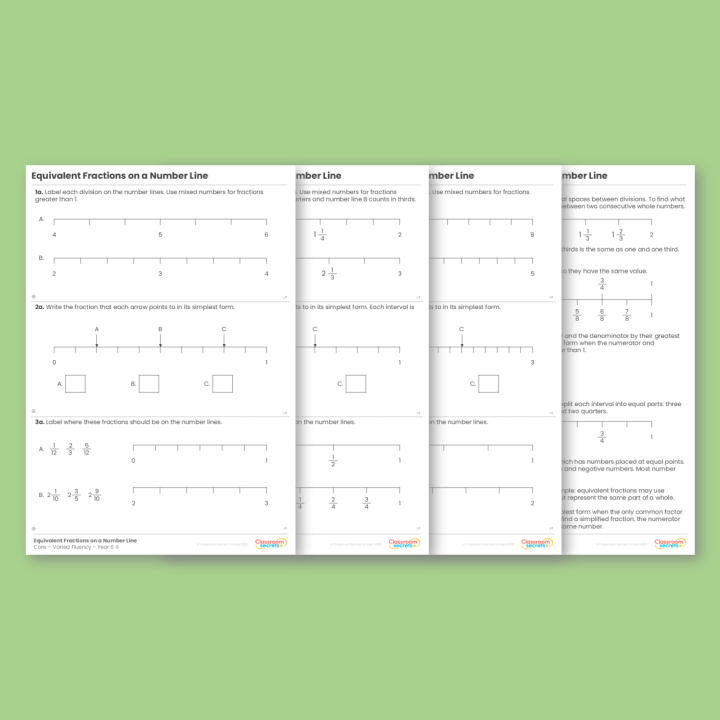
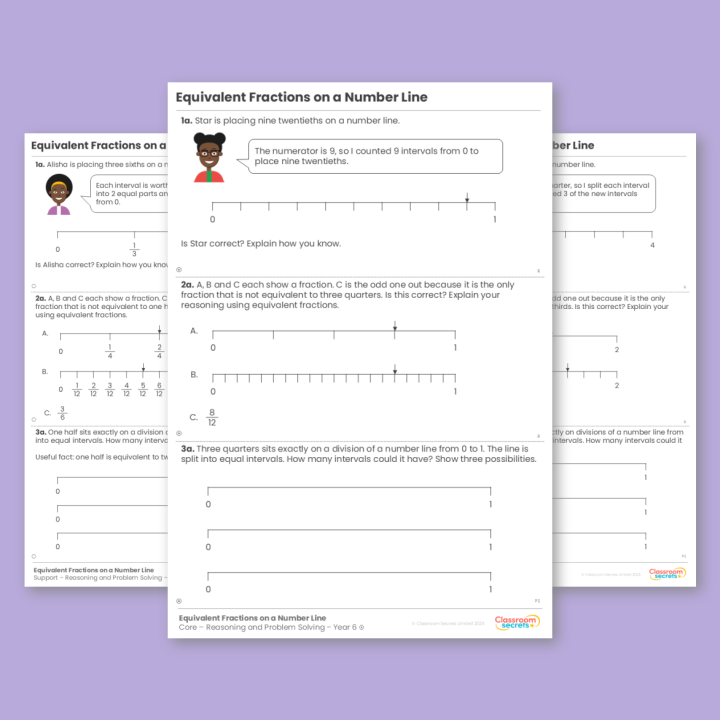
The Year 6 Equivalent Fractions on a Number Line PowerPoint guides both teachers and children through the lesson, including use of the varied fluency, reasoning and problem solving, deeper reasoning and scaffolded resources. Key learning information about this step:
Key Vocabulary
number line: A horizontal or vertical line which has numbers placed at equal points. Number lines can be used to show positive and negative numbers. Most number lines begin at 0.
equivalent: Means equal in value. For example: equivalent fractions may use different numerators and denominators but represent the same part of a whole.
simplified fractions: A fraction is in its simplest form when the only common factor of the numerator and denominator is 1. To find a simplified fraction, the numerator and denominator must be divided by the same number.
Varied Fluency
Knowledge Organiser
• Designed to support all children via key information and examples.
Scaffolded Examples
Finding interval values and labelling after 1; simplifying at an arrow.
Support
• Q1: Label fractions on number lines. Intervals given, two divisions and whole numbers labelled.
• Q2: Simplify fractions on a number line from 0 – 1. Intervals given.
• Q3: Label where fractions should be on a number line. Intervals given.
Core
• Q1: Label fractions on number lines. Whole numbers labelled.
• Q2: Simplify fractions on a number line from 0 – 1.
• Q3: Label where fractions should be on a number line.
Stretch
• Q1: Label fractions on number lines. Work backwards to find the missing starting whole number.
• Q2: Simplify fractions on a number line from 2 – 3.
• Q3: Label where fractions should be on a number line. Some use of improper fractions.
Reasoning and Problem Solving
Support
• Q1: Reasoning – explain whether a character has placed a fraction correctly on a line with labelled divisions.
• Q2: Reasoning – decide whether a claimed odd one out is correct, using labelled number lines and a written fraction.
• Q3: Problem Solving – find how many intervals a number line could have for a unit fraction to sit on a division, with a useful fact.
Core
• Q1: Reasoning – explain whether a character has placed a fraction correctly when its denominator is double the number of intervals.
• Q2: Reasoning – decide whether a claimed odd one out is correct, using unlabelled number lines and a written fraction.
• Q3: Problem Solving – find how many intervals a number line could have for a non-unit fraction to sit on a division.
Stretch
• Q1: Reasoning – explain whether a character has placed a mixed number correctly, splitting intervals into 2 or 3.
• Q2: Reasoning – decide whether a claimed odd one out is correct, using mixed numbers and improper fractions.
• Q3: Problem Solving – find how many intervals a number line could have for two fractions to sit on divisions.
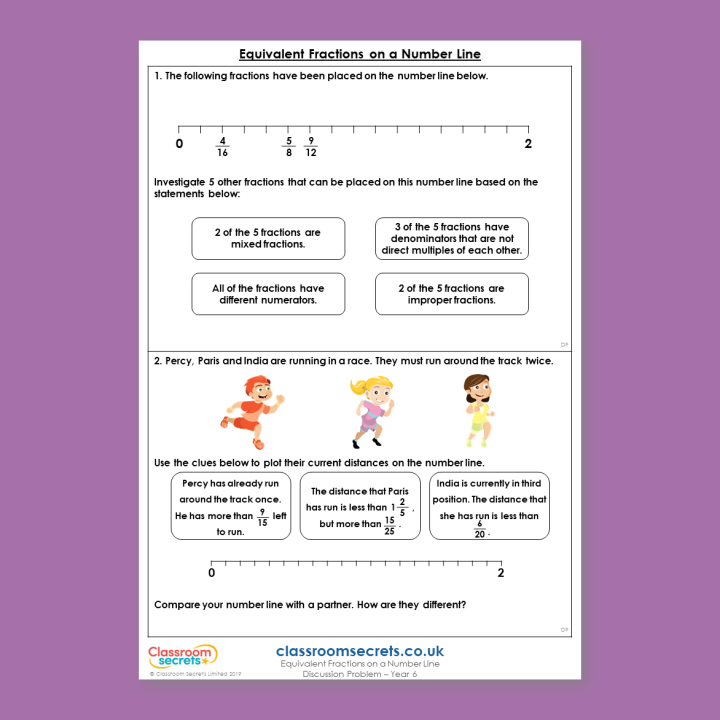
Deeper Reasoning
The questions in this set focus on problem solving with equivalent fractions and number lines to deepen understanding in using common factors to simplify fractions and placing them on a number line.