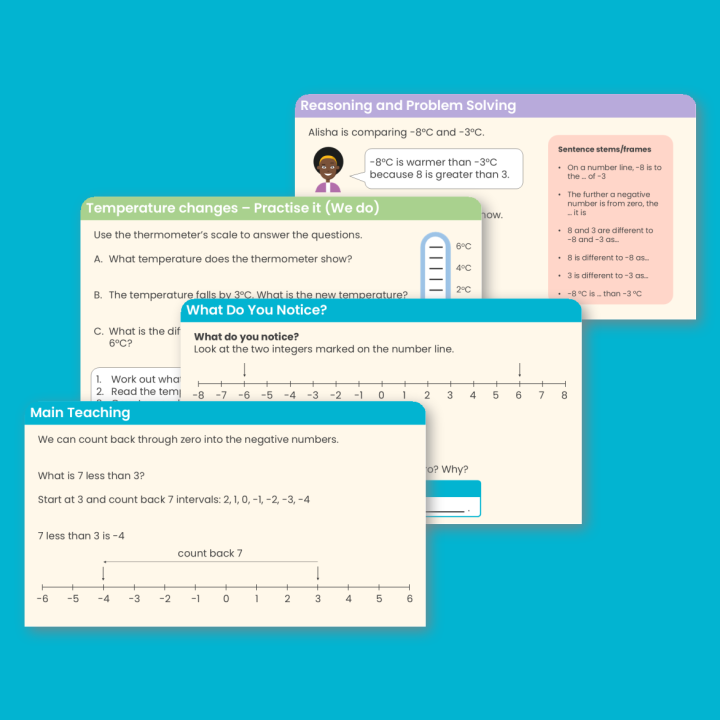
The Year 6 Negative Numbers PowerPoint guides both teachers and children through the lesson, including use of the varied fluency, reasoning and problem solving, deeper reasoning and scaffolded resources. Key learning information about this step:
Key Vocabulary
integers: Whole numbers that can be positive, negative or zero.
negative numbers: Numbers less than zero. They can be represented on either a horizontal or vertical number line. A negative number is written with a negative symbol in front of it. For example: -4
number lines: A horizontal or vertical line that has numbers placed at equal points. Number lines can be used to show either positive or negative numbers. Most number lines begin at 0.
finding the difference: Involves finding how far apart two given numbers are.
Varied Fluency
Knowledge Organiser
• Designed to support all children via key information and examples.
Scaffolded Examples
• Number lines and sentence stems to count forwards and backwards across zero, and to find a difference across zero.
Support
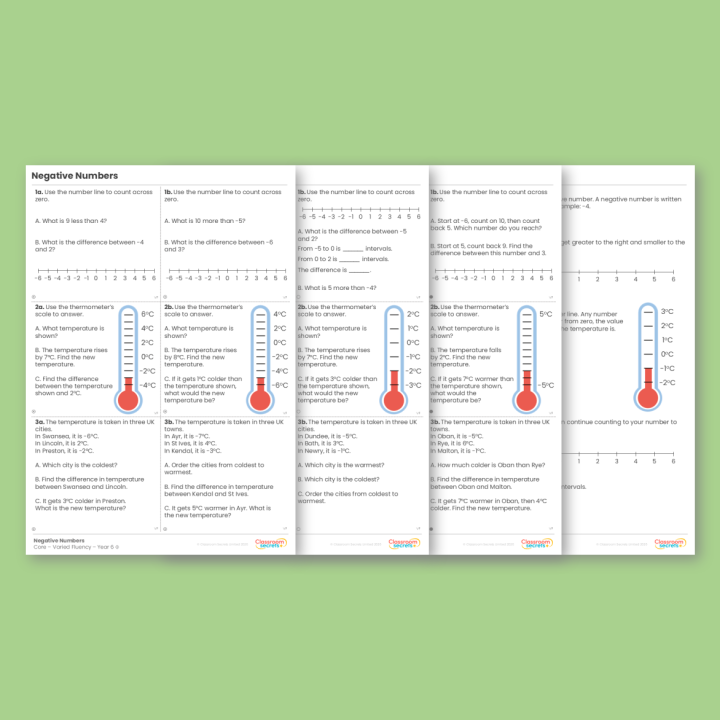
• Q1: Count forwards or backwards through zero. Sentence stems to support.
• Q2: Read a thermometer scale to answer questions. Intervals increase by one; Each interval labelled.
• Q3: Compare and order three temperatures.
Core
• Q1: Count forwards or backwards through zero.
• Q2: Read a thermometer scale to answer questions. Intervals increase by one; every other interval labelled.
• Q3: Compare, order and find the difference between three temperatures.
Stretch
• Q1: Count forwards and backwards through zero (two-step).
• Q2: Read a thermometer scale to answer questions. Start and end increments labelled.
• Q3: Compare, order and find the difference between three temperatures. Some two-step questions.
Reasoning and Problem Solving
Support
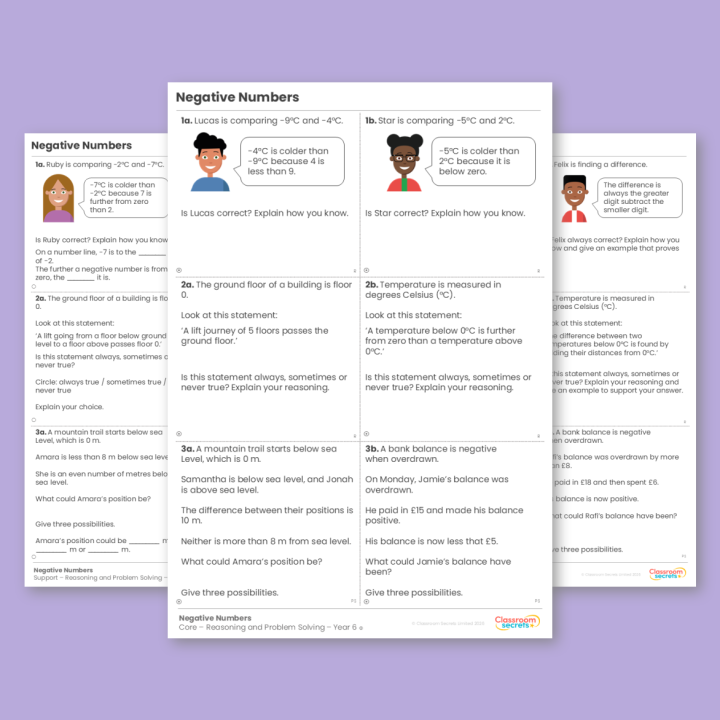
• Q1: Reasoning - judge whether a character has compared two negative temperatures correctly. Sentence stems to structure the explanation.
• Q2: Reasoning - decide whether a statement about building floors and about temperature, is always, sometimes or never true. Options given.
• Q3: Problem Solving - find a height below sea level within a limit, and balances before and after a payment. Answer frames provided.
Core
• Q1: Reasoning - judge whether a character has compared temperatures correctly.
• Q2: Reasoning - decide whether statements about building floors and about temperature are always, sometimes or never true; both are sometimes true, so a case and a counter-case are needed.
• Q3: Problem Solving - find two heights either side of sea level from a given difference, and a starting balance after one payment.
Stretch
• Q1: Reasoning - test a general rule about comparing temperatures and find a counter-example that shows that it fails.
• Q2: Reasoning - decide whether statements about building floors and about temperature are always, sometimes or never true; both are never true, so the hidden error must be explained with an example.
• Q3: Problem Solving - find two heights from a difference and a relational condition, and a starting balance after two transactions.
Deeper Reasoning
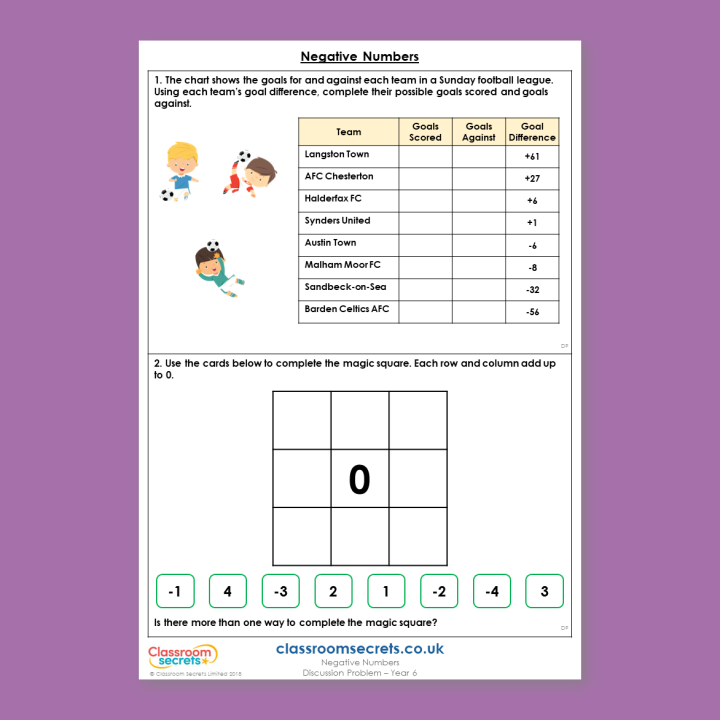
The questions in this set focus on using negative numbers in context to deepen understanding in using negative numbers in context, and calculating intervals across zero.