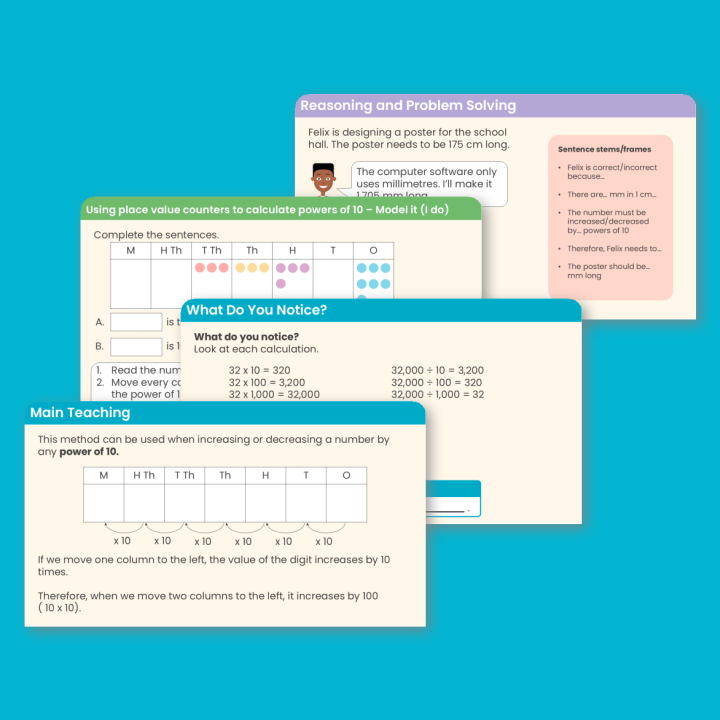
The Year 6 Powers of 10 PowerPoint guides both teachers and children through the lesson, including use of the varied fluency, reasoning and problem solving, deeper reasoning and scaffolded resources. Key learning information about this step:
Key Vocabulary
place value counters: A physical resource that represent numbers. They are usually in different colours and have different numbers written on them to represent ‘ones’, ‘tens’, ‘hundreds’, etc. They can also represent decimal numbers.
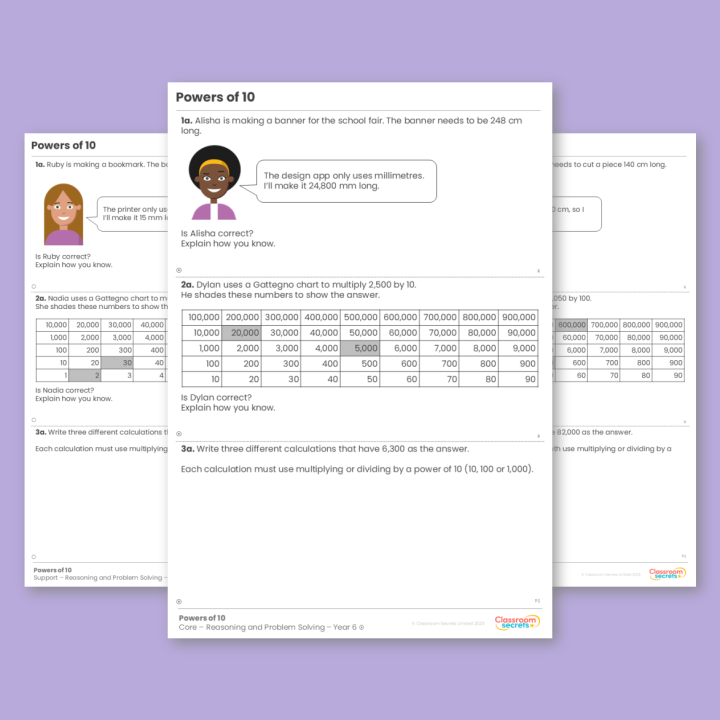
Gattegno chart: A type of place value chart designed to help us recognise the patterns in the way that we count and the structure of our numbers.
powers of 10: When ten is multiplied by itself a certain number of times (when the power is a positive integer). For example: 10,000 means 10 x 10 x 10 x 10 (10 to the power of 4).
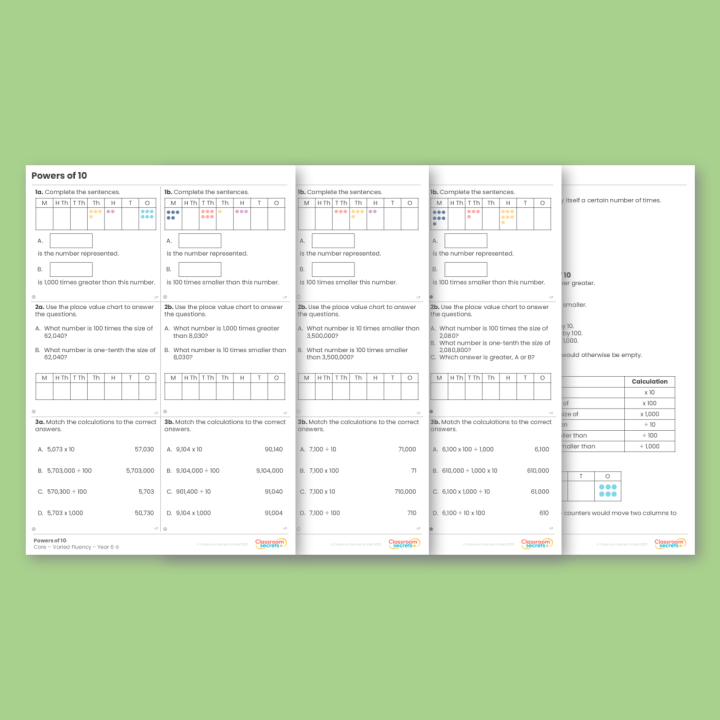
Varied Fluency
Knowledge Organiser
• Designed to support all children via key information and examples.
Scaffolded Examples
• Multiplying and dividing by 10 using place value counters.
Support
• Q1: Write the number shown on the place value chart with counters. No placeholders used between digits.
• Q2: Use a place value chart to multiply and divide by 10, 100 and 1,000. No placeholders used between digits.
• Q3: Match four calculations to answers. No placeholders used between digits.
Core
• Q1: Write the number shown on the place value chart with counters. One placeholder used between digits.
• Q2: Use a place value chart to multiply and divide by 10, 100 and 1,000. One placeholder used between digits.
• Q3: Match four calculations to answers. One placeholder used between digits.
Stretch
• Q1: Write the number shown on the place value chart with counters. Multiple placeholders used.
• Q2: Use a place value chart to multiply and divide by 10, 100 and 1,000. Multiple placeholders used; compare answers.
• Q3: Match four two-step calculations to answers.
Reasoning and Problem Solving
Support
• Q1: Reasoning - explain whether a length conversion using powers of 10 is correct, using familiar conversions.
• Q2: Reasoning - explain whether a Gattegno chart has been used correctly to multiply by 10.
• Q3: Problem Solving - write three calculations using powers of 10 with a given answer that is a multiple of 1,000.
Core
• Q1: Reasoning - explain whether a length conversion using powers of 10 is correct.
• Q2: Reasoning - explain whether a Gattegno chart has been used correctly to multiply or divide.
• Q3: Problem Solving - write three calculations using powers of 10 with a given answer.
Stretch
• Q1: Reasoning - explain whether a comparison of two lengths in different units is correct.
• Q2: Reasoning - explain whether a Gattegno chart has been used correctly for a two-place move.
• Q3: Problem Solving - write three two-step calculations using powers of 10 with a given answer.
Deeper Reasoning
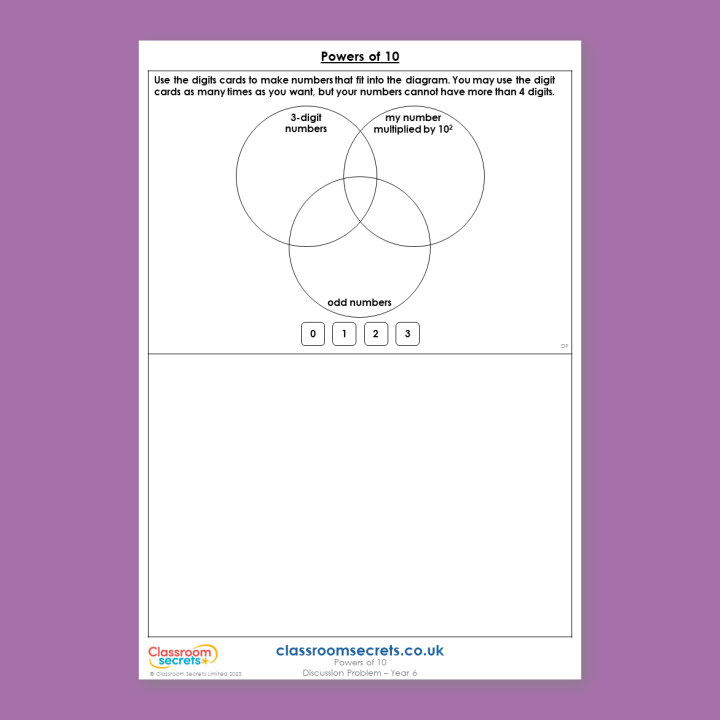
creating numbers and powers of 10 that will fit into a Venn diagram to deepen understanding in identifying integers that are 10, 100 or 1,000 times smaller or greater than other integers.