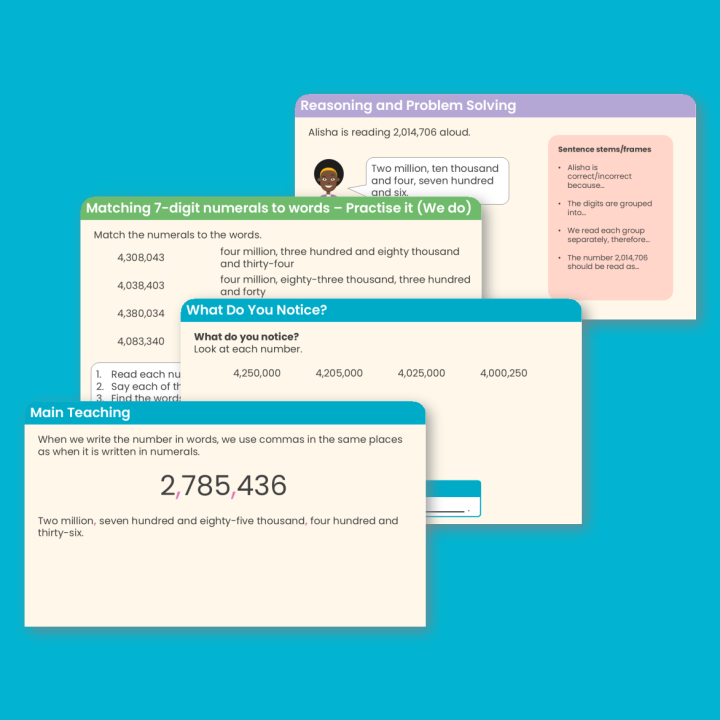
The Year 6 Read and Write Numbers to 10,000,000 PowerPoint guides both teachers and children through the lesson, including use of the varied fluency, reasoning and problem solving, deeper reasoning and scaffolded resources. Key learning information about this step:
Key Vocabulary
partitioning: The splitting of a number into different parts. For example: the number 547 can be partitioned into 500, 40 and 7.
placeholder: 0 is used to hold a place in a number and maintain its place value.
part-whole model: A representation showing the whole number and the parts it has been split into.
representation: A number that has been shown in different ways. For example: in numerals, words or using equipment such as Base 10 or a place value chart.
Gattegno chart: A type of place value chart designed to recognise the patterns in the way that we count and our number structure.
Varied Fluency
Knowledge Organiser
• Designed to support all children via key information and examples.
Scaffolded Examples
• A worked example reading a 7-digit numeral in groups to write it in words, a version to complete, and a place value chart for writing words as numerals.
Support
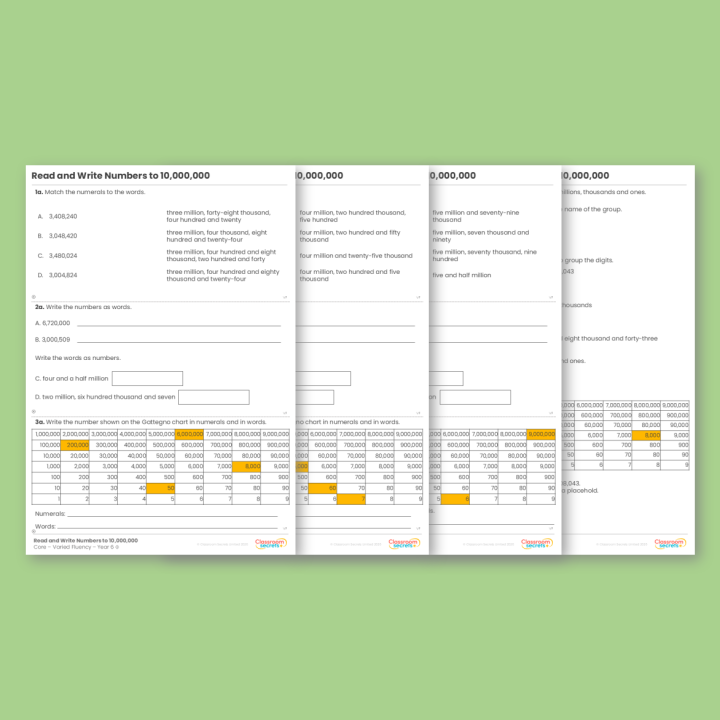
• Q1: Match numerals to word forms. All numbers are multiples of 100.
• Q2: Write numerals in words and words as numerals. Whole thousands only.
• Q3: Read a Gattegno chart with every row highlighted.
Core
• Q1: Match numerals to word forms; the same digits rearranged.
• Q2: Write numerals in words and words as numerals. Includes half a million.
• Q3: Read a Gattegno chart. Unhighlighted rows are placeholders.
Stretch
• Q1: Match numerals to word forms. One number is a fraction of a million.
• Q2: Write numerals in words and words as numerals. Fractions of a million and subtraction of powers of 10 involved.
• Q3: Read a Gattegno chart, then write 10,000 less in words or 10,000 more in numerals.
Reasoning and Problem Solving
Support
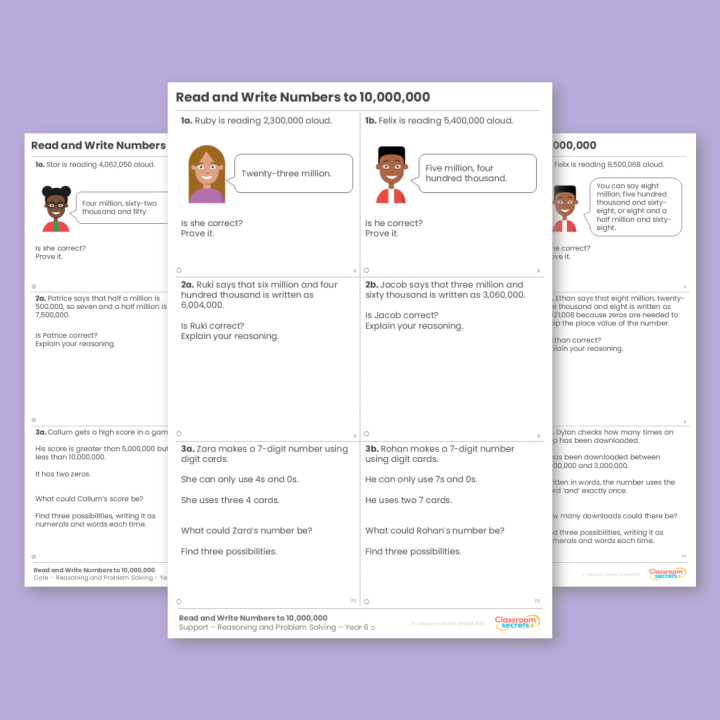
• Q1: Reasoning - decide whether a 7-digit number has been read aloud correctly. Millions and thousands groups read aloud only.
• Q2: Reasoning - decide whether a number given in words matches its numeral. Millions and thousands groups read aloud only.
• Q3: Problem Solving - make 7-digit numbers with two parameters. Any 7-digit number can be given.
Core
• Q1: Reasoning - decide whether a 7-digit number has been read aloud correctly. Millions, thousands and ones groups read aloud.
• Q2: Reasoning - decide whether a number given in words matches its numeral. Millions, thousands and ones groups read aloud; half a million used.
• Q3: Problem Solving - make 7-digit numbers with two parameters. Number must be within a certain range.
Stretch
• Q1: Reasoning - decide whether a 7-digit number has been read aloud correctly. Numbers used that can be said in more than one way, for example ‘half a million’.
• Q2: Reasoning - decide whether a number given in words matches its numeral. Requires knowledge of correct use of placeholders to keep place value.
• Q3: Problem Solving - make 7-digit numbers with two parameters. Number must use the word ‘and’ exactly once when said aloud or written in words.
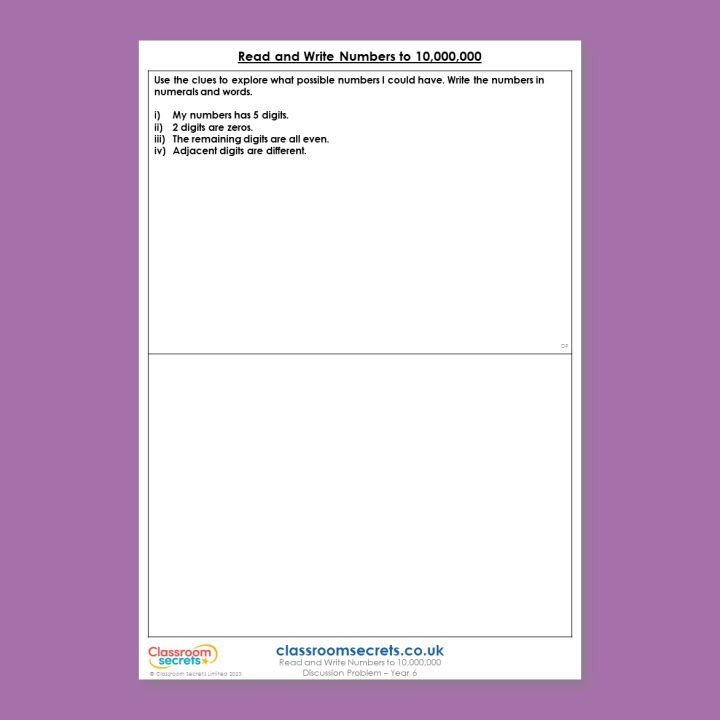
Deeper Reasoning
writing different numbers in numerals and words to deepen understanding in reading and writing numbers to 10,000,000 in words.