FREE
x1
x1
![An image of the [object Object] Resource](https://d52m8jhkbaeog.cloudfront.net/featured-images-lq/2ade1b0db270cc3795ae4a48daa0bb6409fd8ae8/2ade1b0db270cc3795ae4a48daa0bb6409fd8ae8.webp)
Select a tag to view relevant resources
Adaptive Reading Resources
Year 4 Adaptive Reading Practice Following the Fox (Working Towards Pack 1) pack is designed to help you deliver a full sequence of reading sessions built around a single short text, in small steps before pupils move on to independent comprehension work. The pack helps you cover pre-teaching, fluency, sequencing and comprehension in one place, prompting moments to assess understanding, address misconceptions and move children onto independent tasks.
Each pack has been carefully designed, along with core materials and supporting materials, to help you guide children on their own journey and ensure progress for every child, not just the average child. A different year group specific theme is used as a setting, and these can be found in our adaptive reading resources here.
An on-screen PowerPoint version of the pack is also available as part of the download. This can be used alongside the worksheets for in-class group, whole-class discussion or to reduce printing.
Following the Fox uses the Year 4 theme of habitats. The story follows Leo, who has noticed a fox slipping into his garden at dusk most evenings, always pausing by the same gap in the fence before disappearing. One evening, curious enough to finally follow, he slips through the gap after it and finds himself in the woods as the light fades. He tracks the fox to a hollow log, and just as he crouches down and reaches for something small and shiny tucked underneath it, a twig snaps somewhere behind him. The fox bolts, and Leo is left crouched in the dark, heart pounding, with no idea what — or who — made the sound.
It's a short, tightly-built suspense piece: a single setting, one central mystery object, and a deliberately unresolved ending that leaves the reader to infer what happens next.
Each pack follows this structure:
Core Materials
• The Text - Following the Fox, used with the dictogloss and as a reference point throughout the pack. Includes key Year 3 and Year 4 words (often, disappear, notice, strange, surprise) and spelling rules (dis- words and un- words) for further GPS opportunities. The text is linked to the science topic of habitats.
• Image - Children discuss a scene from the text and answer two questions to encourage retrieval and inference.
• Dictogloss - The teacher models reading the text (or a section) two or three times before children first read it themselves, reducing cognitive load. Children make notes, then work together to reconstruct the text.
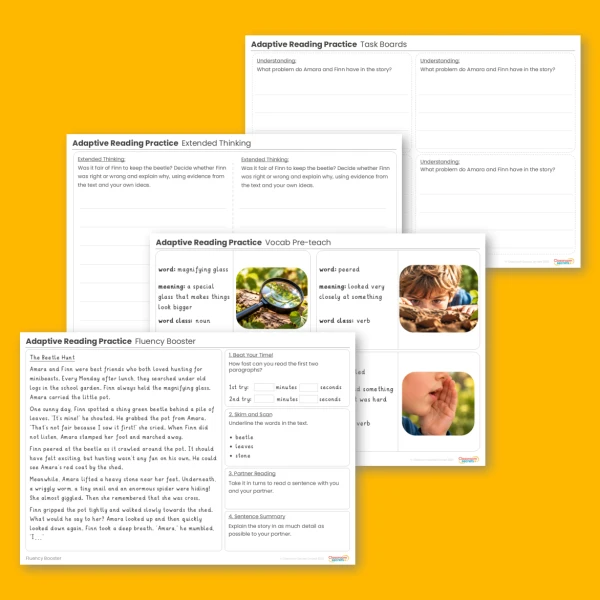
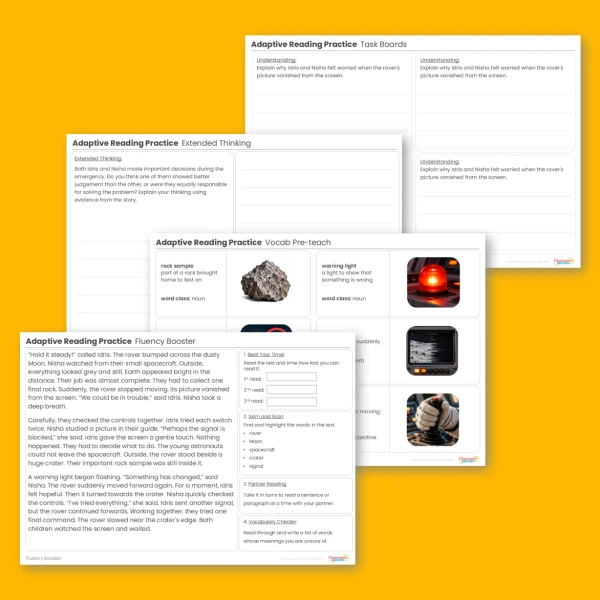
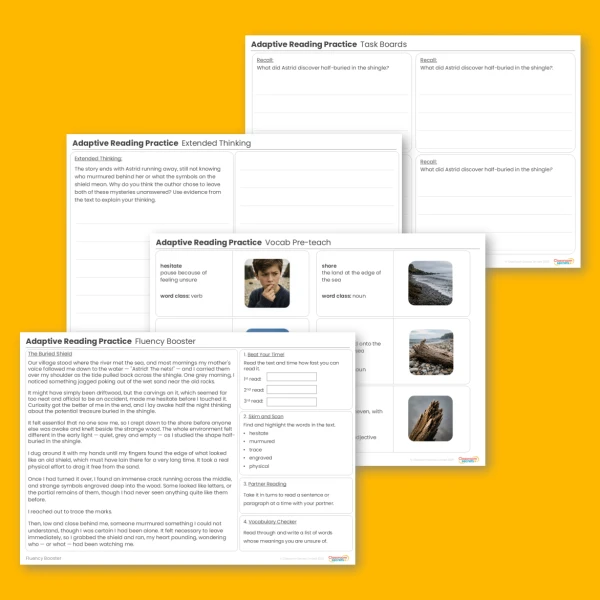
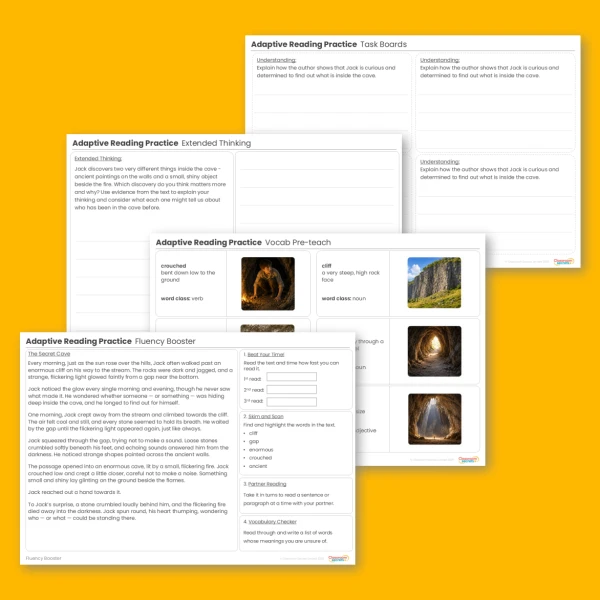
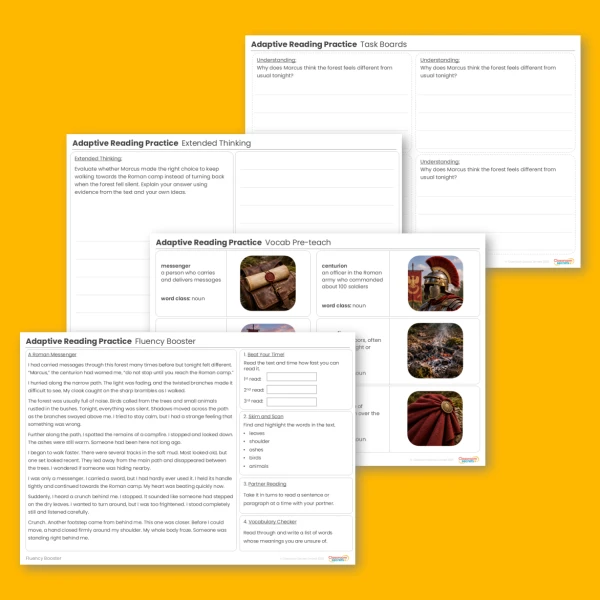
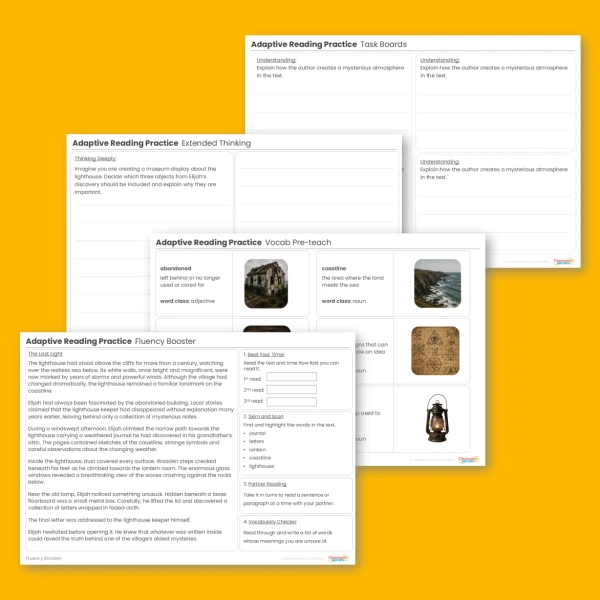
• Fluency Booster - A copy of the text alongside four activities: Beat Your Time, Skim and Scan, Vocab Checker and Partner Read, which can be repeated as needed.
• Comprehension - Retrieval, inference, vocabulary, prediction, effect of language and summary questions, with scaffolds included in the PowerPoint to support adaptive teaching.
Supporting Materials (used adaptively, individually or as a whole class)
• Vocab Pre-teach - Key vocabulary with images to encourage children to ask questions and make predictions about the story, using six words: crouched, fence, bushy, gap, rustled and hollow.
• Sequencing - A set of three activities (a story mountain, ordering the text and creating the order) for children who require more sequencing practice.
• Task Boards - Tasks based on recall, explaining and justifying. Use as an assessment tool. Tasks are repeated across the sheets for printing purposes. Cut 1 task out per child. Children are not expected to (but can) complete all three questions.
• Extended Thinking - A challenge to develop evaluation skills, asking children to use clues from the text to explain which person they agree with.
Our Adaptive Reading Practice resources provide targeted, responsive support so that every child can access the same reading material at the right level of challenge. They work best used together across a number of sessions throughout the week, rather than in a single lesson.
• Start with discussing the image then complete the dictogloss activity using the teacher model read of the text.
• If required, introduce key vocabulary using the pre-teach before the children encounter the text.
• Use the fluency booster and if adaptive teaching is needed, provide the sequencing / task boards to provide extra support before moving on.
• Children will then move on to the comprehension activity to access the retrieval, inference, vocabulary, prediction, effect of language and summary questions.
• Challenge children using the Extended Thinking task to provide further stretch and depth.
Packs provide as many reading opportunities as possible, and teachers should use discretion over which resources are necessary for their class before printing.
The stories use topics that are common across schools as a setting or story element. This keeps reading skills as the main focus while helping children make links to previous or current learning.
Each year will have 5x Working Towards, 10x Expected and 3x Greater Depth packs, progressing across the year alongside vocabulary, statutory spellings and spelling rules. Start with the five Working Towards texts in autumn – pack 1, pack 2 etc. – and then move to expected when your class is ready.
Adaptive Reading Practice resources are not a separate lower-attainment route. They provide temporary and responsive support to help pupils access the same intended learning.
Select a tag to view relevant resources
Adaptive Reading Resources