Recently updated
x1
![An image of the [object Object] Resource](https://d52m8jhkbaeog.cloudfront.net/featured-images-lq/d30f57dad3b4cf2b03e660c9e7629abc36451bdb/d30f57dad3b4cf2b03e660c9e7629abc36451bdb.webp)
Select a tag to view relevant resources
Autumn
5C5a
Adaptive Teaching
Multiplication and Division A
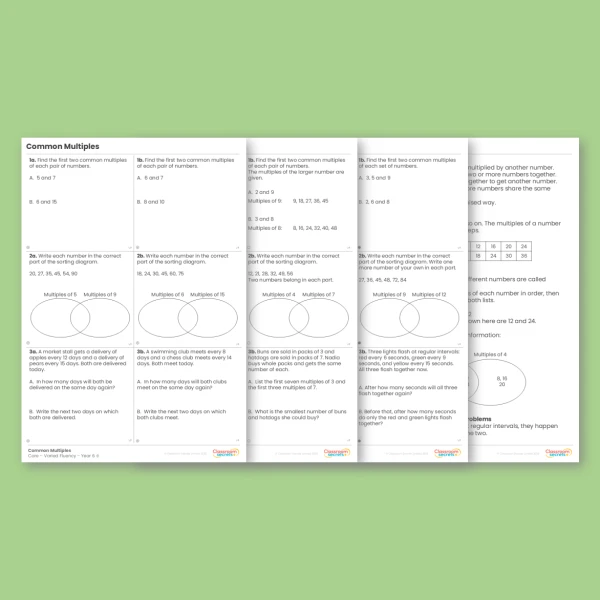
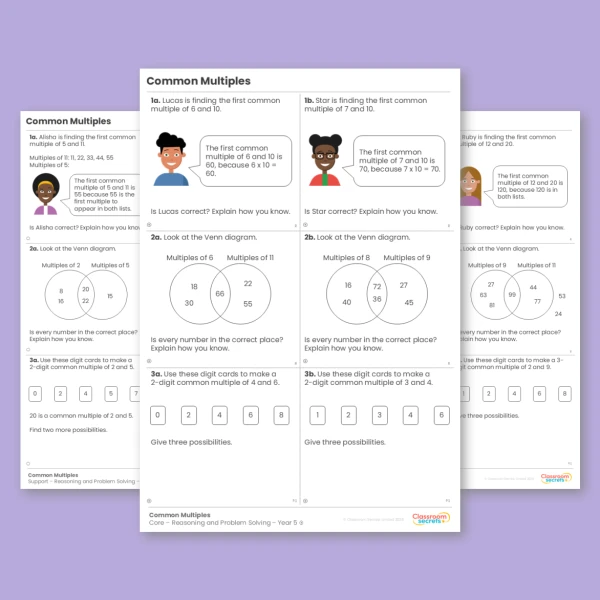
Year 5 Common Multiples Varied Fluency is a set of worksheets during the Try it/You do section of your maths lesson. Each set has been carefully designed to help you meet each child where they are at to ensure progress for every child, not just the average child. The content includes a knowledge organiser for Common Multiples and 4 levelled worksheets covering identifying common multiples and solving problems involving multiplication and division, including using their knowledge of multiples.
• Designed to support all children via key information and examples.
• Listing multiples on number tracks; sorting numbers into a Venn diagram.
• Q1: Find the first two common multiples of a pair of numbers up to 12. One number is a multiple of the other; first five multiples of both numbers already given.
• Q2: Sort multiples into a Venn diagram. Hint given about placement of numbers; middle of diagram labelled.
• Q3: Solve repeating-event problems within known times tables. Some multiples given.
• Q1: Find the first two common multiples of a pair of numbers up to 12 on blank tracks.
• Q2: Sort multiples into a Venn diagram.
• Q3: Solve repeating-event problems with common multiples. Multiples to be listed on a number track.
• Q1: Find the first two common multiples, counting in 12s, 15s, 16s and 25s.
• Q2: Sort multiples into a Venn diagram. Add one more multiple to each diagram section.
• Q3: Solve repeating-event problems with common multiples involving time. Times of new events must be calculated; multiples go beyond known facts.
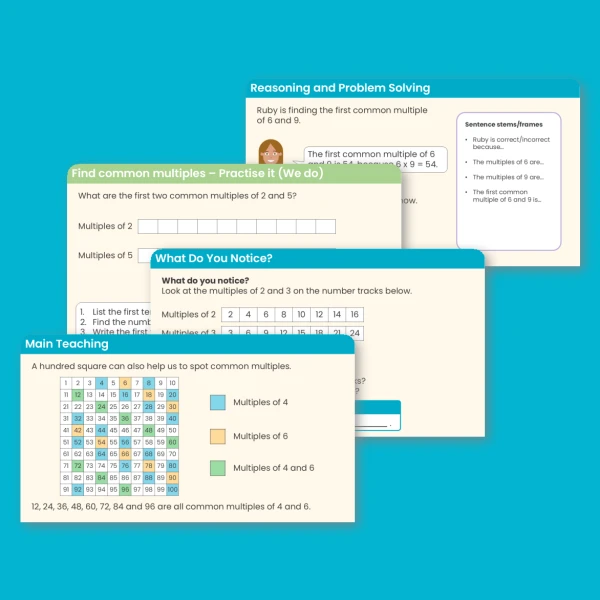
Our varied fluency resources are not just about differentiation, but differentiation in an adaptive way. They work best alongside our teaching PowerPoints, which walk you through the whole lesson along with other lesson resources that you can find on our Common Multiples lesson page.
• After completing the main teaching of the Teaching PowerPoint (PPT), teachers assess whether children are ready to access their Varied Fluency worksheet or require support from the Scaffolded Examples sheet, based on how they have performed during the Model it (I do) / Practise it (We do) / Try it (You do) sequence.
• If any children need additional support, they can use the Scaffolded Examples sheet. This gives children the opportunity to secure key skills required for the Varied Fluency worksheet before they move on to it. The Scaffolded Examples sheet is designed to be completed as a group with a classroom adult.
• If children do not need the Scaffolded Examples, they can progress straight to a Varied Fluency worksheet suited to their level of understanding.
• Most children will use the Core sheet for their Varied Fluency practice.
• Some children may need the Support sheet. This is designed to be used after the Scaffolded Examples sheet, but some children might access this sheet without having used that scaffold.
• Some children may need additional challenge; the Stretch sheet will deepen their understanding of the core content.
Adaptive Maths Resources are not a separate lower-attainment route. They provide temporary and responsive support to help pupils access the same intended learning.
This resource is designed to align to White Rose Maths version 3. Classroom Secrets Limited is not affiliated with, endorsed by, or in any way connected to White Rose Education Limited. Our products are original to Classroom Secrets Limited and any reference to White Rose Maths is solely for the purpose of indicating compatibility and does not imply any association with White Rose Education.
Select a tag to view relevant resources
Autumn
5C5a
Adaptive Teaching
Multiplication and Division A