Should We Still Use Developing, Expected and Greater Depth in Primary Maths?
24th August 2026
Written by Lee Peckover
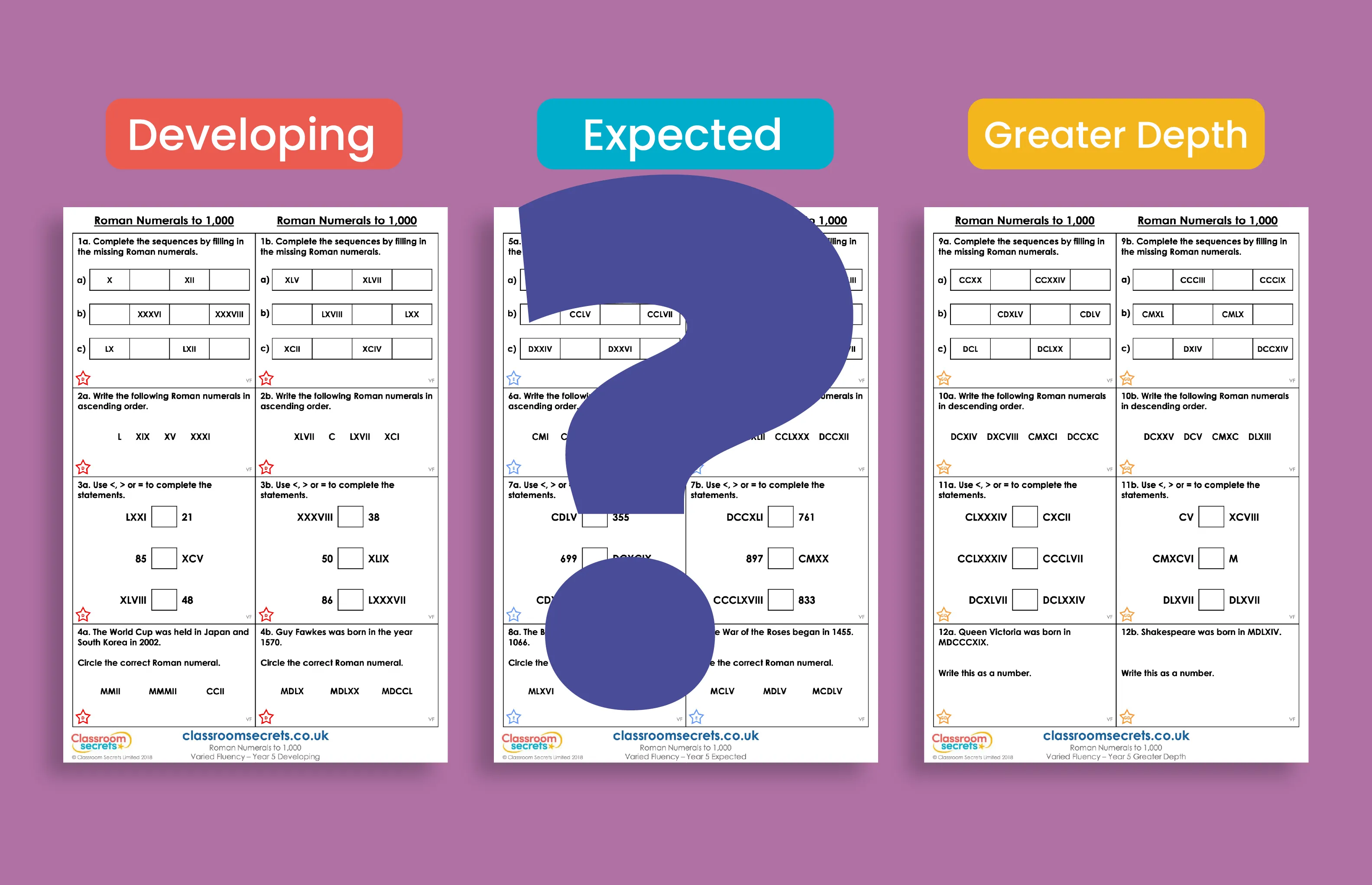
They are useful words, but there’s more than three types of child
Developing, Expected and Greater Depth are deeply familiar in primary schools.
They have been used in assessment conversations, planning documents and on teaching resources for years. They were on ours too.
There was a logic to it. Developing sounded like more support. Expected sounded like the main task. Greater Depth sounded like the harder one.
Simple enough.
The problem came when those labels stopped being shorthand and started acting like a pathway through the lesson.
The Developing children sit over there. The Greater Depth group sits over there. This table gets that sheet. That table gets the other one.
And before long, the label is deciding what maths a child gets to do.
A broad attainment label cannot tell you exactly what a child needs in every lesson. It cannot tell you whether they understand today’s concept, whether they have a gap in a prerequisite skill or whether they are ready for more challenge in this particular small step.
That is why we no longer think these labels are the right way to organise day-to-day maths work.
What is actually official?
This is where things get a bit muddy.
“Developing” is familiar language, but it is not the formal term used in the current optional KS1 teacher assessment framework for maths.
At Key Stage 1, where schools choose to use the optional framework, the standards are:
working towards the expected standard
working at the expected standard
working at greater depth
(Standards and Testing Agency [STA], 2025)
“Working Towards” is the more official phrase. But that does not make it a level of worksheet. It is still an assessment judgement.
At Key Stage 2, the picture is different again. Maths is reported through the national tests, with pupils meeting the expected standard or, in national reporting, the higher standard. There is no statutory KS2 maths teacher-assessment framework that places pupils into Working Towards, Expected and Greater Depth categories in the way many schools have become used to talking about them (STA, 2026a, 2026b).
So, if a school is routinely grouping children in KS2 maths as Developing, Expected and Greater Depth, that is a school or publisher habit, not a national requirement. That distinction matters more than people sometimes realise.
What is official:
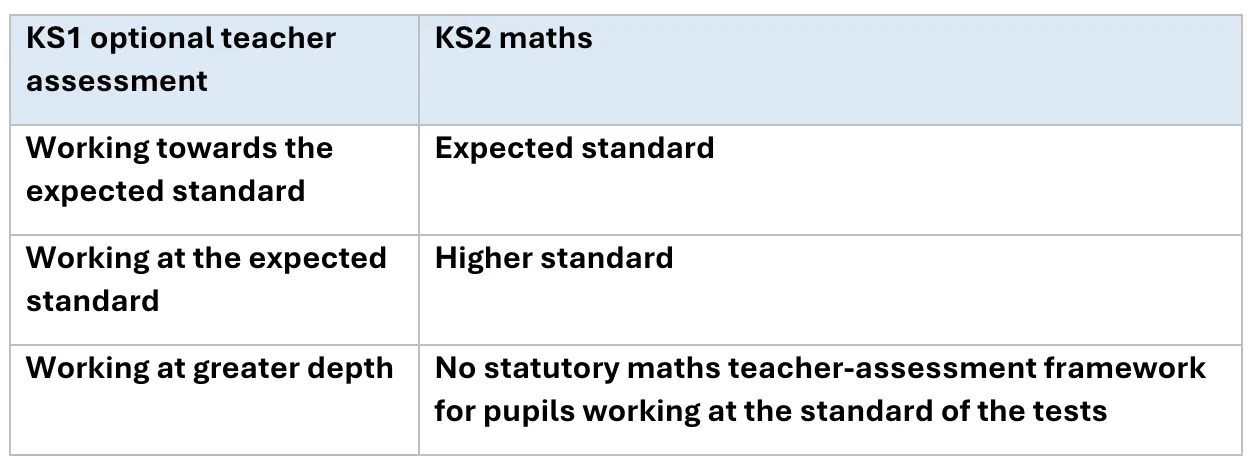
These, as stated, are about assessment and attainment. The issue is not the words themselves.
Schools need language for discussing attainment and they need to talk about who is broadly secure, who is not there yet, and who is working beyond the expected standard. That is all fine. What is less fine, is when those assessment words get turned into teaching groups or worksheet levels.
A child who is generally working towards the expected standard may be completely secure in the maths being taught today. A child who usually attains highly may need much more support with a new concept. A broad label is too blunt to do the teacher’s thinking for them.
The National Curriculum itself points in a different direction. It says that the majority of pupils should move through the programmes of study at broadly the same pace, while decisions about progression should come from secure understanding. Children who grasp things rapidly should be challenged through rich and sophisticated problems rather than simply being pushed on, while pupils who are not yet fluent should consolidate before moving on (Department for Education [DfE], 2014).
That is not a picture of three fixed pathways.
Ofsted’s 2023 mathematics subject report is even more direct. It describes a move away from the once common use of “3 levels of differentiation”, where pupils were assigned, or chose, tasks at different levels (Ofsted, 2023).
One concern was that some children repeatedly ended up on the more basic work while others were the ones who reached reasoning and problem solving. If that happens often enough, the grouping is no longer just responding to differences. It is helping to create them.
That is why simply changing “Developing” to “Working Towards” does not really solve anything. If the same children are still routinely sent towards the lower-level task, the label has changed but the model has not.
So, should schools still use these terms?
Yes, but for the right job. They are useful as assessment language. They are much less useful as lesson-planning language.
If you are discussing a broad picture of attainment, “working towards the expected standard” has a clear purpose. If you are writing a report, moderating judgements or looking at end-of-key-stage outcomes, these labels can be helpful.
What they are not good at is deciding in advance what worksheet a child should receive in today’s maths lesson. That decision should come from what the child knows and needs now.
Sometimes that will mean more support. Sometimes it will mean a less demanding task for a while, so a missing piece of knowledge can be secured. Sometimes it will mean more challenge.
The point is that the response should come from the mathematics in front of the teacher, not from a label attached to the child.
What this looks like in Classroom Secrets Maths
This is exactly why we changed the way we organise our own maths resources.
Instead of Developing, Expected and Greater Depth, our new maths lessons use Support, Core and Stretch. It works like this:
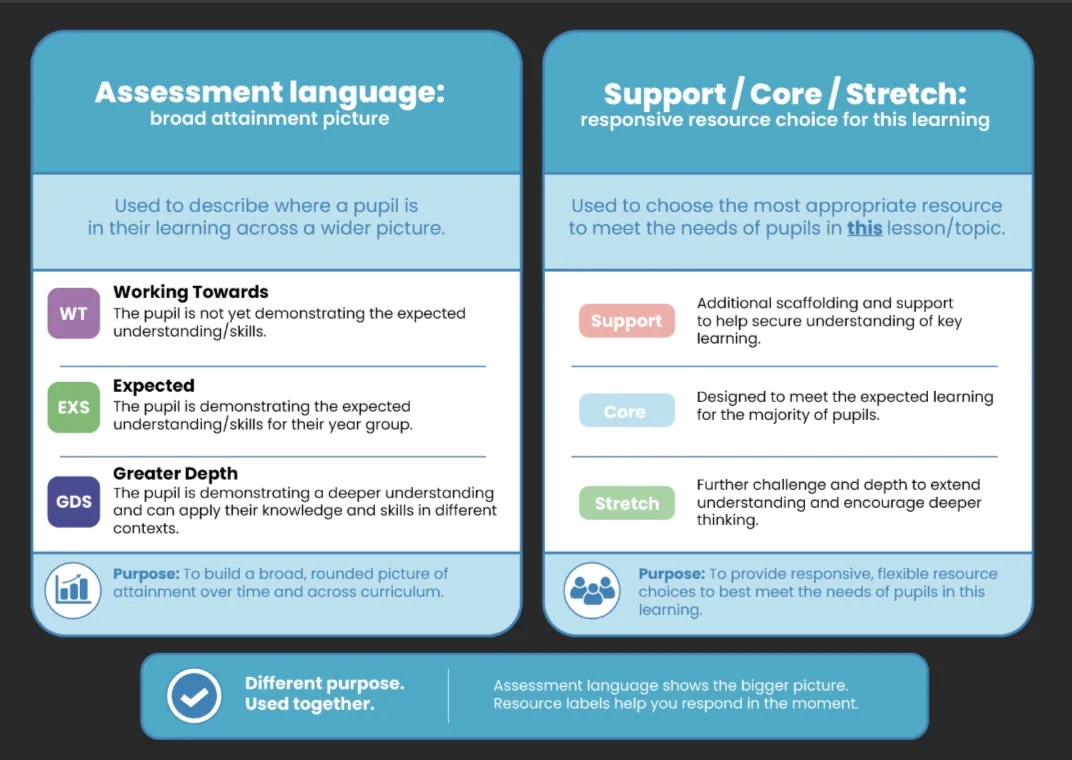
That is not just a rebrand.
Support, Core and Stretch describe the resource, not the child.
For most children, Core is the main route through the learning.
If a child needs more help, the teacher can use Support, Scaffolded Examples or the Knowledge Organiser. Sometimes that support will reduce the demand temporarily so the child can secure what they need and then move back into the main learning.
Stretch is there when the important knowledge is secure and a child is ready for greater complexity.
The same child might need Support in one lesson, Core in the next, and Stretch somewhere else entirely. They might even need one of our support resources as well as the core one.
That is how it should be.
We do not want a “Support child” any more than we wanted a “Developing child”.
References
Department for Education. (2014). Mathematics programmes of study: Key stages 1 and 2.
Ofsted. (2023). Coordinating mathematical success: The mathematics subject report.
Standards and Testing Agency. (2025). Optional key stage 1 teacher assessment guidance 2026.
Standards and Testing Agency. (2026a). Key stage 2 teacher assessment guidance.
Standards and Testing Agency. (2026b). Assessment results at the end of key stage 2: Information for parents.
Try us today!