Neuromyths (Part 2): Multiple Intelligences, the 10% Brain Myth and the Mozart Effect
2nd November 2026
Written by Lee Peckover
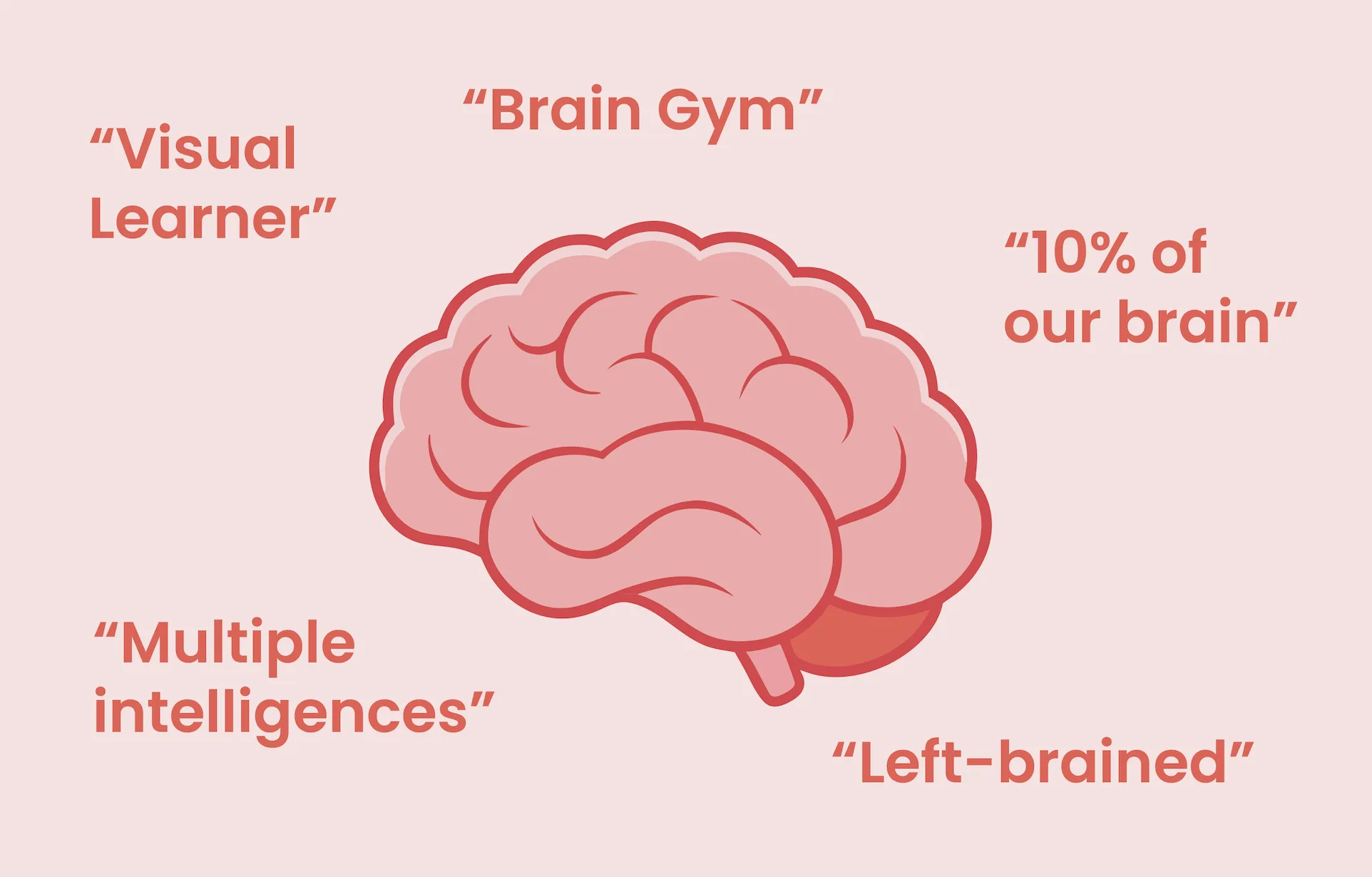
Welcome to part two of our little series investigating neuromyths, pseudoscience and some of the more questionable ideas that have found their way into education.
In part one, we looked at VAK learning styles, left-brained and right-brained learners, and Brain Gym. A few people have since raised questions about some of the other ideas we mentioned, particularly Howard Gardner's theory of multiple intelligences.
So, this time we're going to spend a little longer on the one main idea, then, once we navigate our way back out of that particular rabbit hole, we'll serve up a swift roundhouse kick to a couple of much easier old favourites. Namely: the suggestion that we only use 10% of our brains and the idea that listening to Mozart makes us more intelligent.
Let's start with the complicated one though, shall we?
Are multiple intelligences actually a myth?
Howard Gardner first introduced his theory of multiple intelligences in 1983, challenging traditional ways of thinking about intelligence.
The theory proposed that human intelligence could be understood through several different capacities. These included linguistic, logical-mathematical, musical, spatial, bodily-kinaesthetic, interpersonal and intrapersonal intelligence. Naturalistic intelligence was added later.
This is quite different to VAK styles, even if a couple of bits sound like they might overlap. It is also distinct from IQ, despite some overlaps there, too. Much like with VAK learning styles, it's easy to see why the idea caught on.
If you've taught in a primary classroom, you might well have known children whose abilities aren't particularly well reflected in their English and maths books, but they shine elsewhere.
I remember one child I taught who really struggled to get their ideas down in writing, but give them a complicated piece of music to try to learn and play and they’d have it down in minutes. Children have different strengths and weaknesses; this much is pretty straightforward. But do those differences actually reflect the separate kinds of intelligence? This idea is the one Gardner proposed.
Gardner also raised some reasonable questions about the way intelligence had traditionally been measured, particularly the emphasis placed on linguistic and logical-mathematical abilities. This really is where the overlaps in elements of IQ are pushed away by his concept of multiple intelligences. I have quite a lot of sympathy with the broader educational concern. We should value children's abilities across a much wider range of activities than those traditionally associated with academic attainment. I also have my own fairly strong opinions on the relevance of IQ, and, in fact, how much EQ might be of more importance, but that is for another time.
Back to Gardner’s theory. This goes further than recognising that people are good at different things. Gardner proposes that these abilities actually reflect relatively autonomous forms of intelligence, grounded in distinct cognitive processes.
And that's where we shall begin to look a little more carefully at the evidence…
First, what did Gardner actually claim?
One problem with multiple intelligences is that the theory has taken on something of a life of its own. What many have encountered of it is often an exaggerated version of the original theory, or, at times, the theory taken to what seems like logical conclusions, but ones that the evidence doesn’t really allow for one to draw.
Over the years, it has been used to justify questionnaires, intelligence profiles, classroom displays and lesson-planning approaches. Some of these have very little connection to what Gardner himself proposed.
In a 2006 paper responding to criticism from researcher Lynn Waterhouse, Gardner and Seana Moran explained that the proposed intelligences are relatively independent but also interact. They were never intended to describe eight completely isolated sections of the brain (Gardner & Moran, 2006).
Gardner also made clear that he had not developed a prescribed teaching method based on the theory. His educational suggestions included recognising individual capabilities and approaching important ideas through different activities and representations. He has even expressed concerns about assigning children simplistic intelligence labels. So, if you’ve ever seen or heard it being taken to the point of assigning labels, it was almost certainly being stretched beyond any evidential realities.
If you’ve ever seen a questionnaire to determine which of the eight intelligences you possess, you shouldn't automatically assume Gardner would approve.
It's also worth remembering something we discussed earlier: multiple intelligences and learning styles are different theories.
Gardner has made this point himself. It would be unfair to dismiss multiple intelligences simply because the evidence for VAK learning styles is so poor.
What does psychology tell us about different intelligences?
There are a lot more positives than there are for VAK learning styles. In fact, there’s plenty of evidence that people have different cognitive abilities and research showing that performance across many cognitive tasks tends to be positively correlated.
Research suggests that our cognitive abilities aren't as separate as Gardner's theory might seem to imply. People who perform well on one type of cognitive test tend, on average, to perform well on others too. Psychologists have long studied this relationship, identifying a common factor known as general intelligence, or g.
This doesn't mean that everyone is equally capable at everything, but it does challenge the idea that our abilities can be divided into relatively independent forms of intelligence.
In 2006, Visser and colleagues investigated Gardner's theory using 16 tests designed to examine his eight proposed intelligence domains. They tested 200 adults and found that many of the cognitive measures were substantially related to a general intelligence factor, although some additional domain-specific variation was present (Visser et al., 2006).
These findings present a problem for the idea that the proposed intelligences operate with a high degree of independence. As always in psychology/cog-sci land though, it wasn’t quite as clean-cut as this might imply. Gardner challenged the validity of some of the tests used, arguing that conventional assessment approaches may favour particular abilities and fail to capture how intelligence operates in more natural settings.
And, to be fair, that's a pretty reasonable methodological criticism to investigate. If you want to measure somebody's musical ability, for example, you'd want an assessment that genuinely captures the abilities you're interested in, not a more generalised one.
However, there is a difficulty here for Gardner, too. The theory needs to make sufficiently clear predictions that researchers can test it properly. This really is what every theory requires. (I am toying with getting into a confusion that bugs me here, that of the true meaning of a theory, but I’ll hold off for now, lest this blog get completely out of hand.)
If the proposed intelligences are independent, we'd expect to find evidence of that independence. If they overlap substantially, Gardner's argument is that this can reflect the ways the intelligences interact.
There is a danger of reaching a point where almost any finding can be accommodated within the theory, in which case, what is the point in the theory? What is it even showing?
My concern is that the available psychological evidence has not convincingly established Gardner's particular classification of intelligences. We already have models of cognitive ability that accommodate both general and more specific abilities, with considerable research behind them.
For multiple intelligences to offer a better scientific explanation, it needs to demonstrate something those models cannot adequately account for.
But hasn't neuroscience found evidence for different intelligences?
Yeah. Well, kind of. This is where things become particularly interesting, because there is published research making precisely that argument.
In 2017, Shearer and Karanian examined 318 neuroscience reports and investigated whether brain structures and networks could be associated with Gardner's eight proposed intelligences.
They concluded that the evidence supported distinctive neurological patterns associated with each intelligence (Shearer & Karanian, 2017).
On the surface, that sounds fair, right? A review of hundreds of neuroscience studies, published in an academic journal, providing evidence for the theory. Should be a home run. You can probably imagine that finding making its way into a CPD session or onto a website promoting multiple intelligences. In fact, you’d be right to imagine that. It has. I won’t name and shame here, though.
Unfortunately, a large number of studies does not automatically make a review convincing. We need to consider how those studies were identified, what they investigated and whether the conclusions are justified by the findings. And, as with many bold claims made in CPD sessions across the land, this is where the problems begin.
In a detailed criticism published in 2023, Waterhouse questioned how Shearer and Karanian had selected their studies and whether the identified brain regions could meaningfully be described as unique networks supporting particular intelligences.
The proposed neurological regions overlapped considerably. Waterhouse highlighted, for example, that the regions identified in connection with linguistic intelligence covered a substantial proportion of the brain (Waterhouse, 2023). There is nothing surprising about different cognitive activities involving recognisable patterns of brain activity. We'd expect differences between the processes involved in language, movement, music and mathematical reasoning.
However, establishing that particular brain networks contribute to particular abilities doesn't automatically establish eight relatively autonomous intelligences organised according to Gardner's theory.
In many ways, this is another pet peeve of mine, alongside the question of what actually makes a theory: so much CPD and so many blogs full of guidance portray the brain far too simply. The brain is extraordinarily interconnected, and individual regions participate in multiple cognitive processes.
There are also questions about the review methodology itself. If researchers begin with Gardner's proposed categories and search for neuroscience findings that correspond to them, how confidently can we say the results independently validate those categories?
I wouldn't dismiss Shearer and Karanian's work out of hand. It provides an argument worth examining, and further research may help clarify the relationship between different cognitive capacities and their neurological foundations. I just don't think the existing evidence justifies the confident claim that neuroscience has established Gardner's eight intelligences as distinct neurological systems. Despite what some may claim here.
Waterhouse takes a considerably firmer position than I would, arguing that multiple intelligences should be considered a neuromyth and rejected as a scientific explanation (Waterhouse, 2023). This is how it ended up in this little series. Some vehemently defend it. Some call it a neuromyth. There needs to be some nuance with this one.
The theory faces substantial scientific difficulties, and some of its central claims remain insufficiently validated. I don't think every aspect has been conclusively disproven, but the evidence does not currently justify treating it as an established account of human intelligence.
And even if future neuroscience offered stronger support for some of Gardner's proposed distinctions, we would still need to answer a further question:
Does using multiple intelligences theory actually help children learn?
This is probably the most important question for teachers, and it's where a particularly revealing piece of research comes in.
In 2021, Ferrero, Vadillo and León published a systematic review and meta-analysis examining the effectiveness of teaching interventions inspired by multiple intelligences theory. They identified 39 studies involving 3,009 participants across 14 countries, covering a range of ages and educational settings.
The studies generally reported positive results. In fact, the estimated improvements were extraordinarily large, much greater than the effects typically found in well-controlled educational research. Amazing news, right? Perhaps we should all switch over and teach this stuff!
If you’ve taken in the rest of this blog so far though, you probably know where we go next here…
The researchers then looked closely at how the studies had actually been conducted.
Across the 39 studies, only one included an active control group receiving an alternative intervention. Just three described their teaching interventions in enough detail for researchers to replicate them, and there were substantial problems with the reporting and validation of assessments.
None of the studies had been preregistered, and the authors identified signs of possible selective reporting bias (Ferrero et al., 2021).
In academia, those are some fairly serious problems.
Without appropriate comparisons and reliable measurement, we cannot confidently isolate what produced any reported improvement. And when the research doesn't adequately describe what teachers actually did, it's difficult to know what anybody else should replicate from it.
Ferrero and colleagues explored the unusually large reported effects and found that different statistical approaches to adjusting for possible bias produced substantially different estimates. Some suggested positive effects, while another produced findings compatible with no benefit.
The researchers concluded that the available studies could not provide a reliable assessment of the effectiveness of multiple intelligences-inspired teaching.
I think this is an excellent example of why education research needs more scrutiny than a glance at an abstract or an impressive-looking effect size. We all need to ensure that when we hear bold claims behind a product or an approach, we look beyond the headlines.
Thirty-nine studies reporting generally positive findings sounds compelling. Thirty-nine studies with significant methodological limitations give us a much less reassuring picture.
Does that mean teachers should stop using anything inspired by multiple intelligences?
Maybe. Maybe not? I'd be reluctant to firmly advise people to ditch it out of hand in the same way I’d be reluctant to say anyone should pick it up and run with it.
Some of the educational ideas associated with Gardner's work are perfectly reasonable. Children have a wide range of capabilities, and schools should recognise and develop them. Providing different representations and approaches to learning can be extremely useful, too.
In maths, for example, practical equipment, diagrams, carefully modelled examples and opportunities for children to explain their thinking are all valuable regardless of any of this stuff.
Those approaches can be justified through other established areas of educational research. We can select them according to the content, pupils' prior knowledge and what we're trying to help them understand without needing to determine that one child possesses musical intelligence and another bodily-kinaesthetic intelligence before deciding how to teach them fractions.
I see no good evidential justification for schools to spend substantial time or money identifying children's multiple intelligence profiles, reorganising their curriculum around categories like this or requiring teachers to demonstrate that certain intelligences have been addressed within a lesson. Let’s not make this the new VAK before we’re sure as to what it is this time.
If a school is using an approach associated with multiple intelligences and finding it helpful, I wouldn't tell them to immediately abandon every aspect of it. I'd encourage them to examine which particular practices are beneficial, what evidence supports those practices and whether they need the theory to explain their usefulness.
There is something rather appealing about Gardner's desire to recognise children's capabilities more broadly. We can retain that ambition while being appropriately sceptical about the scientific claims.
For now, multiple intelligences remains an influential but insufficiently validated concept, with educational intervention evidence that is too weak to justify the confident claims sometimes made for it.
Which brings us to two myths for which we can reach a conclusion considerably faster, thank goodness...
Do we really only use 10% of our brains?
No. We don't.
Should I stop there?
I wish I could offer some exciting possibility that there's another 90% of my brain waiting to be unlocked. I certainly believed this for a while as a kid. At one point, this was so widespread that, back then, I wanted the other 90% to be accessible to allow me Matilda-esque skills. These days, I’d just like to access more brain power to help with remembering why I walked into a room.
Unfortunately, neuroscience has rather comprehensively put this particular idea to bed.
It’s really hard to figure out where this idea even came from. It is sometimes attributed to Albert Einstein, despite there being no reliable evidence that he ever said it. A lot of quotes seem to land at his doorstep, don’t they? Is anyone keeping a record of the most misattributed quotes? He has to be up there.
Brain imaging, neurological research and studies of brain injuries all show that it just isn’t true. Different areas of the brain are involved in different activities, and they are not all equally active at every moment. Across ordinary life, however, the brain is extensively active (Beyerstein, 1999).
Weird one.
Does listening to Mozart make children more intelligent?
The Mozart Effect. This one is a little more interesting because there really was an experimental finding behind the original claim.
In 1993, Rauscher and colleagues published research suggesting that listening to Mozart's music could temporarily improve performance on a particular spatial reasoning task.
The original study involved university students, and the reported improvement was short-lived. Nevertheless, the finding attracted considerable attention, eventually developing into the much grander claim that listening to classical music could increase children's intelligence. There really was no reason to make that leap. And this happens a lot. There’s a sliver of evidence of something, and people run with it.
There tends to be a bit of a snowball effect with these things. It often starts with an extrapolation error, where people assume it is possible to take one small effect from a specific study and apply it to a completely different setting and group. Was a short listening task with an effect lasting minutes really applicable to children in schools? Then we get the media sensationalism. Suddenly, teachers are being told they should make use of it, parents are being sold things built on it too. An accidental a dicto secundum quid ad dictum simpliciter, should anyone wish to get philosophical on this one.
Subsequent studies produced mixed findings, and a large meta-analysis by Pietschnig and colleagues (2010), examining nearly 40 studies and more than 3,000 participants, found little evidence for a specific Mozart effect.
Shame, really. All this being said, there’s nothing wrong with introducing a bit of classical music to the classroom anyway. It might not raise scores across the board, but it can broaden horizons a little.
Should you wish to stick some classical music on anyway, personally, I prefer Sarasate. Try Zigeunerweisen, Op. 20. It’s a lot more dramatic than Mozart.
What next then?
There are plenty more of these ideas still doing the rounds, so we'll continue our investigation in part three…
References
Beyerstein, B. L. (1999). Whence cometh the myth that we only use 10% of our brains? In S. Della Sala (Ed.), Mind myths: Exploring popular assumptions about the mind and brain (pp. 3–24). Wiley.
Ferrero, M., Vadillo, M. A., & León, S. P. (2021). A valid evaluation of the theory of multiple intelligences is not yet possible: Problems of methodological quality for intervention studies. Intelligence, 88, Article 101566. https://doi.org/10.1016/j.intell.2021.101566
Gardner, H., & Moran, S. (2006). The science of multiple intelligences theory: A response to Lynn Waterhouse. Educational Psychologist, 41(4), 227–232. https://doi.org/10.1207/s15326985ep4104_2
Pietschnig, J., Voracek, M., & Formann, A. K. (2010). Mozart effect–Shmozart effect: A meta-analysis. Intelligence, 38(3), 314–323. https://doi.org/10.1016/j.intell.2010.03.001
Rauscher, F. H., Shaw, G. L., & Ky, K. N. (1993). Music and spatial task performance. Nature, 365, 611. https://doi.org/10.1038/365611a0
Shearer, C. B., & Karanian, J. M. (2017). The neuroscience of intelligence: Empirical support for the theory of multiple intelligences? Trends in Neuroscience and Education, 6, 211–223. https://doi.org/10.1016/j.tine.2017.02.002
Visser, B. A., Ashton, M. C., & Vernon, P. A. (2006). Beyond g: Putting multiple intelligences theory to the test. Intelligence, 34(5), 487–502. https://doi.org/10.1016/j.intell.2006.02.004
Waterhouse, L. (2023). Why multiple intelligences theory is a neuromyth. Frontiers in Psychology, 14, Article 1217288. https://doi.org/10.3389/fpsyg.2023.1217288
Try us today!