What Does Good Scaffolding Look Like in a Primary Maths Lesson?
1st September 2026
Written by Lee Peckover
Scaffolding is temporary support
A scaffold helps a child do something they cannot yet do independently.
Good scaffolding is not the same as making the work easier and leaving it there, or putting support in place that becomes something the child cannot manage without. Scaffolding is temporary. The point is to help a child access the mathematics they are meant to be learning, then reduce that support when they no longer need it.
The EEF describes scaffolding as temporary verbal, visual or written support, targeted to the specific area where a pupil needs help (Education Endowment Foundation [EEF], 2026a).
That is a helpful definition because it keeps the focus where it belongs. A scaffold should change access to the mathematics. It should not quietly take the mathematics away, and it should not become something that actually stops progress.
What does scaffolding actually look like in maths?
Usually, scaffolding is nothing fancy. There is no magical “scaffolded worksheet” that works for everything. The right scaffold depends on what is getting in the way.
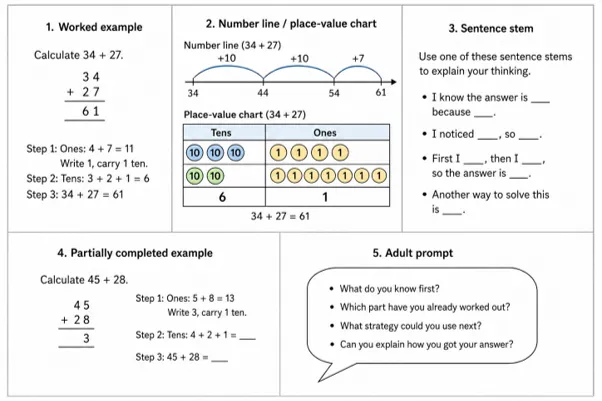
If a child cannot keep track of the steps in a method, a worked example might help.
If the difficulty is understanding the structure of the number, a place value chart, Base 10 or a number line might do the job.
If the child can almost do it, but not quite, a partially completed example can help them finish the process without starting from nothing.
If the barrier is language, a sentence stem, key vocabulary or a knowledge organiser may be the right support.
If the child needs another explanation, then the best scaffold may simply be more modelling with an adult.
Good scaffolding is precise and responds to the actual barrier, serving as a facilitator to aid children towards understanding.
Good scaffolding should not remove the thinking
This is where scaffolding can go wrong. Sometimes support is added in a way that removes so much challenge that the child is no longer doing the same mathematical thinking as everyone else.
For example, if the class is comparing methods and deciding which is more efficient, replacing that task with a page of straightforward number practice may make the work feel more manageable, but it is not scaffolding the same learning. It is changing the learning.
The EEF’s guidance on adaptations and additional support warns against oversimplifying tasks in ways that reduce pupil thinking. Its wider SEND guidance places scaffolding alongside explicit instruction and flexible grouping as part of high-quality teaching, not as a separate low-attainment curriculum (EEF, 2026a, 2026b).
So a useful test is this:
Is the scaffold helping the child get to the mathematics, or helping them avoid it?
If it is the second one, it probably needs rethinking.
There’s a lot of options when it comes to scaffolding:
Fading…
We need to look at fading now. As we’ve said already: a scaffold is temporary. But removing them needs doing carefully. If a child always has the same prompt, the same representation or the same worked example, the scaffold can turn into a dependency. The child may begin to rely on it rather than moving towards independence.
That means the teacher needs to think about fading from the start.
Can a full worked example become a partially completed one?
Can the child move from a place value chart in every question to choosing when they need it?
Can a sentence stem be shortened and then removed?
Can the child explain the method without the prompt in front of them?
Fading does not have to happen instantly. Some children will need the same support several times before they are ready to lose it. But the direction of travel should still be clear.
We are not trying to create a supported dependence. We are trying to help a child do more for themselves.
What does scaffolding look like in Classroom Secrets Adaptive Maths
Scaffolding is built into the way our maths lessons are organised.
After the Teaching PPT, there is a Teacher Decision Point before independent Varied Fluency (though of course that formative assessment is going on all the time too).
If a child is not ready for Core, the teacher can choose temporary adaptive support.
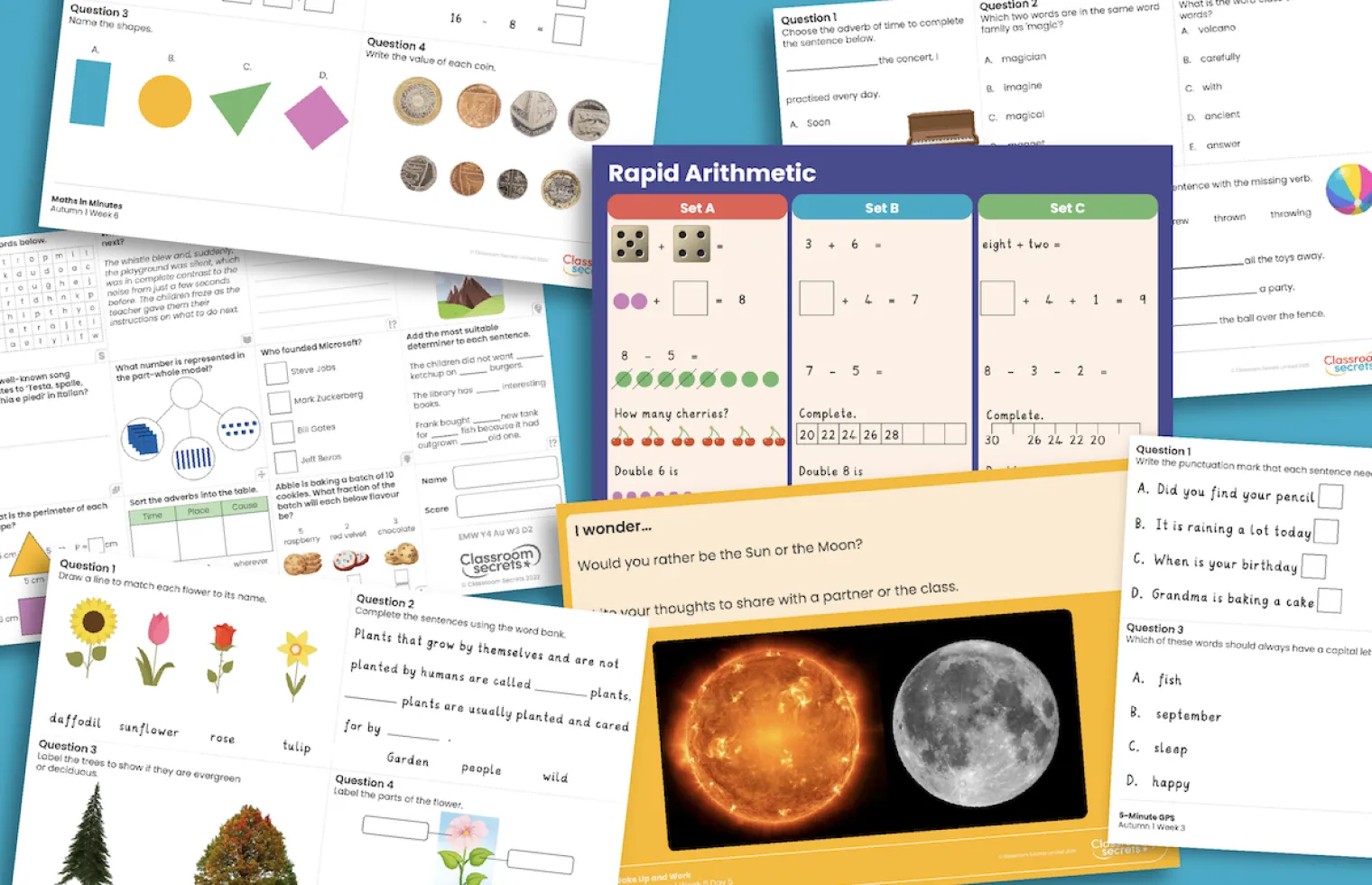
That might be Scaffolded Examples, a Knowledge Organiser or selected questions from our Support worksheet.
These resources can also be used with a temporary group, for pre-teaching or for same-day intervention. The aim is to give the children who need help enough support to access the learning and then move back towards independence.
Three questions to ask before using a scaffold
Before you use any scaffold, it is worth stopping for a moment and asking:
1. What exact barrier is this addressing?
2. Does the child still have to do the important mathematical thinking?
3. What will independence look like afterwards?
If you can answer those, the scaffold is probably doing useful work.
We don’t know your class though. We’re not the expert in the room. All we can do is offer as much support to you as we can to help reduce your workload while you adapt for your class. If you want to see some of our adaptive resources and how they work, one lesson is here: https://classroomsecrets.co.uk/lesson/year-4-maths-place-value-represent-numbers-to-1-000-lesson. You’ll find the rest through our menu or scheme pages. We’re adding more all the time!
References
Education Endowment Foundation. (2026a). Five a day: Supporting high-quality teaching for pupils with SEND.
Education Endowment Foundation. (2026b). Adaptations and additional support.
Nickl, M., Sommerhoff, D., Radkowitsch, A., Huber, S. A., Bauer, E., Ufer, S., Plass, J. L., & Seidel, T. (2024). Effects of real-time adaptivity of scaffolding: Supporting pre-service mathematics teachers’ assessment skills in simulations. Learning and Instruction, 94, 101994.
Ofsted. (2023). Coordinating mathematical success: The mathematics subject report
Try us today!