What Are Worked Examples in Maths and When Should You Use Them?
2nd September 2026
Written by Lee Peckover
What Are Worked Examples in Maths and When Should You Use Them?
What is a worked example?
Pretty much what it sounds like.
Instead of giving children a question and asking them to solve it, a worked example shows how the problem has been solved, usually step by step.
That might mean showing how to bridge through 10, how to partition before using a written method or how to work through the information in a multi-step problem.
The important bit is that the example should show more than the final answer.
If all a child sees is:
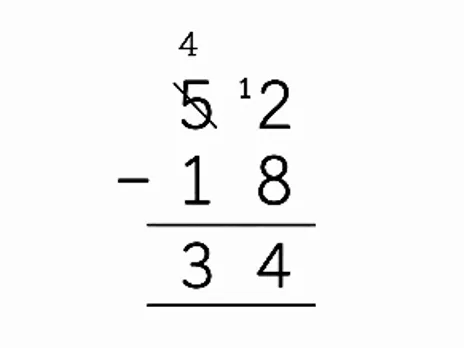
52 – 18 = 34
there is not much to learn from.
A useful worked example shows what happened between 52 – 18 and 34, and ideally why.
The EEF recommends worked examples as a way of making mathematical thinking more visible. It also suggests using them as something children can explain, question and discuss, rather than simply copy (Education Endowment Foundation [EEF], 2023).
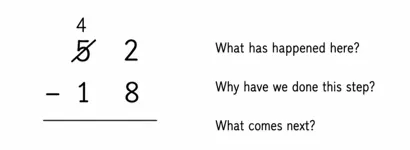
Add prompts such as: Why has the 5 (the number of tens) changed to 4? Where has the extra ten gone? or Why can we now calculate 12 – 8?
Why use worked examples?
When something is new, there can be a lot for a child to think about at once.
They need to remember the maths they already know, understand the new method, work out what to do next and keep track of where they are, and, sometimes, that is too much all at once.
A worked example removes some of that guesswork. Instead of having to discover the whole method while also trying to understand it, the child can concentrate on the steps and the mathematics behind them.
That is particularly useful when introducing a new process or when a child understood the teaching but has got stuck trying to organise the steps independently.
There is research behind this too. Gökdeniz Tahiroğlu and Özcan (2025) found higher achievement, motivation and attitudes following a six-week worked-example intervention with Year 5-aged children learning fractions.
It was a Turkish study using a digital tool, so we would not pretend that means every worked example automatically improves learning. But it adds recent evidence with school-age children to a much longer history of research into worked examples.
The danger is copying without thinking
Worked examples can also go wrong. Give a child a completed method and say “do one like this” and they may become very good at copying what is in front of them without really understanding why any of it works. So, talk about the example. Ask:
Why did we do this first?
What does this digit represent?
Would this step still work if the numbers changed?
Where could someone make a mistake?
Could we solve it another way?
The EEF has written specifically about using worked examples to generate mathematical talk (EEF, 2023). The example becomes something to think about, rather than an answer to imitate.
Incomplete examples can work well too. Give children the first couple of steps and ask them to finish it. Or show an incorrect example and ask them to find where things went wrong.
Once children know enough mathematics to analyse it, that can tell you much more than another page of calculations.
Why this step?
What does this digit represent?
What would change if the numbers changed?
What comes next?
What has already happened?
When are worked examples useful?
We would use them most when:
introducing a new method or process
a child understood the idea but cannot yet organise the steps alone
a problem has several stages and the child is losing track
a temporary group needs some extra modelling
you want children to compare methods or explain why something works
They become less useful once the child no longer needs them; remove them just like any other scaffolding. A full worked example can become a partially completed one. Then perhaps just a prompt. Eventually, there is no example at all.
What this looks like in Classroom Secrets Maths
Worked examples are one of the support options in our new adaptive maths lessons.
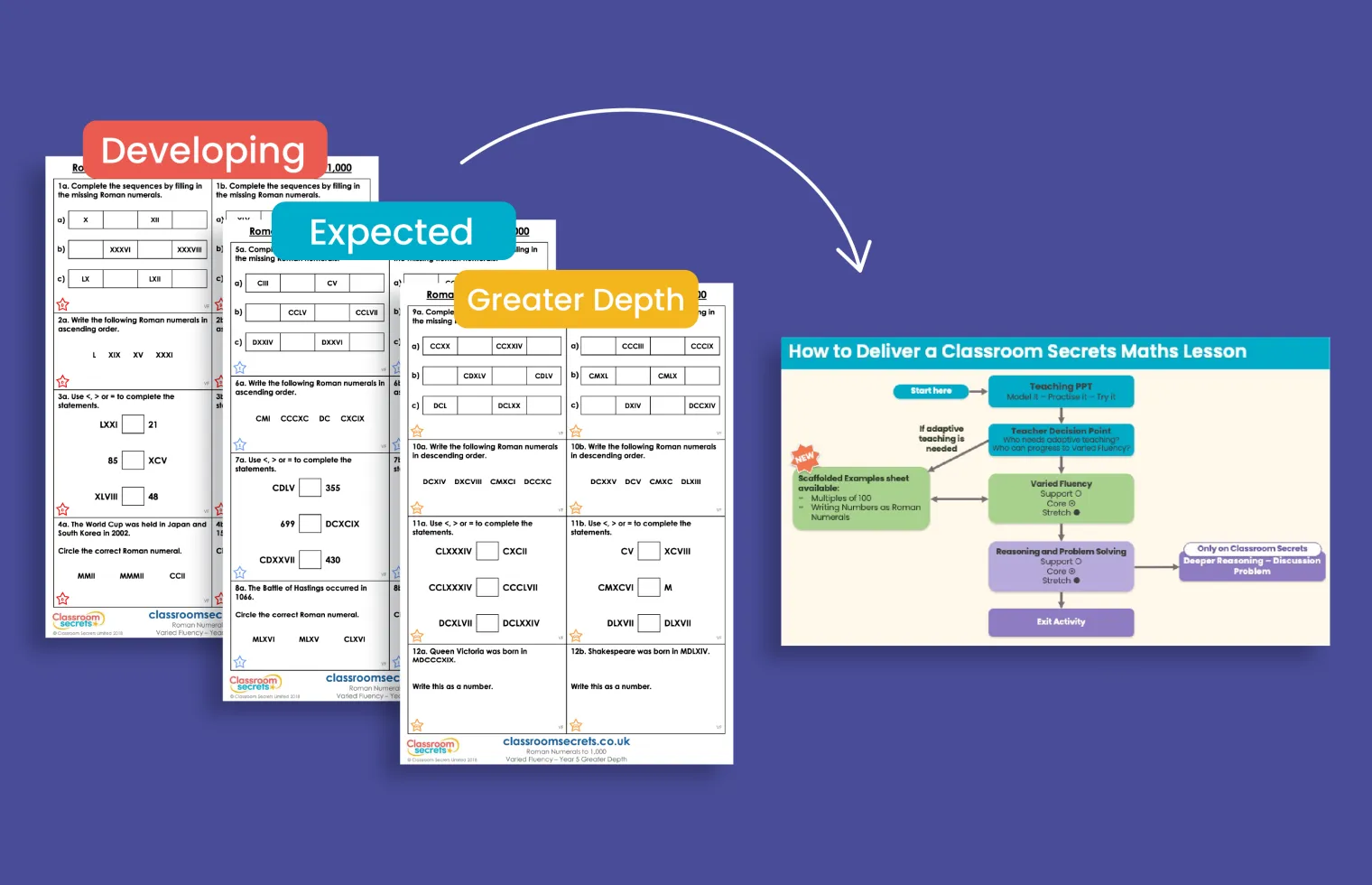
After the Teaching PPT, there is a Teacher Decision Point before children move into independent Varied Fluency.
If a child is not quite ready for Core, one option is to use our Scaffolded Examples.
A classroom adult might work through one with a child or temporary group, drawing attention to the steps, vocabulary or representation. The children can then try a similar example with less support before moving into the main task.
So Scaffolded Examples are not another fixed worksheet route.
They are there for the point in the lesson when a child needs a bit more modelling before they can move on.
That fits with the sequence already built into the lesson:
Model it → Practise it → Try it → Teacher Decision Point → independent practice
The aim is still independence.
A child being able to follow somebody else’s worked solution is useful. A child knowing what to do when the example disappears is better.
You can see our new adaptive maths resources here:
https://classroomsecrets.co.uk/campaign/new-adaptive-maths
References
Education Endowment Foundation. (2023, January 12). Using worked examples to promote high-quality mathematical talk.
Education Endowment Foundation. (2022, January 4). How can we improve children’s problem solving in maths?.
Gökdeniz Tahiroğlu, N., & Özcan, Z. Ç. (2025). Impact of worked-out examples via a Web 2.0 tool on fifth graders’ achievement, attitudes, and motivation in mathematics. Journal of Pedagogical Research, 9(4), 202–224.
National Centre for Excellence in the Teaching of Mathematics. (n.d.). Five big ideas in teaching for mastery.
Try us today!