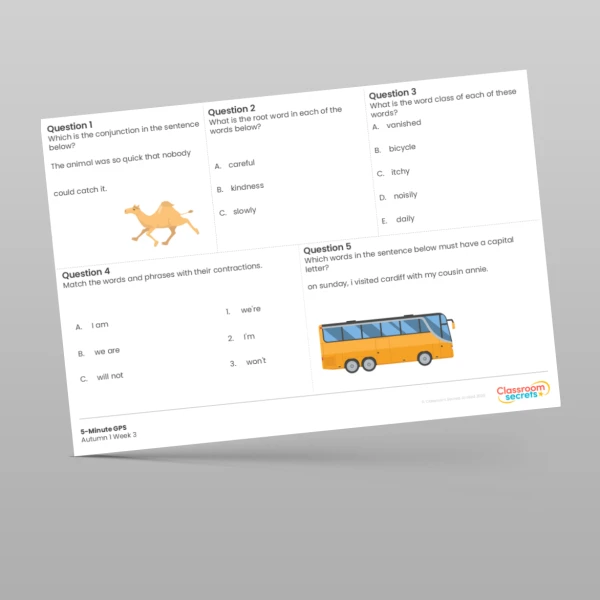
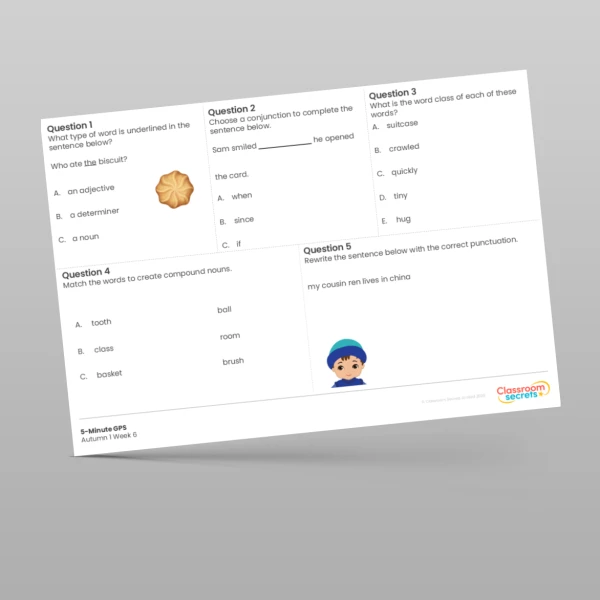
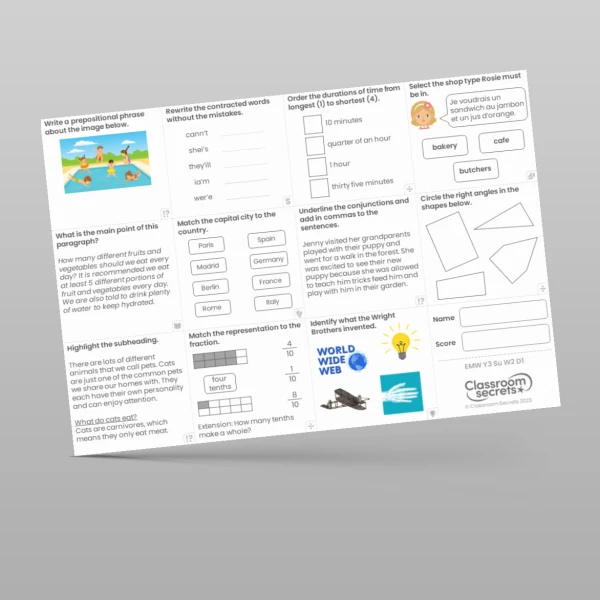
Free 5-Minute GPS Autumn 1 Week 1

Worksheet
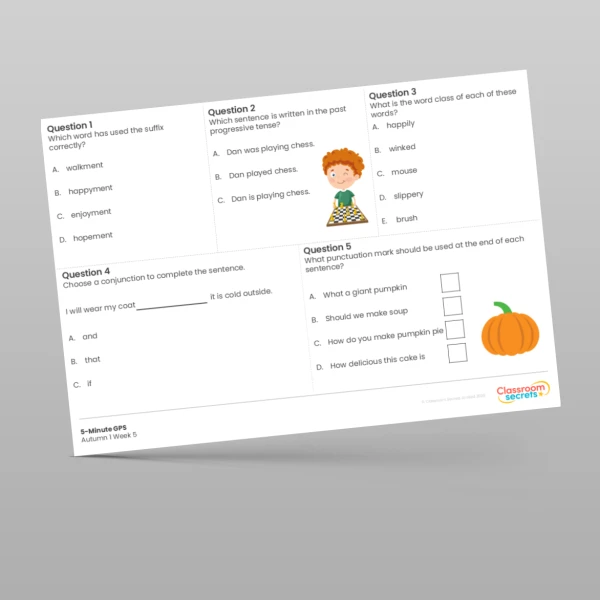
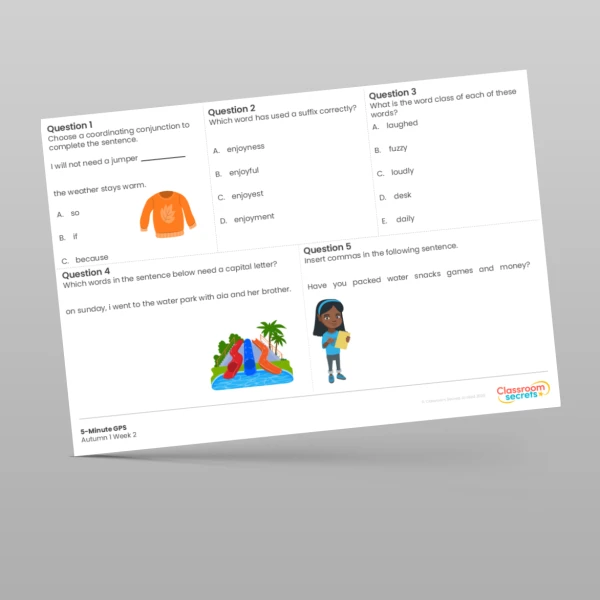
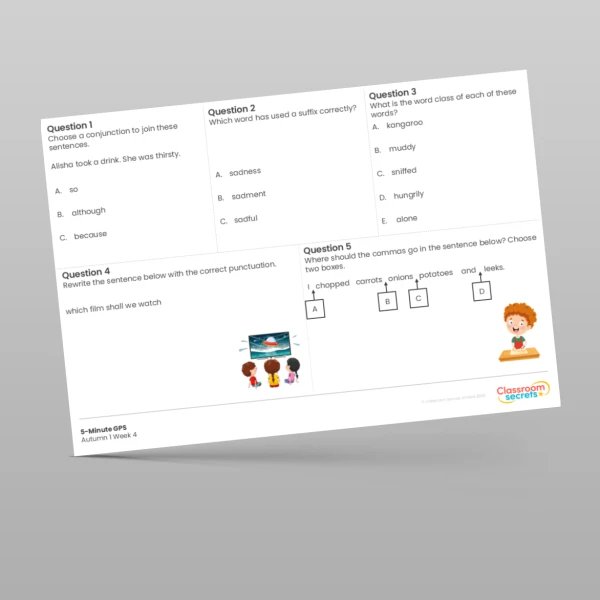
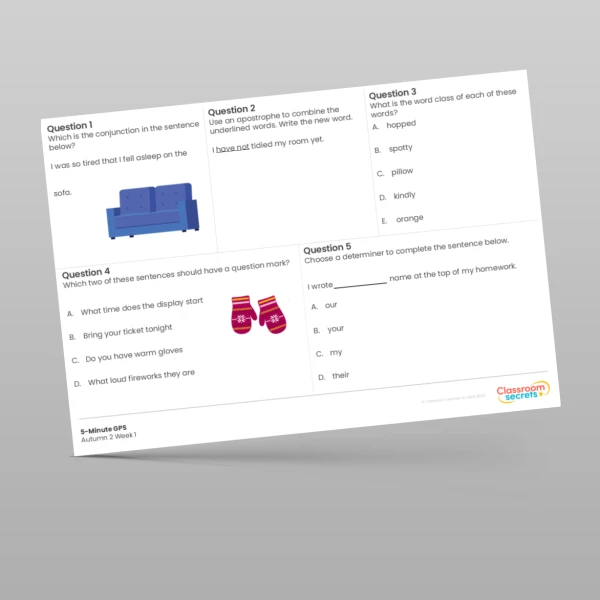
An image of the Free 5-Minute GPS Autumn 1 Week 1 Resource


Are you looking for an effective but speedy way to help children embed their grammar, punctuation and spelling skills? This Year 3 5-Minute GPS Autumn 1 Week 1 resource could be just what you need. With three pages of mixed questions, it ensures all topics are covered throughout the year so that children get chance to secure their skills.

As this is an autumn resource, the questions will focus on key learning from the previous year. As new content is taught following the Classroom Secrets GPS scheme, new content for the current year group will be gradually introduced.

Designed to be displayed on the interactive whiteboard for early morning work, a lesson starter, or a 5-minute challenge, this colourful resource ties in with our grammar, punctuation and spelling curriculum and our ever-popular grammar assessments.

Download it today!


Curriculum Objectives

  • Learning how to use both familiar and new punctuation correctly including: full stops / Use of full stops to demarcate sentences
  • Learning how to use both familiar and new punctuation correctly including: capital letters / Use of capital letters to demarcate sentences
  • Learning how to use both familiar and new punctuation correctly including: commas for lists / Commas to separate items in a list / Terminology for pupils: comma
  • Learning how to use both familiar and new punctuation correctly including: apostrophes for contracted forms and apostrophes for the possessive (singular) / Apostrophes to mark where letters are missing in spelling and to mark singular possession in nouns [for example, the girl’s name] / Terminology for pupils: apostrophe
  • Understand and use sentences with different forms: statement / How the grammatical patterns in a sentence indicate its function as a statement / Terminology for pupils: statement
  • Understand and use sentences with different forms: question / How the grammatical patterns in a sentence indicate its function as a question / Terminology for pupils: question
  • Understand and use sentences with different forms: exclamation / How the grammatical patterns in a sentence indicate its function as a exclamation / Terminology for pupils: exclamation
  • Understand and use sentences with different forms: command / How the grammatical patterns in a sentence indicate its function as a command / Terminology for pupils: command
  • Learn how to use: Expanded noun phrases to describe and specify [for example, the blue butterfly] / Expanded noun phrases for description and specification [for example, the blue butterfly, plain flour, the man in the moon] / Terminology for pupils: noun phrase
  • Learn how to use: The present and past tenses correctly and consistently including the progressive form / Correct choice and consistent use of present tense and past tense throughout writing / Terminology for pupils: tense (past, present)
  • Learn how to use: Co-ordination (using or, and, or but) / Co-ordination (using or, and, but)
  • Learn how to use: Subordination (using when, if, that, or because) / Subordination (using when, if, that, because) / Develop their understanding of the concepts set out in English appendix 2 by: Extending the range of sentences with more than one clause by using a wider range of conjunctions, including: when, if, because, although
  • Formation of nouns using suffixes such as –ness, –er and by compounding [for example, whiteboard, superman] / Formation of adjectives using suffixes such as –ful, –less (A fuller list of suffixes can be found in the year 2 spelling section in English Appendix 1) / Use of the suffixes –er, –est in adjectives / Terminology for pupils: compound / Terminology for pupils: suffix
  • Use of the progressive form of verbs in the present and past tense to mark actions in progress [for example, she is drumming, he was shouting]

Tags

Select a tag to view relevant resources

Autumn

2G5.2

2G5.1

2G5.5

2G5.8

2G2.1

2G2.2

2G2.4

2G2.3

2G3.2

2G4.2

2G3.3

2G3.4

2G6.3

2G4.1d