Tags
Select a tag to view relevant resources
Summer
2G5.1
2G5.4
2G5.8
2G2.1
2G2.2
2G2.4
2G2.3
2G4.2
2G6.3
3G3.4
3G4.1b
3G1.4
3G1.6
3G1.7
3G1.8
3G3.1
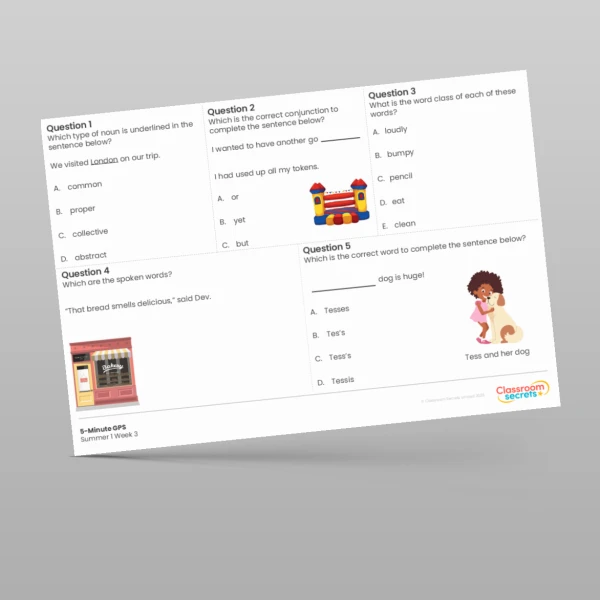
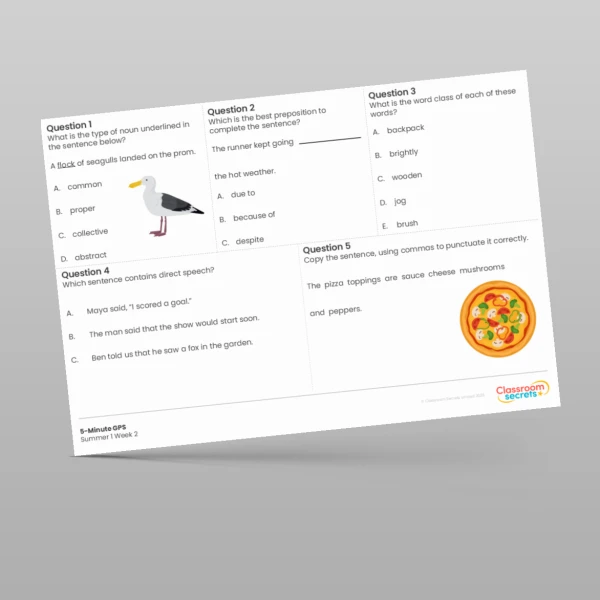
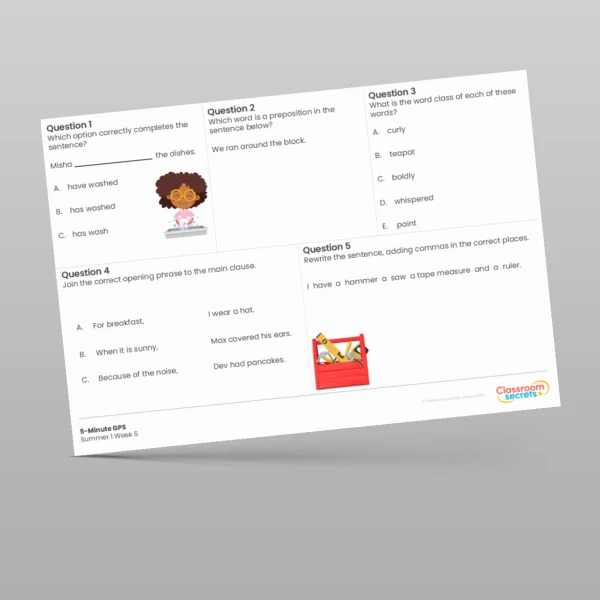
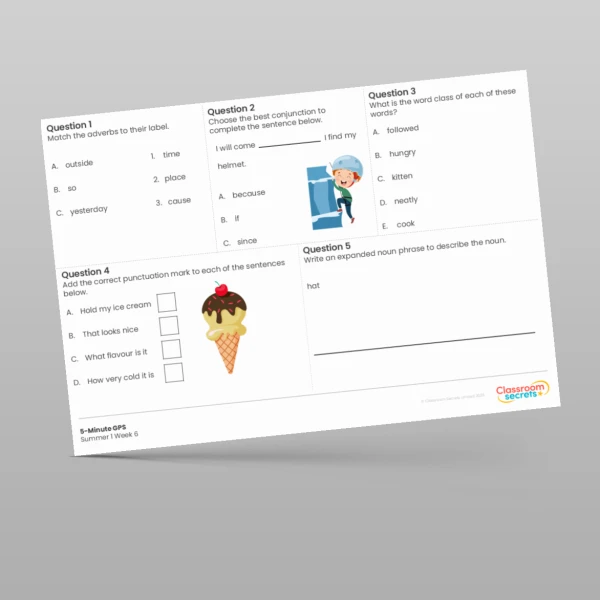
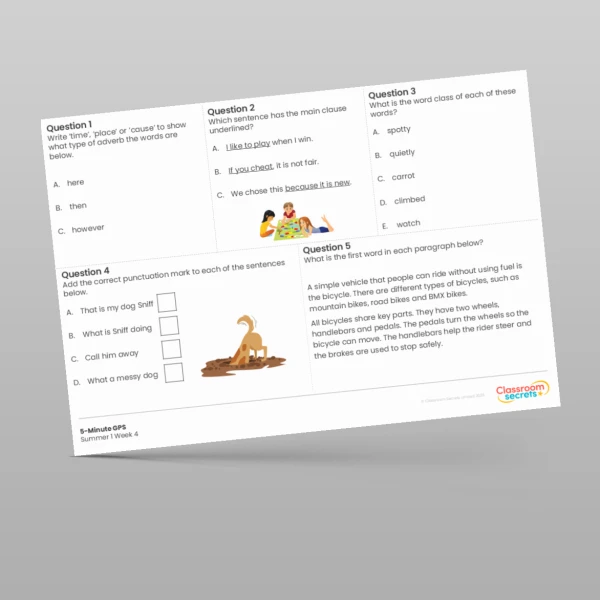
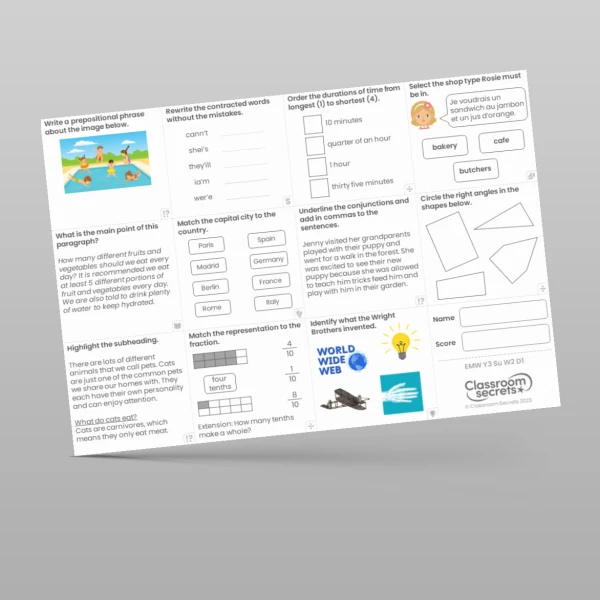
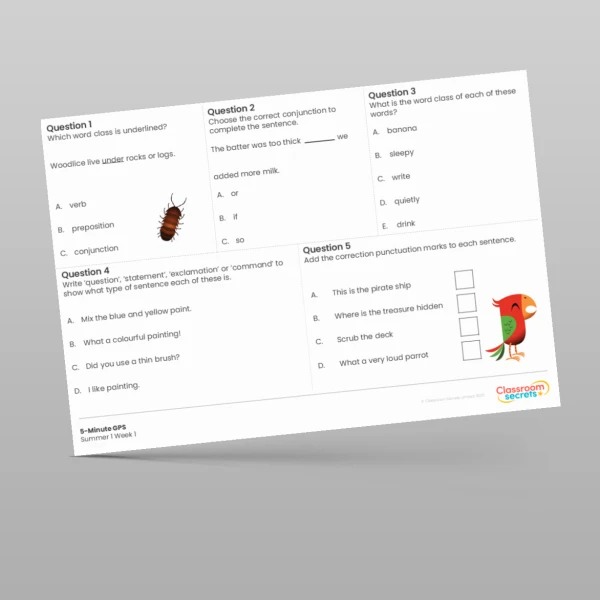
Are you looking for a quick-fire activity to elevate your children's grammar skills? This Year 3 5-Minute GPS Summer 1 Week 1 resource could be just what you need to keep those important, but tricky-to-remember, grammar rules in children's working memories.
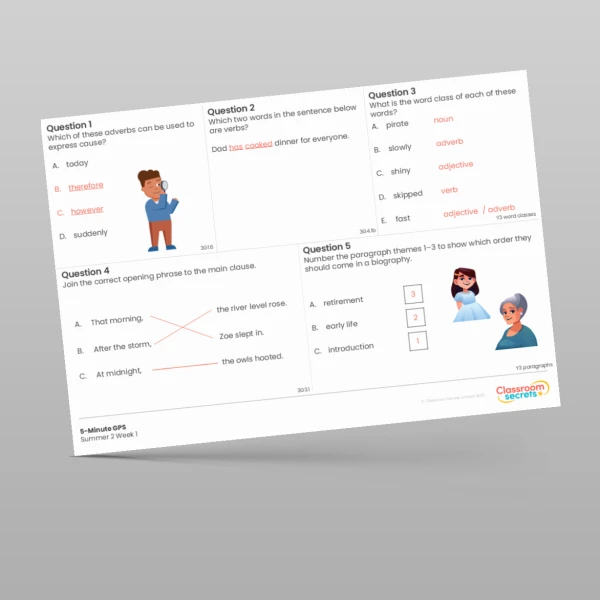
Each of the 3 question slides has been carefully curated to match what they have already learnt, and answer sheets are provided to enable quick and easy self-marking.
Designed to be displayed on the interactive whiteboard for early morning work, a lesson starter, or a 5-minute challenge, this colourful resource ties in with our grammar, punctuation and spelling curriculum and our ever-popular grammar assessments.
Download it today to take grammar confidence in your classroom to a new level.
Curriculum Objectives
- Learning how to use both familiar and new punctuation correctly including: capital letters / Use of capital letters to demarcate sentences
- Learning how to use both familiar and new punctuation correctly including: exclamation marks / Use of exclamation marks to demarcate sentences
- Learning how to use both familiar and new punctuation correctly including: apostrophes for contracted forms and apostrophes for the possessive (singular) / Apostrophes to mark where letters are missing in spelling and to mark singular possession in nouns [for example, the girl’s name] / Terminology for pupils: apostrophe
- Understand and use sentences with different forms: statement / How the grammatical patterns in a sentence indicate its function as a statement / Terminology for pupils: statement
- Understand and use sentences with different forms: question / How the grammatical patterns in a sentence indicate its function as a question / Terminology for pupils: question
- Understand and use sentences with different forms: exclamation / How the grammatical patterns in a sentence indicate its function as a exclamation / Terminology for pupils: exclamation
- Understand and use sentences with different forms: command / How the grammatical patterns in a sentence indicate its function as a command / Terminology for pupils: command
- Learn how to use: The present and past tenses correctly and consistently including the progressive form / Correct choice and consistent use of present tense and past tense throughout writing / Terminology for pupils: tense (past, present)
- Formation of nouns using suffixes such as –ness, –er and by compounding [for example, whiteboard, superman] / Formation of adjectives using suffixes such as –ful, –less (A fuller list of suffixes can be found in the year 2 spelling section in English Appendix 1) / Use of the suffixes –er, –est in adjectives / Terminology for pupils: compound / Terminology for pupils: suffix
- Terminology for pupils: subordinate clause
- Develop their understanding of the concepts set out in English appendix 2 by: Using the present perfect form of verbs in contrast to the past tense / Use of the present perfect form of verbs instead of the simple past [for example, He has gone out to play contrasted with He went out to play]
- Develop their understanding of the concepts set out in English appendix 2 by: Using conjunctions to express time and cause / Express time, place and cause using conjunctions [for example, when, before, after, while, so, because] / Terminology for pupils: conjunction
- Develop their understanding of the concepts set out in English appendix 2 by: Using adverbs to express time and cause / Express time, place and cause using adverbs [for example, then, next, soon, therefore]
- Develop their understanding of the concepts set out in English appendix 2 by: Using prepositions to express time and cause / Express time, place and cause using prepositions [for example, before, after, during, in, because of] / Terminology for pupils: preposition
- Use the forms a or an according to whether the next word begins with a consonant or a vowel [for example, a rock, an open box] / Terminology for pupils: consonant / Terminology for pupils: consonant letter / Terminology for pupils: vowel / Terminology for pupils: vowel letter
- Terminology for pupils: clause
Tags
Select a tag to view relevant resources
Summer
2G5.1
2G5.4
2G5.8
2G2.1
2G2.2
2G2.4
2G2.3
2G4.2
2G6.3
3G3.4
3G4.1b
3G1.4
3G1.6
3G1.7
3G1.8
3G3.1