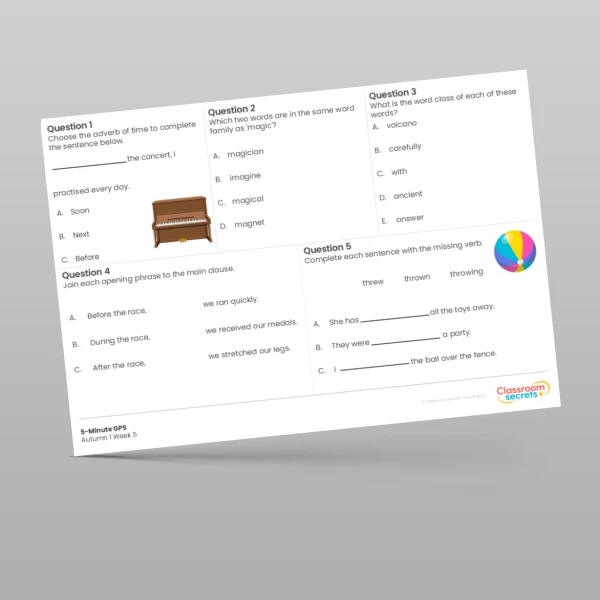
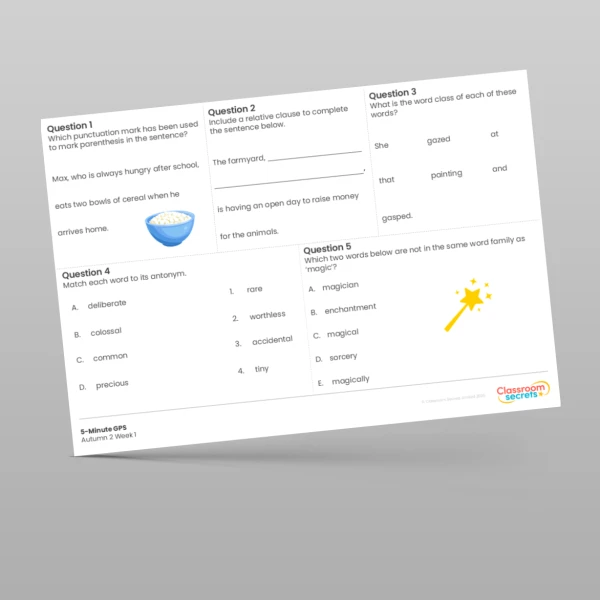
5-Minute GPS Autumn 1 Week 6

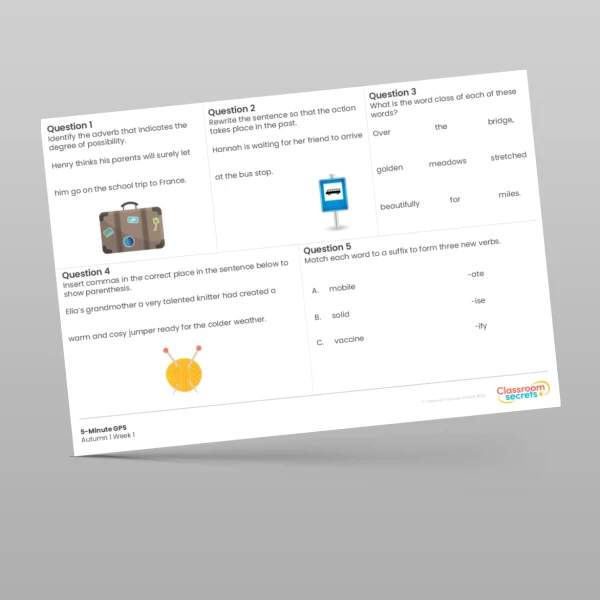
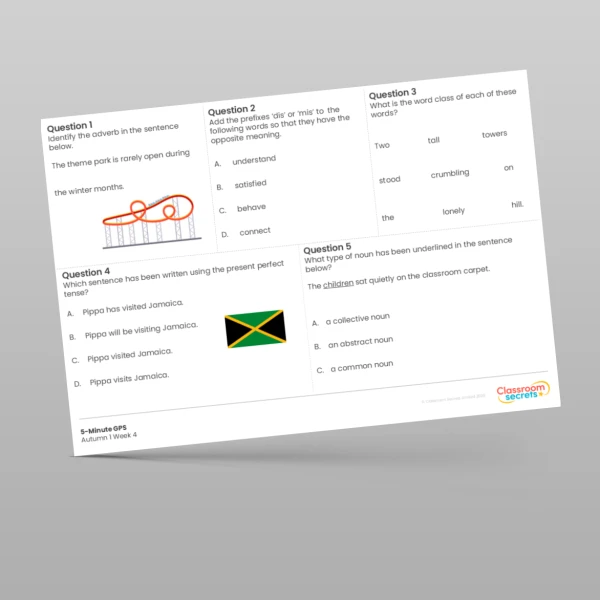
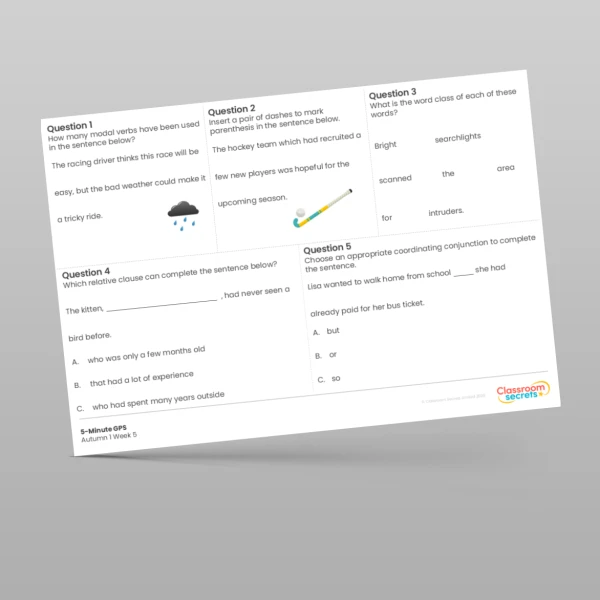
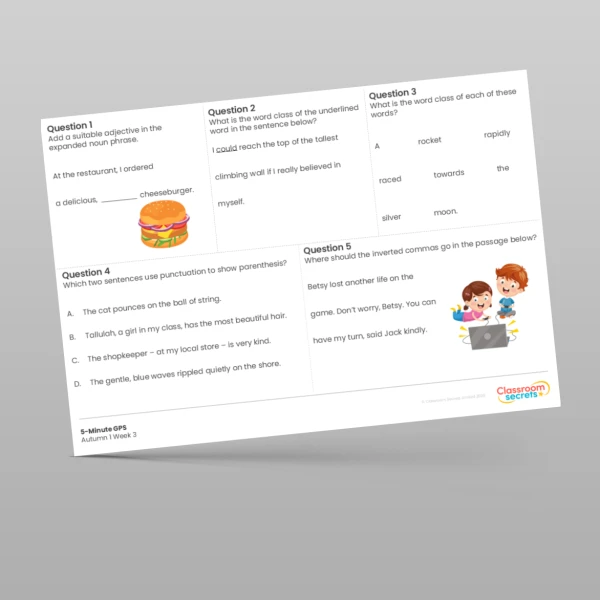
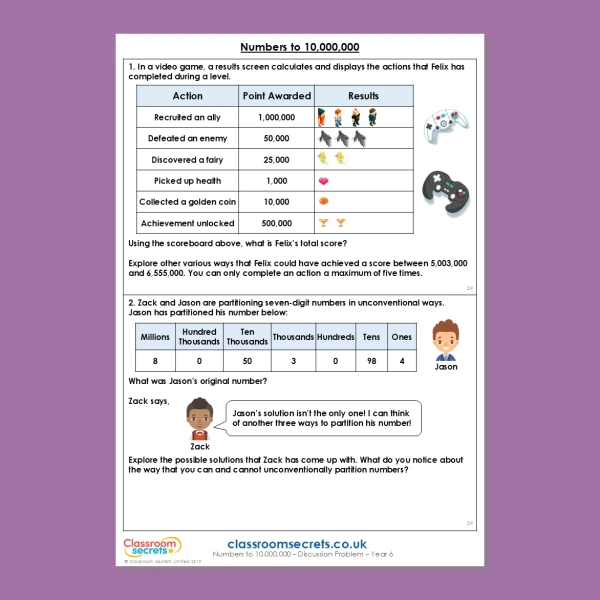
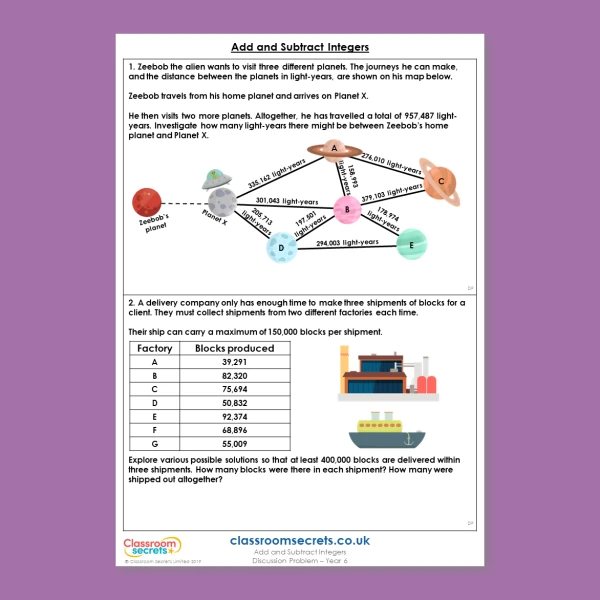
An image of the 5-Minute GPS Autumn 1 Week 6 Resource


Are you looking for a quick-fire activity to elevate your children's grammar skills? This Year 6 5-Minute GPS Autumn 1 Week 6 resource could be just what you need to keep those important, but tricky-to-remember, grammar rules in children's working memories.

As this is an autumn resource, the questions will focus on key learning from the previous year. As new content is taught following the Classroom Secrets GPS scheme, new content for the current year group will be gradually introduced.

Designed to be displayed on the interactive whiteboard for early morning work, a lesson starter, or a 5-minute challenge, this colourful resource ties in with our grammar, punctuation and spelling curriculum and our ever-popular grammar assessments.

Download it today to take grammar confidence in your classroom to a new level.


Curriculum Objectives

  • Terminology for pupils: subordinate clause
  • Indicate grammatical and other features by: Indicating possession by using the possessive apostrophe with plural nouns / The grammatical difference between plural and possessive –s / Apostrophes to mark plural possession [for example, the girl’s name, the girls’ names]
  • Indicate grammatical and other features by: Using and punctuating direct speech / Use of inverted commas and other punctuation to indicate direct speech [for example, a comma after the reporting clause; end punctuation within inverted commas: The conductor shouted, "Sit down!"]
  • Develop their understanding of the concepts set out in English appendix 2 by: Using the perfect form of verbs to mark relationships of time and cause
  • Develop their understanding of the concepts set out in English appendix 2 by: Using expanded noun phrases to convey complicated information concisely
  • Develop their understanding of the concepts set out in English appendix 2 by: Using adverbs to indicate degrees of possibility / Indicating degrees of possibility using adverbs [for example, perhaps, surely]
  • Develop their understanding of the concepts set out in English appendix 2 by: Using relative clauses beginning with who, which, where, when, whose, that or with an implied (ie omitted) relative pronoun / Relative clauses beginning with who, which, where, when, whose, that, or an omitted relative pronoun / Terminology for pupils: relative clause
  • Indicate grammatical and other features by: Using brackets, dashes or commas to indicate parenthesis / Brackets, dashes or commas to indicate parenthesis / Terminology for pupils: parenthesis / Terminology for pupils: bracket / Terminology for pupils: dash
  • Converting nouns or adjectives into verbs using suffixes [for example, –ate; –ise; –ify]
  • Verb prefixes [for example, dis–, de–, mis–, over– and re–]
  • Terminology for pupils: cohesion
  • How words are related by meaning as synonyms and antonyms [for example, big, large, little] / Terminology for pupils: synonym / Terminology for pupils: antonym

Tags

Select a tag to view relevant resources

Autumn

3G3.4

4G5.8

4G5.7

5G4.1b

5G3.2

5G1.6

5G3.1a

5G5.9

5G6.3

5G6.2

5G1.5

6G6.1