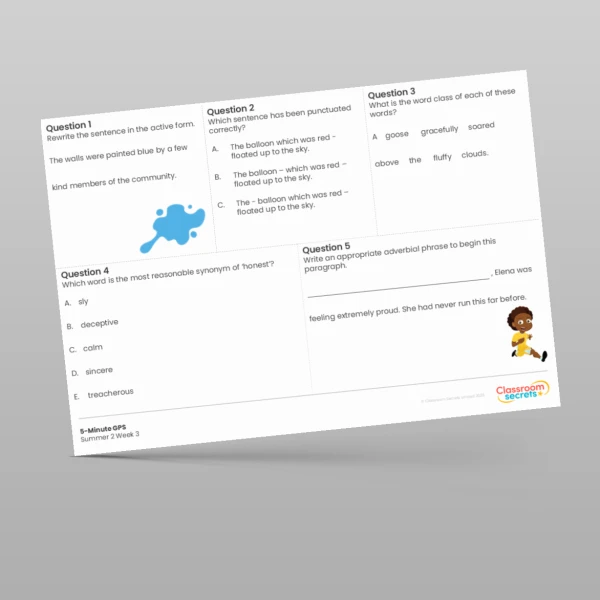
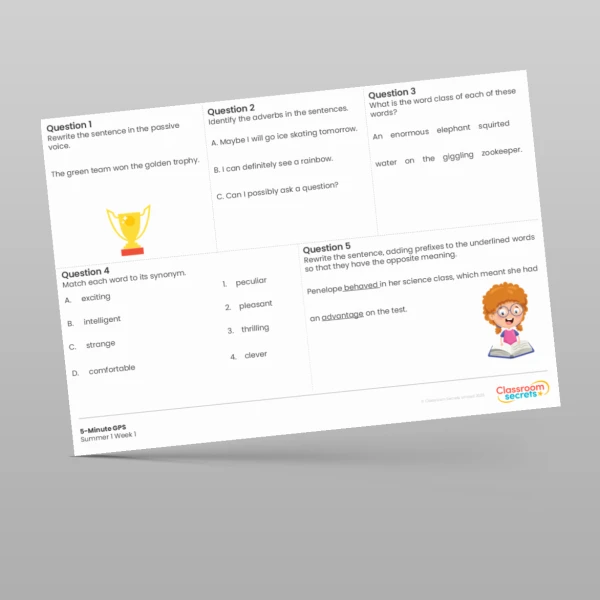
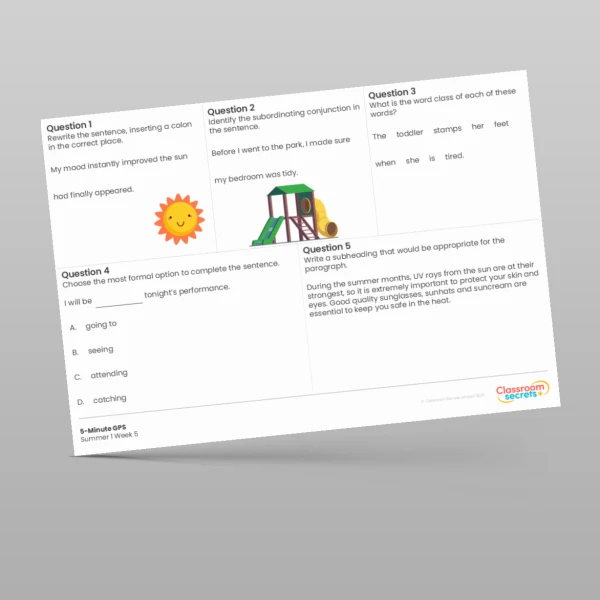
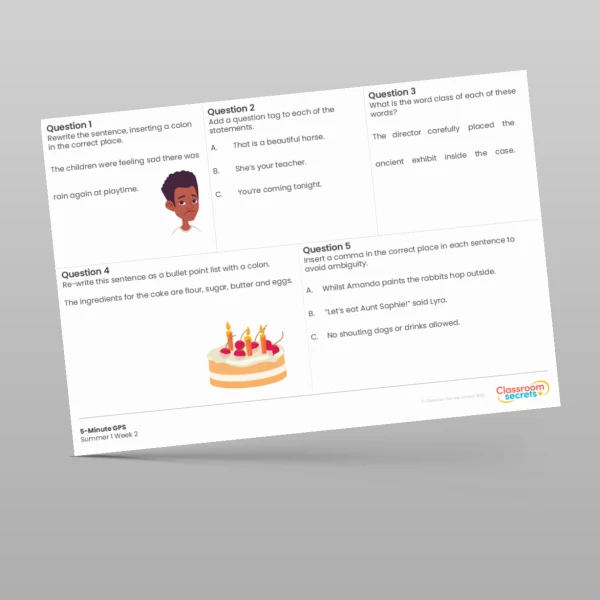
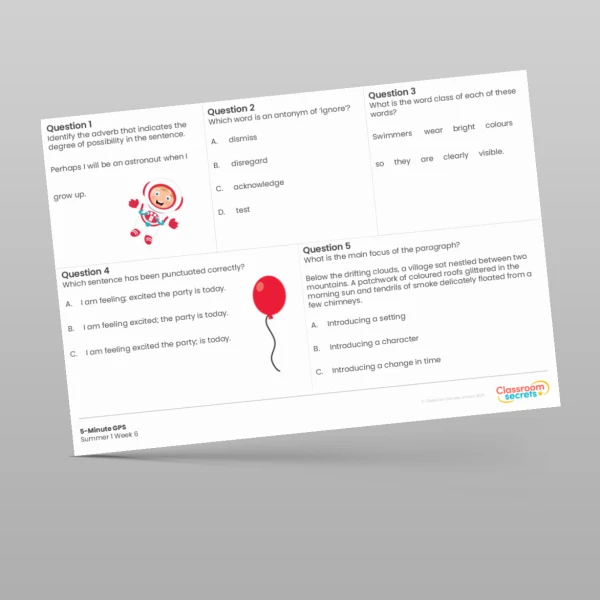
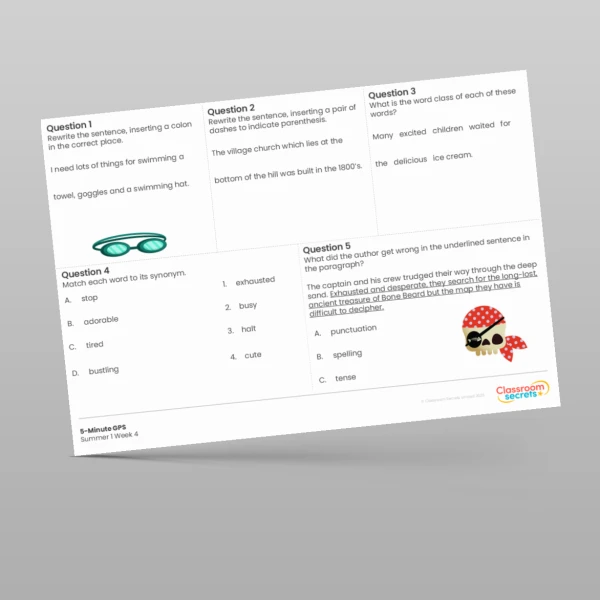
5-Minute GPS Summer 1 Week 3

An image of the 5-Minute GPS Summer 1 Week 3 Resource


Download this Year 6 5-Minute GPS Summer 1 Week 3 to keep those important, but tricky-to-remember, grammar rules in children's working memories.

The activities include a range of question styles and cover all topics taught throughout the year, meaning you can relax in the knowledge that children will recap everything they need to know. Plus, the answer sheets ensure self-marking is quick and easy.

Designed to be displayed on the interactive whiteboard for early morning work, a lesson starter or a 5-minute challenge, this resource ties in with our grammar, punctuation and spelling curriculum and our ever-popular grammar assessments.

Download today!


Curriculum Objectives

  • Develop their understanding of the concepts set out in English appendix 2 by: Using fronted adverbials / Indicate grammatical and other features by: Using commas after fronted adverbials / Fronted adverbials [for example, Later that day, I heard the bad news.] / Use commas after fronted adverbials
  • Develop their understanding of the concepts set out in English appendix 2 by: Using expanded noun phrases to convey complicated information concisely
  • Develop their understanding of the concepts set out in English appendix 2 by: Using modal verbs to indicate degrees of possibility / Indicating degrees of possibility using modal verbs [for example, might, should, will, must] / Terminology for pupils: modal verb
  • Indicate grammatical and other features by: Using brackets, dashes or commas to indicate parenthesis / Brackets, dashes or commas to indicate parenthesis / Terminology for pupils: parenthesis / Terminology for pupils: bracket / Terminology for pupils: dash
  • Converting nouns or adjectives into verbs using suffixes [for example, –ate; –ise; –ify]
  • Develop their understanding of the concepts set out in English appendix 2 by: Using passive verbs to affect the presentation of information in a sentence / Use of the passive to affect the presentation of information in a sentence [for example, I broke the window in the greenhouse versus The window in the greenhouse was broken (by me)] / Terminology for pupils: active / Terminology for pupils: passive
  • Indicate grammatical and other features by: Using hyphens to avoid ambiguity / How hyphens can be used to avoid ambiguity [for example, man eating shark versus man-eating shark, or recover versus re-cover] / Terminology for pupils: hyphen
  • Indicate grammatical and other features by: Using semi-colons to mark boundaries between independent clauses / Use of the semi-colon to mark the boundary between independent clauses [for example, It’s raining; I’m fed up] / Use of semi-colons within lists / Terminology for pupils: semi-colon
  • The difference between vocabulary typical of informal speech and vocabulary appropriate for formal speech and writing [for example, find out – discover; ask for – request; go in – enter]

Tags

Summer

4G5.6b

5G3.2

5G4.1c

5G5.9

5G6.3

6G4.4

6G5.13

6G5.11

6G7.2