30 Children, 30 Starting Points: How Do You Actually Teach One Maths Lesson?
11th September 2026
Written by Lee Peckover
How to Differentiate Maths for Different Abilities: A Practical Guide
There are 30 (or so) children in your class.
They are all about to learn the same maths concept, but they are not all starting in the same place.
Some have completely secured the learning that comes before it. Some can remember most of it with a prompt. Some have gaps you already know about. Others might surprise you once the lesson begins.
So, what do you actually do?
Do you plan different work for different groups? Decide in advance who will need more support and who will need more challenge? Print several versions of the same task just in case? Sit with one group while everyone else gets started?
And what happens when a child you expected to struggle suddenly flies through the work, or somebody who is usually confident hits a misconception?
This is the practical problem behind differentiation and adaptive teaching: how do you teach one maths lesson when 30 children have different starting points?
And if you have opened one of our new Adaptive Maths lessons and thought, “This looks useful, but what am I supposed to do with all these pages?” this guide is for you.
The short answer is: you probably do not need to print them all.
The longer answer is about how you use those resources to respond to what children need during the lesson.
Start with what you want everyone to learn
Before thinking about different sheets, levels or groups, start with the mathematics.
What is the key knowledge or skill children need to learn in this lesson? What prior knowledge does it depend on? What would secure understanding look like?
Start with the destination. Where are you trying to get these 30 children to? Only then does it make sense to think about the different routes they might need to take to get there.
If you were tutoring a child one to one, you probably would not begin by asking, “Which of these three worksheets should I give them?” You would start with what they need to learn, work out what they already understand, notice where they are getting stuck and adjust your teaching accordingly.
Of course, you cannot provide that level of individual attention to every child in a full class. For a long time, one common solution was to prepare different tasks for different groups in advance.
However, Ofsted’s mathematics subject report found that primary mathematics had moved away from the old generic expectation that all teaching should always be differentiated. It reported a broader shift towards carefully sequenced curricula, modelling, regular checks of understanding and helping children to keep up with the curriculum (Ofsted, 2023).
Importantly, Ofsted also found that many pupils with SEND were following the same mathematics curriculum as their peers, with support and adaptations made within lessons. It highlighted approaches such as modelling, representations, additional practice, pre-teaching and same-day intervention (Ofsted, 2023).
That gives us a useful starting point. The aim is not automatically to create several different maths lessons.
It is to think carefully about what support different children might need to access and secure the same important learning.
Use what you already know, but keep checking
You know your class. If you already know that a child is likely to need more support with a particular concept, there is little point waiting for them to struggle before offering it.
But prior attainment should inform your decisions, not determine them.
A child who needed considerable support with fractions might be very secure when you move onto shape. Another child who usually works confidently might meet a concept that requires much more modelling or guided practice. And, sometimes overlooked, some days children just have a little off day. Maybe they are tired, maybe they just didn’t quite grasp a bit of the input on that one day. Sometimes, a child needs a little support when you might not expect it.
That is why checking what children understand during the lesson matters so much.
The EEF describes checking for understanding as feedback to the teacher. It gives you evidence about what children understand so that you can decide what happens next. Its recent Check. Adapt. work describes three broad possibilities: many children misunderstand and you pause to address it; some are unsure and need additional support; or most understand and you can extend the learning (Education Endowment Foundation [EEF], 2026a, 2026b). These responses are not fixed in advance.
A child might need more support for ten minutes and then be ready to work independently. Another might begin independently and then reveal a misconception. The amount of support a child needs can change several times within one lesson.
The task does not always have to change
This is where I am going to magpie something, because here is where I think Aidan Severs’ Mixing Desk Model is particularly useful.
Severs suggests thinking about teaching like the controls on a mixing desk. Rather than assuming that adaptation always means giving a child different work, teachers can turn different elements of support up or down depending on what they are seeing.
That might mean more modelling, another worked example, a representation, more tightly structured questioning, guided practice, immediate feedback or simply more time with an adult.
A child with less secure prior knowledge might need several of those things at once. As their understanding develops, some of that support can be reduced.
Another child might need very little additional support but benefit from questions that push their reasoning further.
The mathematical destination can stay the same even when the route looks slightly different (Severs, 2025).
The adaptation is in the teaching and support, not necessarily in giving somebody a different sheet.
What might that look like in a real lesson?
Imagine a Year 4 lesson on adding two four-digit numbers with one exchange.
You begin by checking the prior knowledge children will need. Most are secure, but a handful are less confident with the place-value knowledge behind the calculation.
During your modelling, you check again. Six children initially appear unsure, so you model the exchange another way and use a representation to make the process clearer.
Four of those children now understand.
Two still need more support.
When independent practice begins, most of the class get started. You keep those two children with you for another couple of minutes, work through another example together and check their understanding again.
One is then ready to work independently. The other still needs the steps broken down more carefully.
At the same time, a few children have shown that the calculation itself is already secure. They now need something that makes them think more deeply about the mathematics rather than simply completing more calculations.
Nothing about that lesson required you to divide the class into three fixed groups beforehand.
You taught the class towards the same mathematical goal and changed the amount and type of support as you learned more about what different children understood.
So where do the Classroom Secrets resources fit?
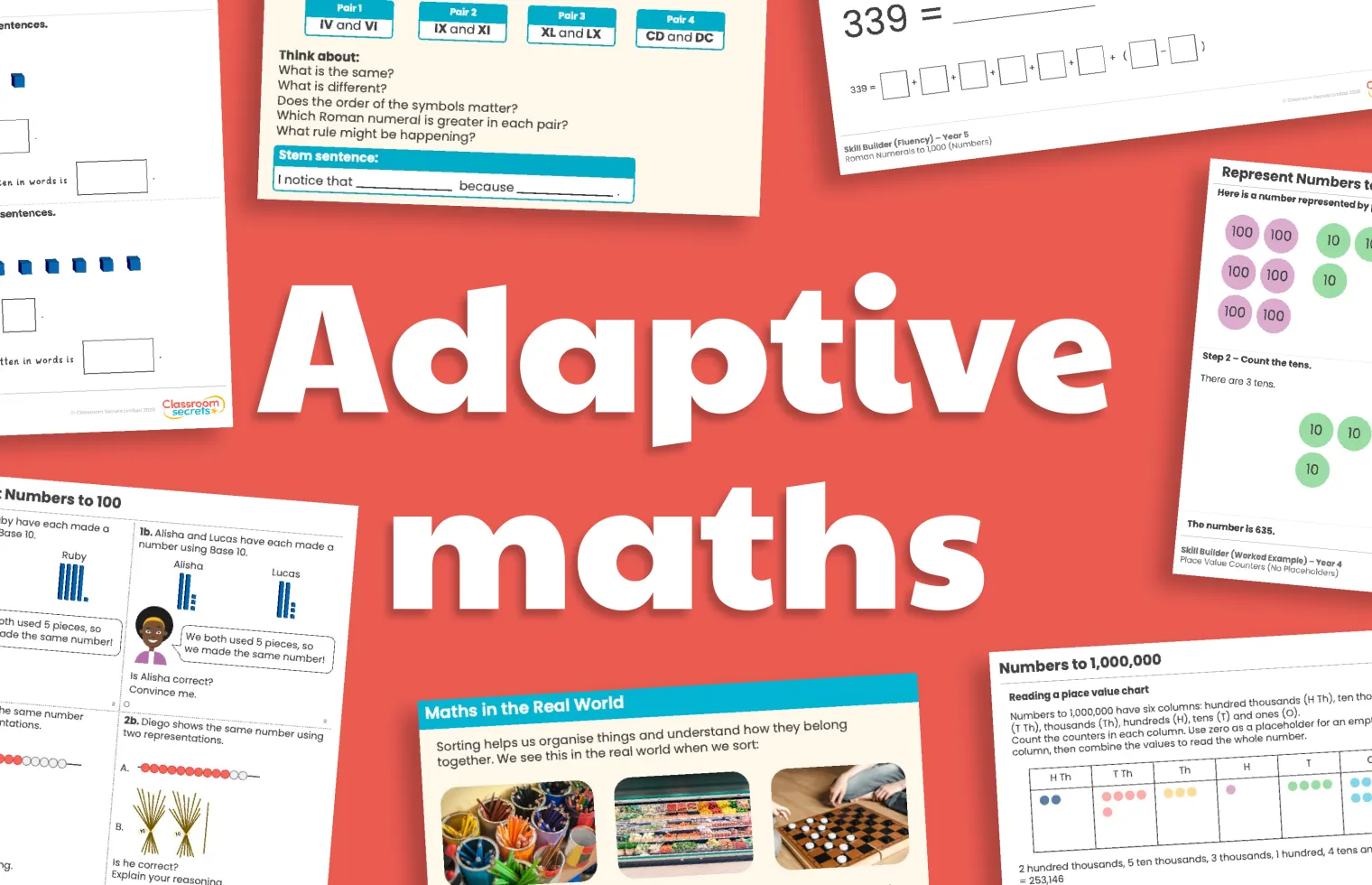
This is the point at which our Adaptive Maths resources become useful.
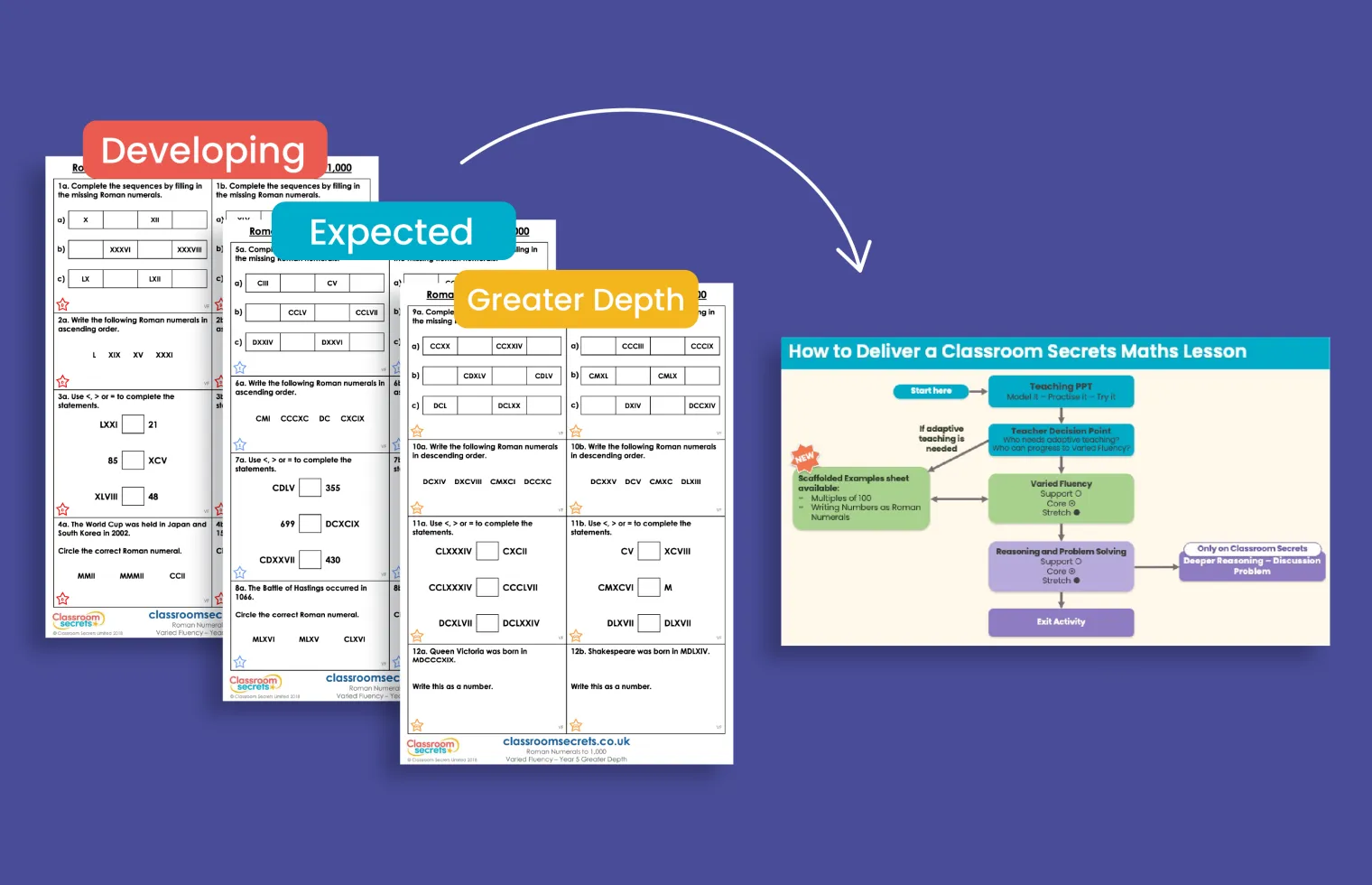
Each lesson gives you different tools you can draw on, including the Knowledge Organiser, Scaffolded Examples, Support, Core and Stretch resources.
Those names describe the resources. They are not labels for children and they are not three groups that you need to create.
You also do not need to print a complete set of every resource for every child.
In many lessons, you might expect most children to use the Core practice. Based on what you already know about the class, you might print a few Support and Stretch copies as well.
But that is only one way to organise it.
You may find that some of the additional resources work better as teaching tools than as individual worksheets.
One copy might be enough
Suppose several children need more support once the class begins practising.
You could give each child their own Support resource.
But you might not need to.
You could bring those children together and use one copy yourself. Work through a question with them. Use the representation. Ask the questions. Model another example. Then check whether they are ready to return to the main practice.
The same resource could instead be displayed on the interactive whiteboard, opened on a tablet or laptop, shared between a couple of children, or used by a teaching assistant to structure questioning with a small group.
A Scaffolded Example can work in exactly the same way.
A child might have one beside them while they complete the main task. You might display it while working with a group. A teaching assistant might use it to model a similar example.
Not every page needs to become another piece of paper on every child’s desk.
Children can move between the resources
This is an important distinction.
A child using the Support resource today is not a “Support child”.
They are a child who currently needs more support with this particular piece of mathematics.
Likewise, Stretch is not a destination reserved for the same predetermined group every day.
A child might need a Scaffolded Example at the beginning of a lesson, move into the main practice once they are secure, and later be ready for a deeper reasoning question.
Another child might normally work independently but need substantial support when the class begins an unfamiliar concept.
That is one reason the EEF cautions against making assumptions about children’s rates of learning based on characteristics such as SEND status. Its inclusive teaching guidance stresses that adaptations should respond to assessed need and should be monitored to make sure that they are actually helping learning (EEF, 2026c).
Support should lead towards independence
More support is not automatically better support.
The purpose of a scaffold is to help a child do something that they cannot yet do independently, then reduce that scaffold as their knowledge becomes more secure.
The EEF warns that adaptations can sometimes hinder learning. Oversimplifying a task, for example, can remove too much of the thinking children need to do. It therefore recommends monitoring whether an adaptation is actually helping the child to learn (EEF, 2026c).
So, a child might initially need a full Scaffolded Example beside them.
Later, they may only need the first step as a reminder.
Eventually, they should not need it at all.
The aim is not to keep children on a permanently easier pathway. It is to give them enough support to reach the learning.
And challenge should mean more thinking, not simply more work
Children who secure the learning quickly need an appropriate response too.
That does not necessarily mean moving straight onto tomorrow’s mathematics.
Ofsted emphasises the importance of children securely learning mathematical knowledge and having opportunities to apply that knowledge through reasoning and problem-solving (Ofsted, 2023).
So, once a child has demonstrated that they are secure, greater challenge might mean asking them to explain why a method works, prove whether something is always true, identify and correct a misconception, compare two methods or solve a problem in more than one way.
That is the role of our Stretch resources.
The intention is greater mathematical depth, rather than simply adding another page of similar calculations.
What should the adults be doing?
The resources should give the adults in the room more options for responding, rather than tying them to a group decided before the lesson.
The EEF’s adaptive teaching work repeatedly emphasises this process: gather evidence from children, then decide whether you need to re-teach, prompt, scaffold, model or extend (EEF, 2026a, 2026b).
The adult can move between children. The children’s needs can change. The resource being used can change.
How much should you actually print?
There is no single answer.
If you are using our Adaptive Maths resources for the first time, a sensible approach might be to print the Knowledge Organiser in the way that works for your lesson, prepare the main practice for the children you expect to use it, and have a small number of alternative resources available based on what you know about the class.
Then look at the additional pages and ask yourself a different question:
Does every child who might benefit from this need their own copy?
Sometimes the answer will be yes.
Sometimes one copy beside you while you teach a group will be enough.
Sometimes displaying it on the board will work better.
Sometimes a teaching assistant might use it from a tablet.
And sometimes you might not need it at all.
There will probably be a little trial and error. You might print six copies of something and use two. After a few lessons, you may realise that you prefer keeping one Scaffolded Example available digitally, or that a particular Support resource works better when used for guided teaching.
That is not a failure of the approach. It is part of finding an efficient routine for your class.
Thirty starting points, one lesson
Children will always come to a maths lesson with different levels of prior knowledge, different misconceptions and different degrees of confidence with the concept being taught. Trying to plan a separate route through the lesson for every child would be unrealistic, and it is not what adaptive teaching requires.
What matters is being clear about the mathematical destination, knowing as much as you reasonably can about where children are starting from, and then responding to what you see during the lesson. For one child, that might mean another model or a worked example. For another, it might mean a different practice task, a well-timed question from an adult or a move into deeper reasoning. Another child may simply be ready to continue independently.
That is the thinking behind the different resources in our Adaptive Maths lessons. They are there to give you options as the lesson unfolds, not to create a requirement to use every page with every child.
Use the resources that help you teach the children in front of you, and leave the rest.
Try us today!