What does Continuous Provision in Year 1 look like and how do I make it work?
20th July 2026
Written by Emma Archer
Continuous provision is having a bit of a moment. (Which is great news!) It has been talked about in staffrooms, shared across social media, featured in the news and even debated in Parliament after more than 100,000 people signed a petition calling for play-based learning to be a core part of KS1 (House of Commons Library).
It is widely acknowledged that for many children, the move from Reception to Year 1 can feel like a big change. What they experienced so far of the world of "school," is that learning is practical, playful, social and rooted in exploration. Then very suddenly, they may find themselves sitting for longer, completing more formal tasks and having to very quickly adjust to a different rhythm of school life. While Year 1 brings new curriculum expectations, it does not mean children suddenly stop needing movement, talk, choice and hands-on learning. And so here is the tricky bit. We know that continuous provision is brilliant, we actually know that really, it is what children need BUT for Year 1 teachers, the big question is not simply should children still learn through play? It is: how on earth do we make it work alongside phonics, maths, writing, reading groups, curriculum coverage and the everyday reality of a busy classroom?
So, how is this magical balance achieved? Continuous provision needs to be practical, purposeful and manageable. Done well, it is not an add-on, a reward or a return to Reception. It is a powerful way of helping Year 1 children practise new skills, build independence and stay deeply engaged in their learning.
Continuous provision is not "just play". Done well, it is a carefully planned classroom approach that allows children to revisit, practise and deepen key learning through meaningful, independent activity. It gives children the chance to apply phonics, maths, writing, science, art, DT and communication skills in contexts that make sense to them. In EYFS, the learning environment is often referred to as "the third teacher." If we think of it in this way then it actually makes sense that in a strong Year 1 classroom, continuous provision does not replace teaching — it can actually be used to strengthen it.
Research around the Reception to Year 1 transition highlights the risk of "pedagogical discontinuity", where children experience an abrupt change in how they are expected to learn. Nicholson's study on transition found that both teachers and pupils were aware of this shift, with National Curriculum pressures often making it harder to maintain play-based approaches into Year 1 (Education 3-13). For many children, especially those who are summer-born, less confident, neurodivergent or still developing self-regulation, this sudden change can affect engagement, independence and confidence.
Continuous provision offers a bridge instead of the "cliff edge." It keeps the expectations high, but the route into learning more developmentally appropriate.
There is strong evidence for the value of guided play. A systematic review and meta-analysis in Child Development found that guided play can have positive effects compared with direct instruction in areas such as early maths, shape knowledge and task switching (Child Development). This matters for Year 1 because, as we know but sometimes this fact seems to be forgotten, 5- and 6-year-old children are still young. They are learning to manage attention, language, friendships, problem-solving and independence at the same time as learning phonics, number bonds and sentence writing.
Continuous provision does not mean stepping back and hoping learning happens. The adult role is still really important. It means setting up the environment with intention, noticing what children do, joining in at the right moment and using skilful questioning to move learning on.
A good Year 1 provision area should answer one simple question: what learning do I want children to return to, apply or deepen here?
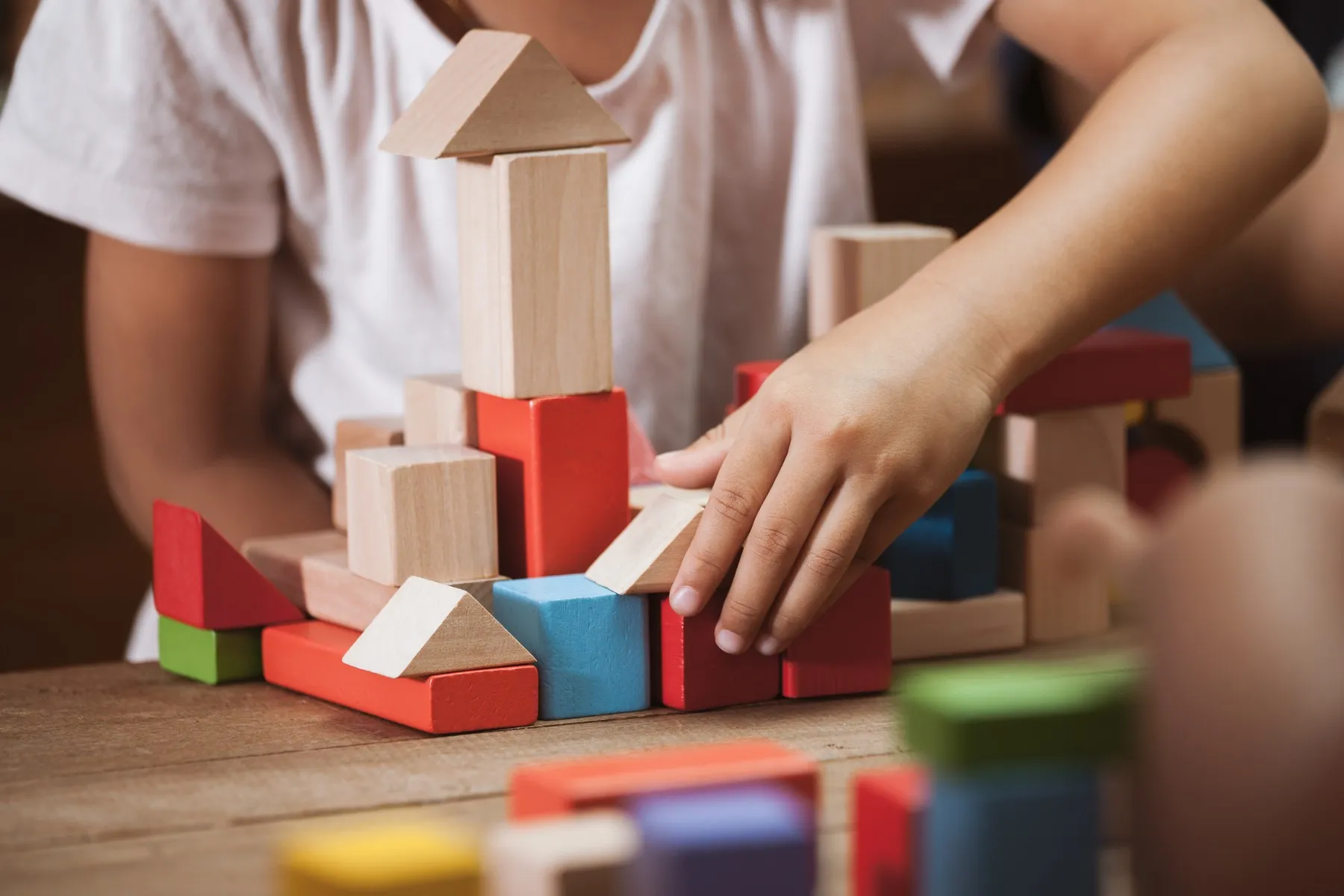
A construction area, for example, is not only about building. With the right resources, it can support positional language, measuring, shape, balance, collaboration and problem-solving. Add rulers, labels, photographs of bridges, clipboards and challenge cards, and suddenly children are designing, testing, adapting and explaining.
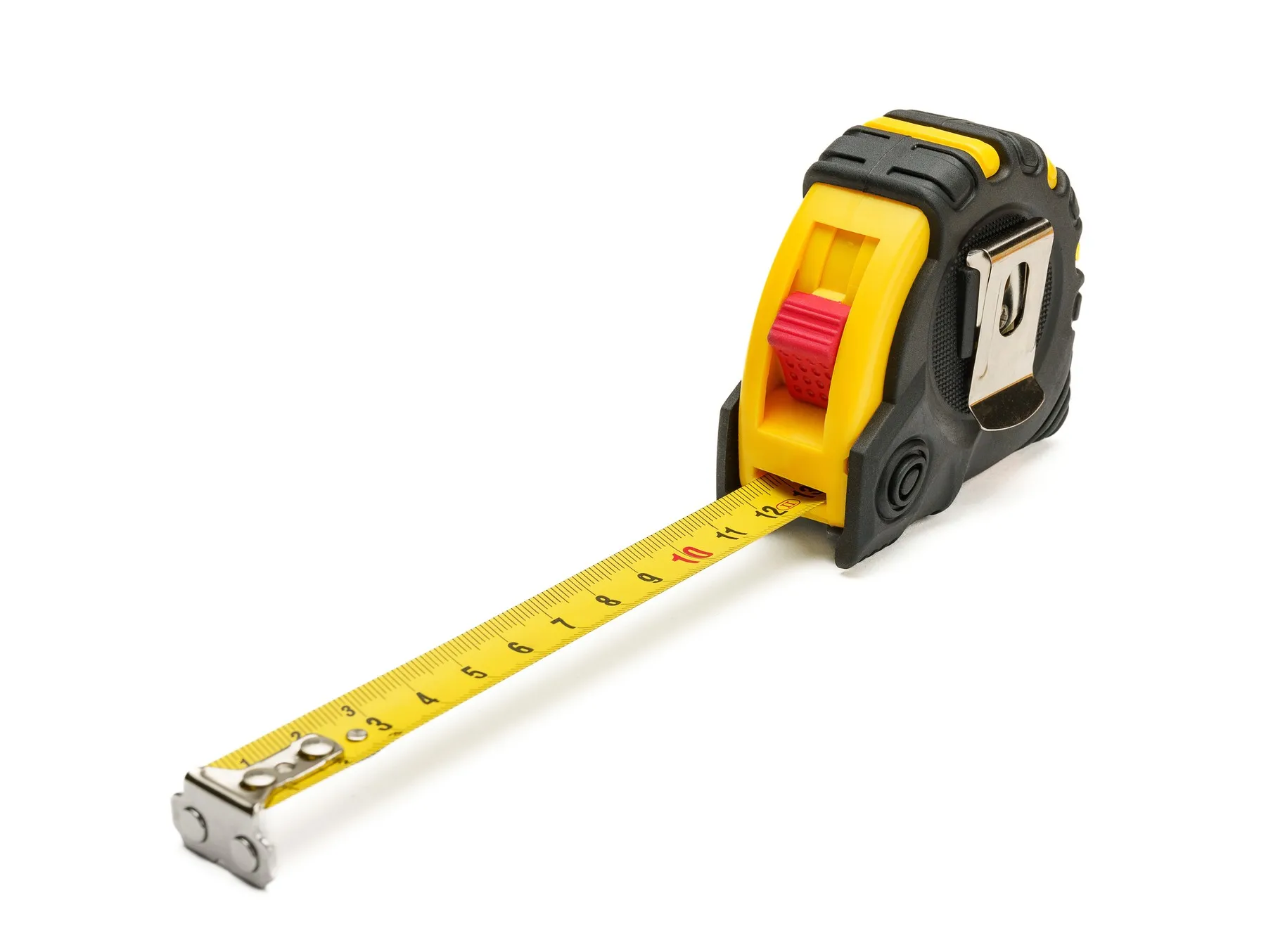
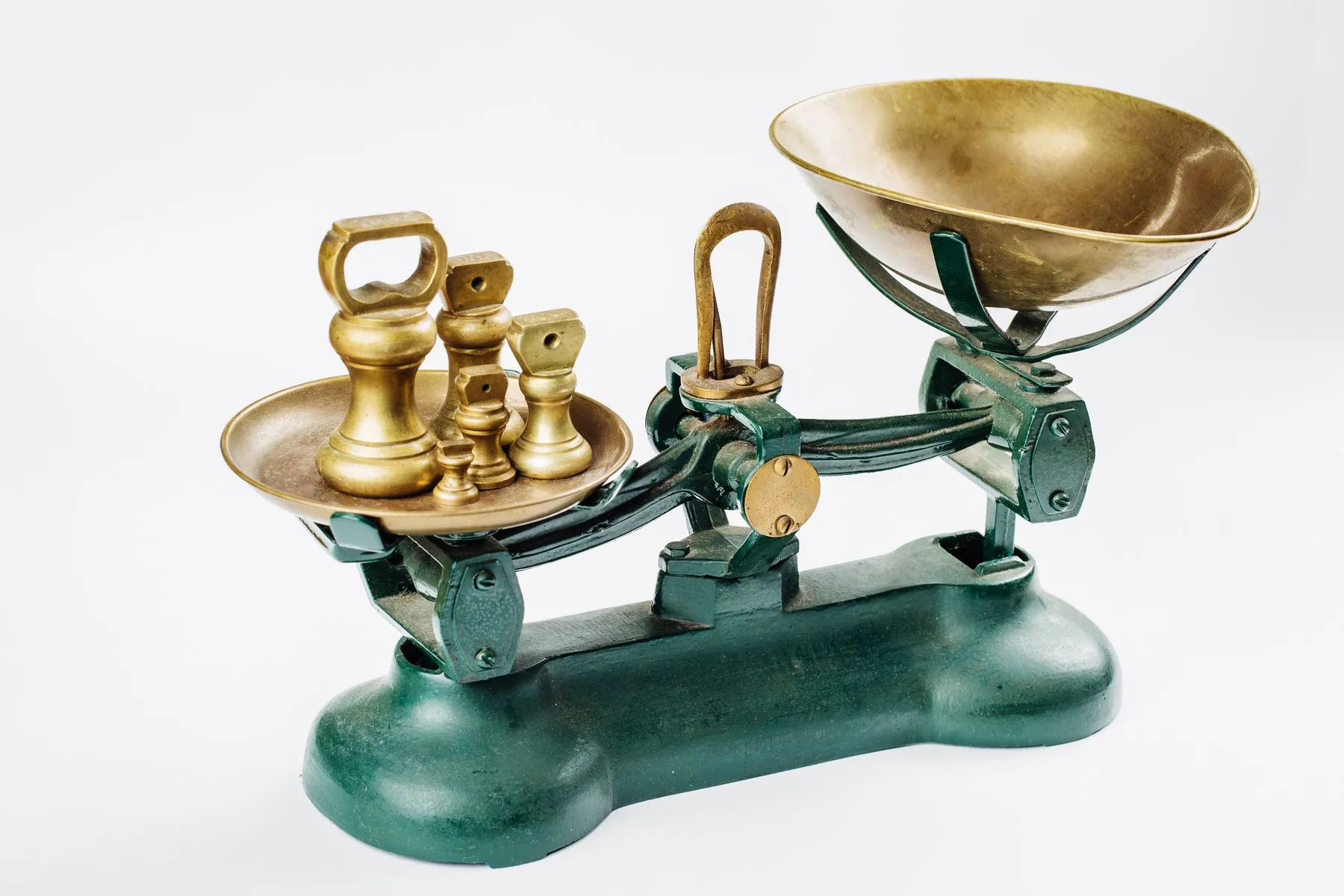
A maths area can help children practise fluency without another worksheet. Ten frames, bead strings, dice, counters, cubes, dominoes, balance scales, coins, clocks and measuring tapes all give children repeated experiences of number in action. This is especially useful in Year 1, where children need to become flexible with number, not simply complete calculations on paper.

Writing areas should feel purposeful. Children are far more likely to write when writing has a reason. Include postcards, envelopes, lists, signs, maps, speech bubbles, tiny notebooks, labels, menus, registers and little "books" stapled together. Link it to current texts or topics but keep it open enough for children to bring their own ideas. For reluctant writers, provision can reduce the pressure while increasing the amount of meaningful writing they choose to do. Also consider: does writing absolutely need to take place at a desk? Some children might be more comfortable on the floor or in a more relaxed space with something to lean on.

Role play remains valuable in Year 1, but it may need to feel a little more grown-up than it did in Reception. The home corner may have been the "staple" in Reception. Now, in Year 1 you have the freedom to explore other ideas such as shops or market set-ups, vet surgeries, post offices, travel agents or cafes, which can all create rich opportunities for vocabulary, counting, social communication, writing and problem-solving. The key is to resource it with real reasons to read, write, count and talk.
Your small-world provision is excellent for storytelling, oral rehearsal and for developing comprehension skills. Story baskets, character figures, maps, natural materials and topic-linked scenes can help children retell familiar stories, invent new ones and practise the language of sequencing. This can be particularly powerful before writing, as children often need to say and play with ideas. It is a great way for them to organise their thoughts before writing something down on a blank piece of paper.
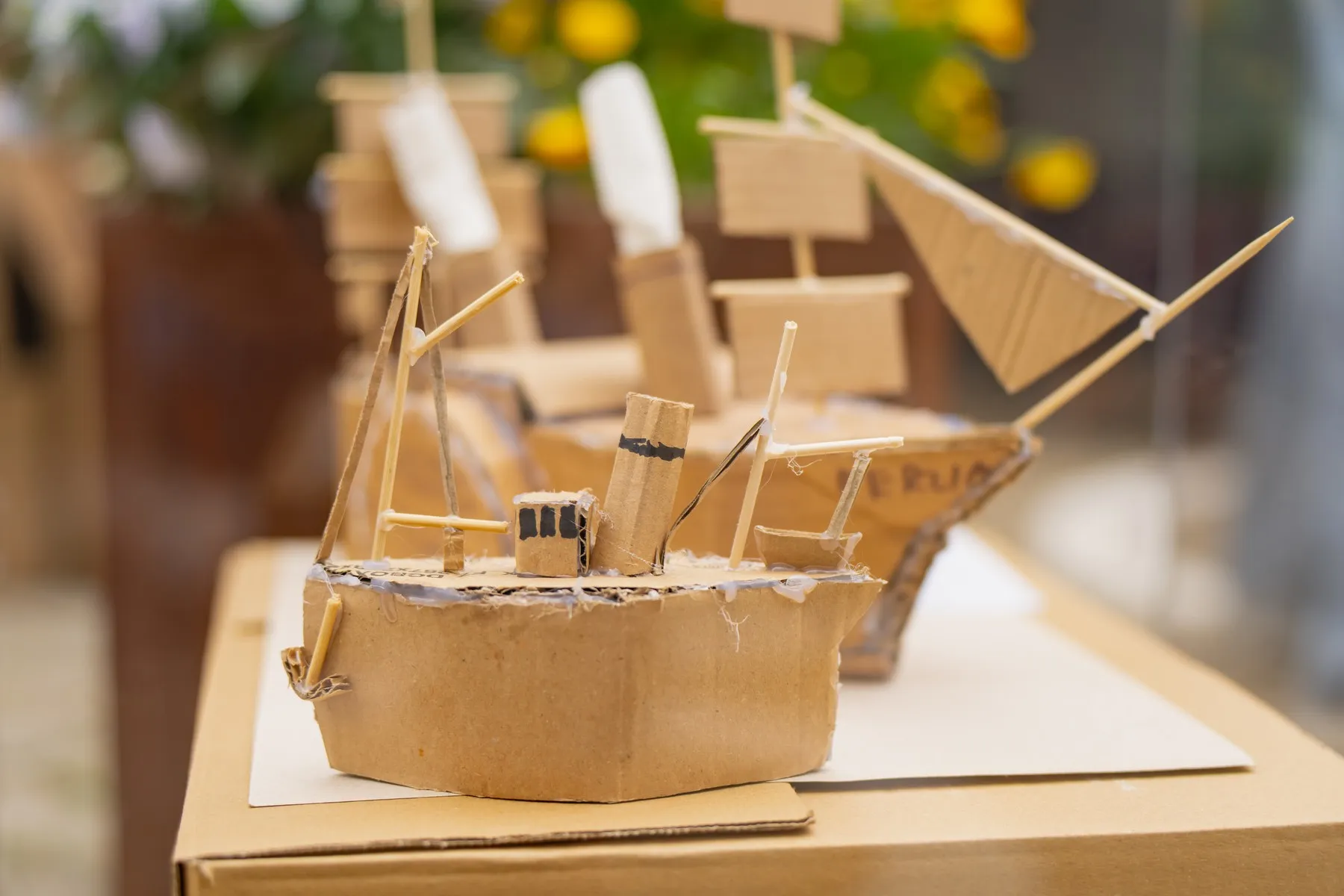
Creative and design areas also have a clear place in Year 1. Creativity and problem solving are such incredible life skills and these areas can really support with this. Junk modelling, collage, joining materials, hole punches, split pins, masking tape, fabric, card and simple tools allow children to plan, make, evaluate and improve. These are not just "filler" activities. They support Design Technology, fine motor control, language, resilience and problem-solving.
If you are lucky enough to still have access to outdoor provision in Year 1, then use it as much as you can! Large-scale construction, sand, water, chalk, gardening, den building, measuring trails and physical maths games allow children to learn through movement. For some children, especially those who struggle to sit still for long periods, outdoor provision can be the place where their thinking becomes most visible.
Here are some essential resources for your classroom areas and the reason behind them.
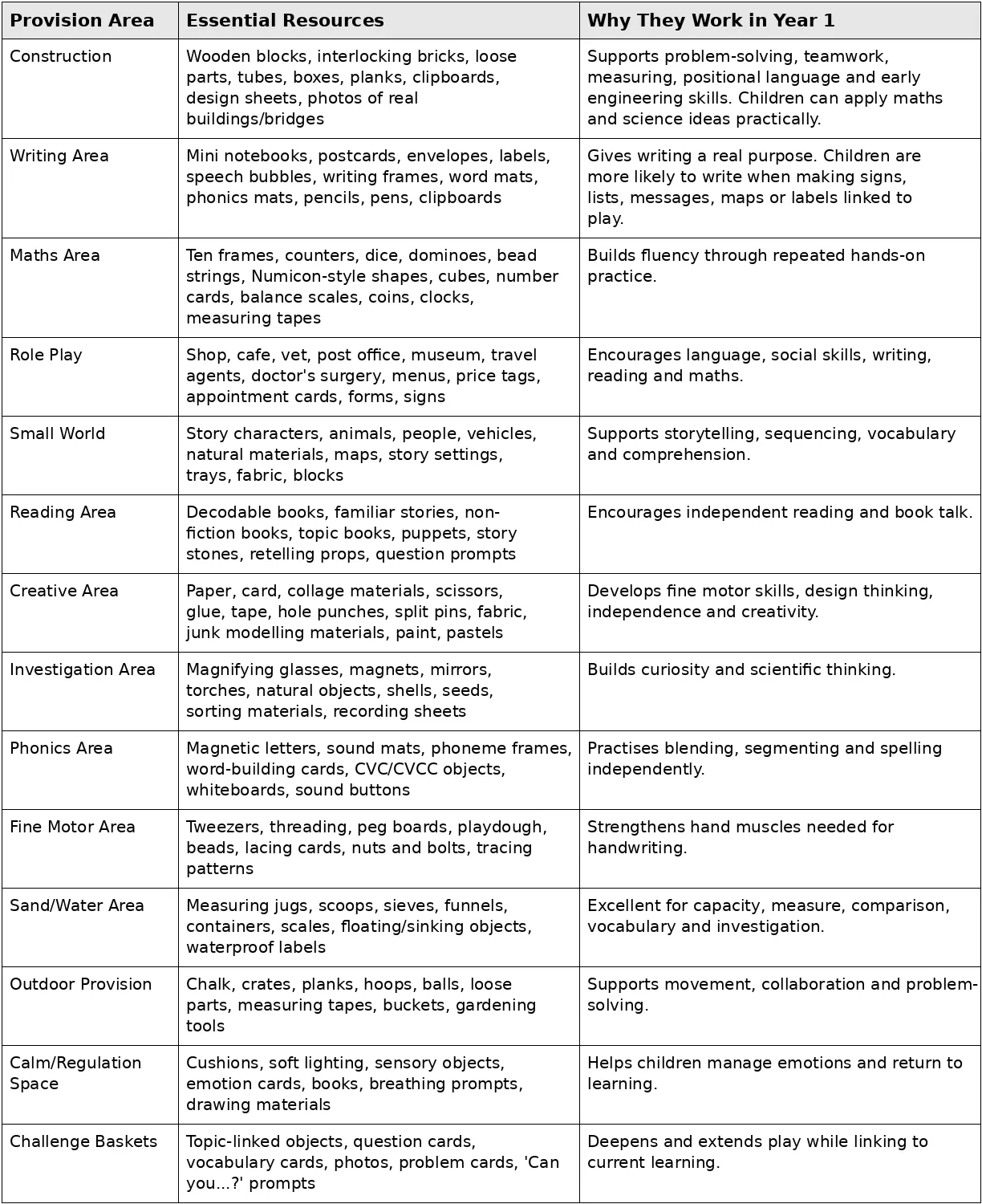
Something essential that you need to remember: a strong Year 1 provision set-up does not need everything at once. The suggestions above can be adapted and changed over time. The key is to have core resources that stay familiar, then add carefully chosen enhancements that link to current phonics, maths, science, history, geography or story learning. A few well-planned areas, linked to current learning and resourced with care, are better than a room full of busy activities with no clear purpose.
Also, we should recognise that continuous provision in Year 1 won't look exactly the same as it does in Reception — and that's fine. The curriculum demands are different, and Year 1 teachers still need to make space for phonics, maths, reading groups, direct teaching and all the other essential parts of the school day.
Something to really consider is that continuous provision benefits children because it respects how six-year-olds learn best: through talk, action, repetition, imagination and meaningful challenge. It supports independence because children have to make their own decisions and to some extent take responsibility for their own learning. It supports language because children need to negotiate, explain and question. It supports curriculum learning because skills are revisited in different contexts. It supports wellbeing because children feel a sense of security in being trusted to take ownership of their learning, while also being active, engaged and involved.
Continuous provision in Year 1 is not about choosing play over progress. It is about creating the conditions for children to practise, apply and deepen their learning in ways that make sense to them.
Eyfs Year 1 Wanted Templates Colour Resource | Classroom Secrets
Year 1 Full And Empty Practical Activities Resource | Classroom Secrets
Year 1 The Number Line To 50 Practical Activities Resource | Classroom Secrets
Images: istock
References
Nicholson, P. (2019). Play-based pedagogy under threat? A small-scale study of teachers' and pupils' perceptions of pedagogical discontinuity in the transition to primary school. Education 3-13, 47(4), 450–461.
Skene, K., O'Farrelly, C. M., Byrne, E. M., Kirby, N., Stevens, E. C., & Ramchandani, P. G. (2022). Can guidance during play enhance children's learning and development in educational contexts? A systematic review and meta-analysis. Child Development, 93(4), 1162–1180.
Pyle, A., & Danniels, E. (2017). A continuum of play-based learning: The role of the teacher in play-based pedagogy and the fear of hijacking play. Early Education and Development, 28(3), 274–289.
Fisher, K. R., Hirsh-Pasek, K., Newcombe, N., & Golinkoff, R. M. (2013). Taking shape: Supporting preschoolers' acquisition of geometric knowledge through guided play. Child Development, 84(6), 1872–1878.
Weisberg, D. S., Hirsh-Pasek, K., Golinkoff, R. M., Kittredge, A. K., & Klahr, D. (2016). Guided play: Principles and practices. Current Directions in Psychological Science, 25(3), 177–182.
Education Endowment Foundation. (n.d.). Communication and language approaches. https://educationendowmentfoundation.org.uk/early-years/toolkit/communication-and-language-approaches

Try us today!