x1
Select a tag to view relevant resources
Autumn
Spring
Summer
Science Events
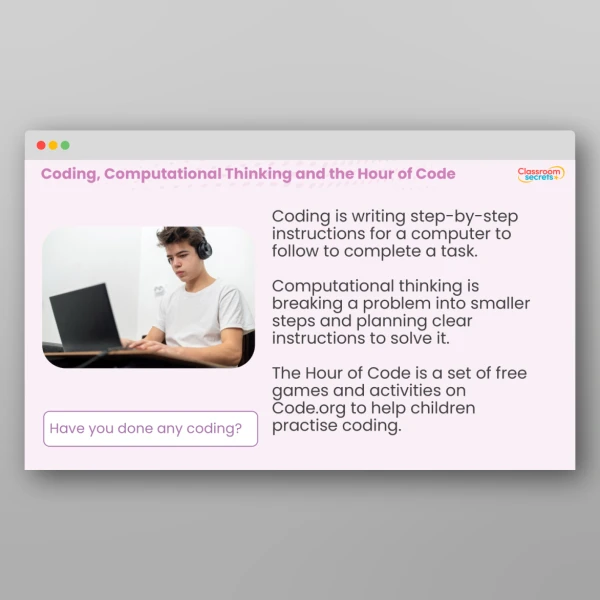
Computer Science Education Week Whole School Assembly PowerPoint is a slideshow for the week in December that celebrates computing and encourages children to learn new computing skills. The content includes 11 slides with teacher notes, covering what Computer Science Education Week is, why it marks Grace Hopper's birthday, why the week is important, coding, computational thinking and the Hour of Code, key computing terms, Ada Lovelace, Cynthia Breazeal, the future of computing and a final recap. It links to computing learning about algorithms and programming.
Why the week is held around Grace Hopper's birthday on 9th December, what coding and computational thinking mean and the free Hour of Code and Hour of AI activities on Code.org, with questions such as "What do you enjoy learning about in Computing lessons?"
A guessing game about algorithms, sequencing, loops and debugging, and the achievements of Ada Lovelace, often considered the first computer programmer, and robotics professor Cynthia Breazeal.
Ideas for sustainable, educational and home computing, asking "Which of these would you most like to help invent in the future? Why?"
Our whole school assemblies are PowerPoint slideshows that follow a similar structure: an introduction, questions to get children thinking, the key points of the topic and reflection time. They're paced to suit a primary school assembly and work best on a whiteboard, projected out to the hall. You can use them:
The majority of our assemblies include teacher notes and guidance to support delivery, and because they're pacey, you can adapt them to however long your assembly lasts.
Every assembly is editable, so you can add, remove or change slides to suit the needs of your school. We cover religious events, seasonal topics, values such as kindness, friendship and tolerance, science, history, PSHE, music, significant people and sporting events, so you can choose the assemblies that fit your school year.
Families can carry the conversation on at home by asking children about their assembly: what they heard, how it made them feel and what they think about it.
You can explore more of our whole school assembly resources here.
Select a tag to view relevant resources
Autumn
Spring
Summer
Science Events