x1
Select a tag to view relevant resources
Autumn
Spring
Summer
Citizenship
Values
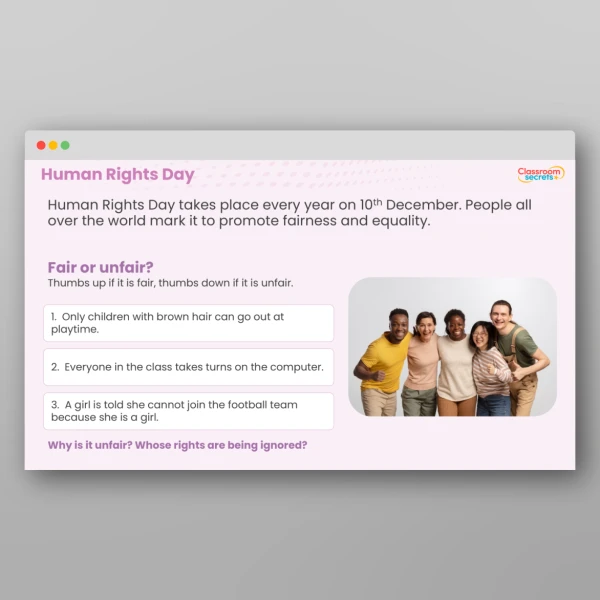
Human Rights Day Whole School Assembly PowerPoint is a slideshow that explores the day celebrated around the world on 10th December to promote fairness, equality and dignity for everyone. The content includes 11 slides, covering what Human Rights Day is, the Universal Declaration of Human Rights, what human rights means, the difference between rights and wants, the UN Convention on the Rights of the Child, discrimination, ways to promote fairness, a take-home challenge and who children can talk to if something doesn’t feel right. It links to the PSHE curriculum and supports learning about rights, respect and equality.
The slides explain how the Universal Declaration of Human Rights was adopted by the United Nations on 10th December 1948, and what the United Nations is. A simple timeline shows how this led to the UN Convention on the Rights of the Child in 1989, which the UK agreed to follow in 1991. Children break down what “human rights” means and learn that rights don’t have to be earned and can’t be taken away as a punishment. A short, age-appropriate story about Ruby Bridges helps children understand discrimination and think about how it feels to be treated unfairly.
The assembly is full of interactive moments to keep the whole hall involved. Children give a thumbs up or thumbs down to decide whether everyday scenarios are fair or unfair and to sort rights from wants, including tricky pairs such as play and toys. In a guess-and-reveal activity, they spot which rights from the Convention are shown in pictures. They also answer questions such as “Imagine a day without one of these rights. What would change?” and “How do you think Ruby felt walking into school?” Optional KS2 questions on several slides stretch older pupils further.
Follow-up ideas include building a rights pledge tree, where each class adds a leaf showing one way they will help everyone feel included. Children can also take on a take-home challenge: drawing a poster about a right that matters to them, talking with their grown-ups about fairness, or doing a kind act for someone in their community.
Our whole school assemblies are PowerPoint slideshows that follow a similar structure: an introduction, questions to get children thinking, the key points of the topic and reflection time. They’re paced to suit a primary school assembly and work best on a whiteboard, projected out to the hall. You can use them:
as a whole school assembly, from EYFS up to KS2
as a class assembly
as a teaching PowerPoint when you want to cover an event or topic in your own classroom
The majority of our assemblies include teacher notes and guidance to support delivery. This assembly includes answer guidance for every activity, background information on the people who wrote the Universal Declaration of Human Rights, and a closing slide signposting children to trusted adults and Childline, with safeguarding guidance for staff. Because they’re pacey, you can adapt them to however long your assembly lasts.
Every assembly is editable, so you can add, remove or change slides to suit the needs of your school. We cover religious events, cultural celebrations, seasonal topics, values such as kindness, friendship and tolerance, science, history, PSHE, music, significant people and sporting events, so you can choose the assemblies that fit your school year.
Families can carry the conversation on at home by asking children about their assembly: what they heard, how it made them feel and what they think about it. The take-home challenge gives families a simple way to celebrate Human Rights Day together.
You can explore more of our whole school assembly resources here.
Select a tag to view relevant resources
Autumn
Spring
Summer
Citizenship
Values