x1
![An image of the [object Object] Resource](https://d52m8jhkbaeog.cloudfront.net/featured-images-lq/6b9cc78099e1d2ad17ef49cb80c36e4ac1c55a8e/6b9cc78099e1d2ad17ef49cb80c36e4ac1c55a8e.webp)
Select a tag to view relevant resources
Autumn
Spring
Summer
Anti-Bullying Week
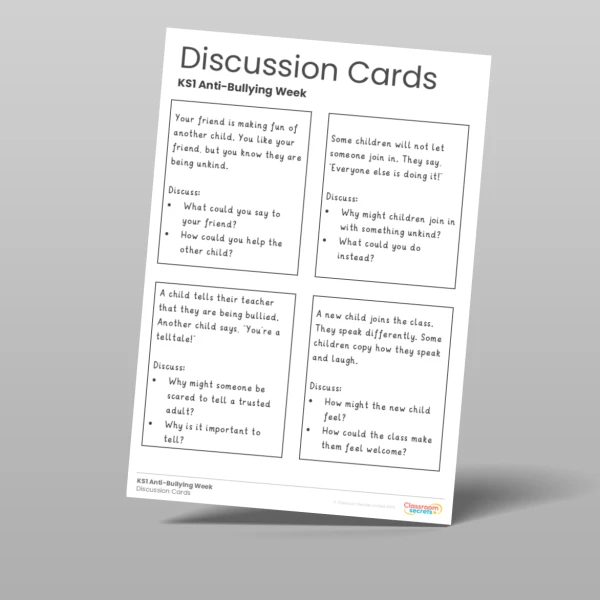
If you are looking for a great way to explore bullying, friendships and speaking up, these KS2 Anti-Bullying Week Discussion Cards are an ideal resource.
The pack contains 20 discussion cards. Each one presents a realistic scenario that children in Year 3 to Year 6 may face at school, online or at clubs, followed by questions that encourage children to reason, share opinions and consider what they could do.
A key focus of the cards is helping children understand what bullying is and what it isn’t. Alongside scenarios showing repeated name-calling, exclusion, threats, rumours and physical behaviour, some cards show situations that are upsetting but not bullying. These include a friend choosing to sit with someone else, a disagreement over a game, a fair consequence from a teacher and not being picked for a team. Children learn to recognise when behaviour is repeated, intentional and hurtful, and why that matters.
Several cards explore online bullying, including unkind messages in a class group chat, nasty comments on a gaming platform and an embarrassing photo shared without permission. These prompt discussion about blocking, keeping evidence and telling a trusted adult.
The cards are perfect for PSHE and RSHE lessons, circle time or small group discussion during Anti-Bullying Week. They also work well at any point in the year when you want to build a kind and respectful classroom culture.
Select a tag to view relevant resources
Autumn
Spring
Summer
Anti-Bullying Week