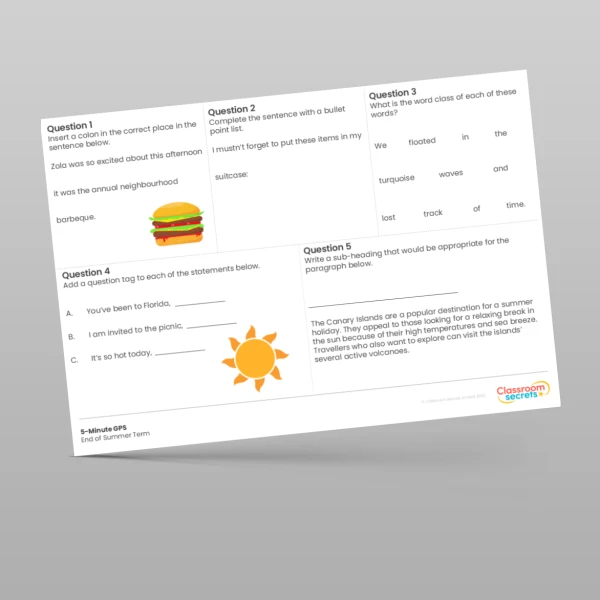
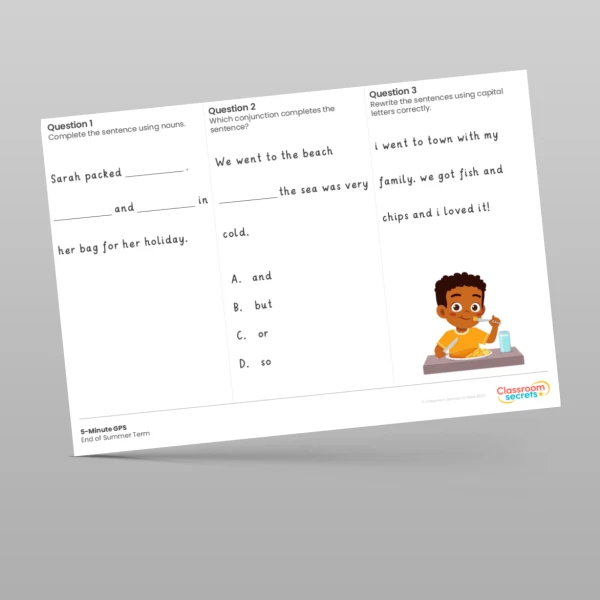
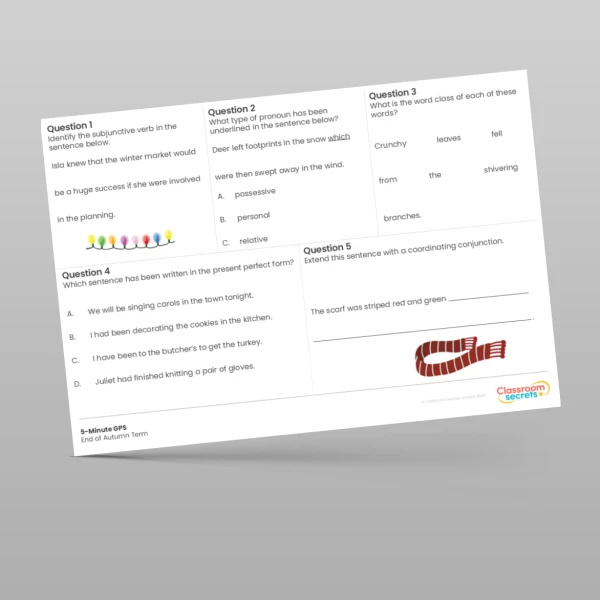
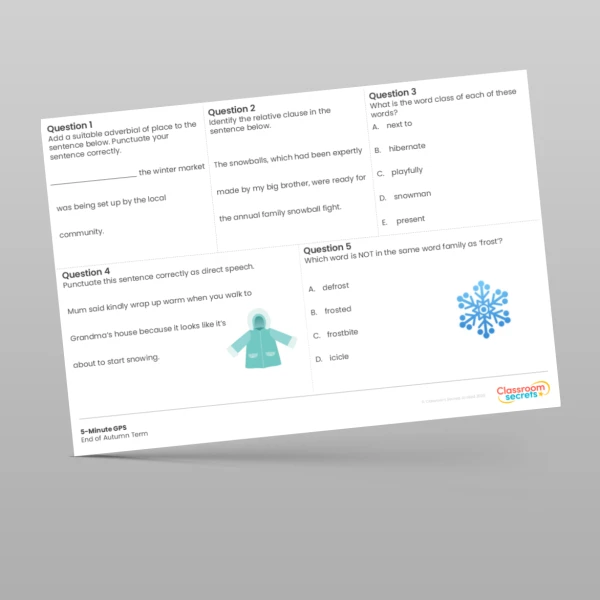
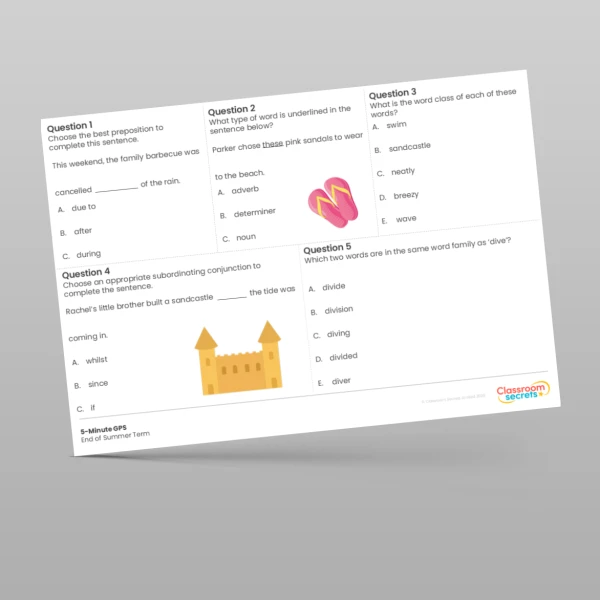
5-Minute GPS End of Summer Term

An image of the 5-Minute GPS End of Summer Term Resource


This Year 2 5-Minute GPS End of Summer Term resource, which features three pages of mixed questions to help your children practice, is a fantastic way to help your children embed their grammar, punctuation and spelling knowledge at the end of the summer term.

All topics are covered throughout the year, meaning you can relax in the knowledge that children will recap everything they need to know with these mixed questions.

As this is a summer resource, the questions will include anything that your class have learned in Year 1 so far. Answer sheets are also provided for quick and easy marking.

Designed to be displayed on the interactive whiteboard for early morning work, a lesson starter or a 5-minute challenge, this colourful resource ties in with our grammar, punctuation and spelling curriculum and our ever-popular grammar assessments.

Download today to try it out!


Curriculum Objectives

  • Learning how to use both familiar and new punctuation correctly including: commas for lists / Commas to separate items in a list / Terminology for pupils: comma
  • Learning how to use both familiar and new punctuation correctly including: apostrophes for contracted forms and apostrophes for the possessive (singular) / Apostrophes to mark where letters are missing in spelling and to mark singular possession in nouns [for example, the girl’s name] / Terminology for pupils: apostrophe
  • Understand and use sentences with different forms: statement / How the grammatical patterns in a sentence indicate its function as a statement / Terminology for pupils: statement
  • Understand and use sentences with different forms: question / How the grammatical patterns in a sentence indicate its function as a question / Terminology for pupils: question
  • Understand and use sentences with different forms: exclamation / How the grammatical patterns in a sentence indicate its function as a exclamation / Terminology for pupils: exclamation
  • Understand and use sentences with different forms: command / How the grammatical patterns in a sentence indicate its function as a command / Terminology for pupils: command
  • Learn how to use: Expanded noun phrases to describe and specify [for example, the blue butterfly] / Expanded noun phrases for description and specification [for example, the blue butterfly, plain flour, the man in the moon] / Terminology for pupils: noun phrase
  • Learn how to use: The present and past tenses correctly and consistently including the progressive form / Correct choice and consistent use of present tense and past tense throughout writing / Terminology for pupils: tense (past, present)
  • Learn how to use: Co-ordination (using or, and, or but) / Co-ordination (using or, and, but)
  • Learn how to use: Subordination (using when, if, that, or because) / Subordination (using when, if, that, because) / Develop their understanding of the concepts set out in English appendix 2 by: Extending the range of sentences with more than one clause by using a wider range of conjunctions, including: when, if, because, although
  • Formation of nouns using suffixes such as –ness, –er and by compounding [for example, whiteboard, superman] / Formation of adjectives using suffixes such as –ful, –less (A fuller list of suffixes can be found in the year 2 spelling section in English Appendix 1) / Use of the suffixes –er, –est in adjectives / Terminology for pupils: compound / Terminology for pupils: suffix
  • Terminology for pupils: noun
  • Terminology for pupils: adjective
  • Terminology for pupils: verb

Tags

Select a tag to view relevant resources

Summer

2G5.5

2G5.8

2G2.1

2G2.2

2G2.4

2G2.3

2G3.2

2G4.2

2G3.3

2G3.4

2G6.3

2G1.1

2G1.3

2G1.2