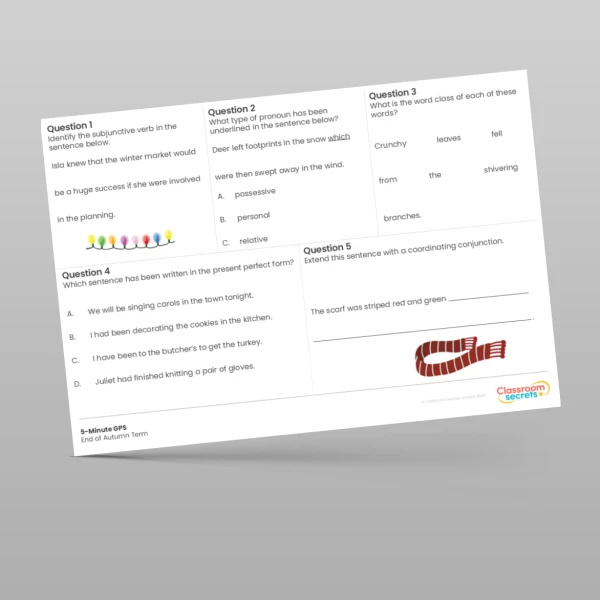
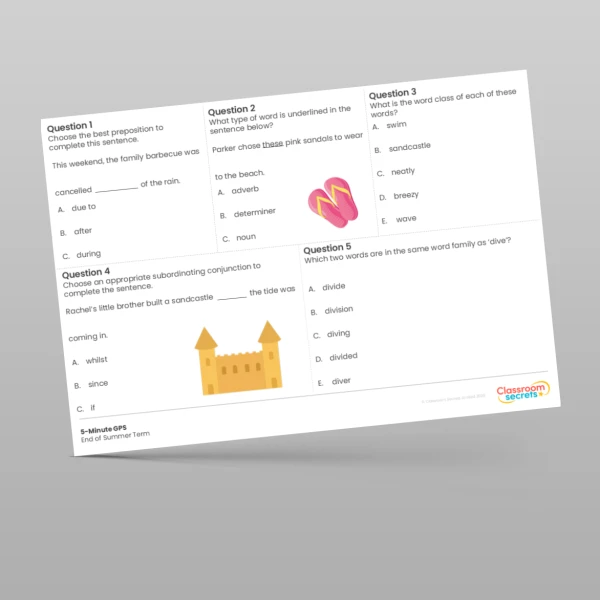
5-Minute GPS End of Summer Term

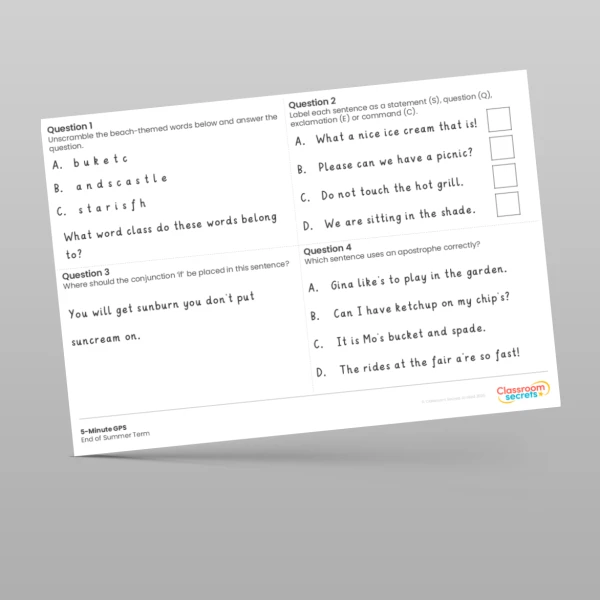
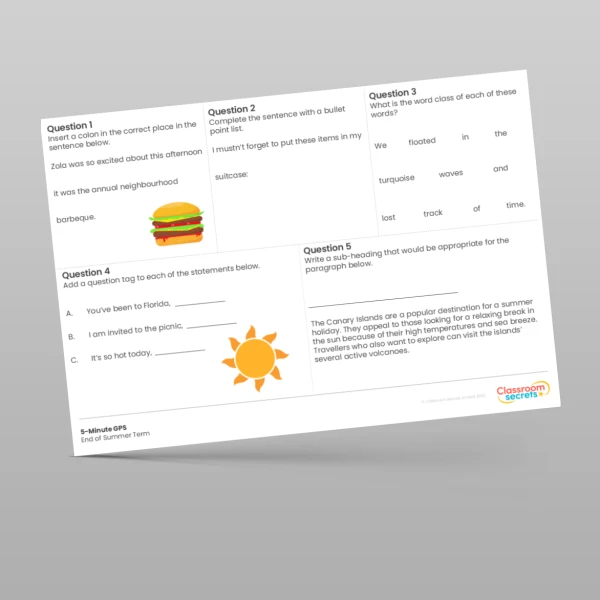
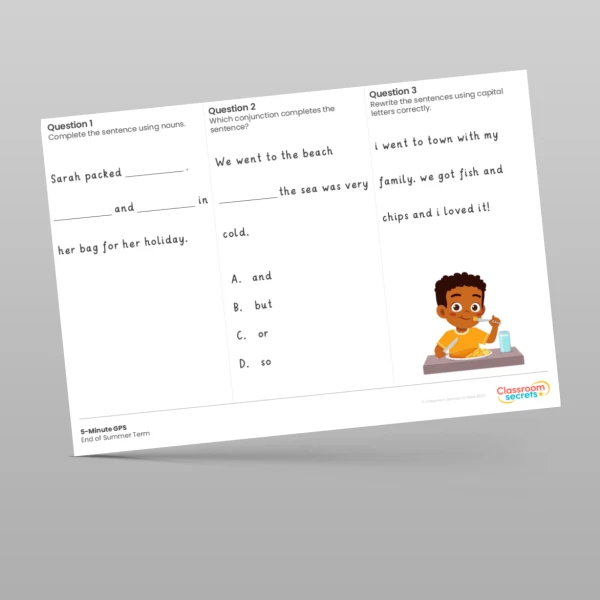
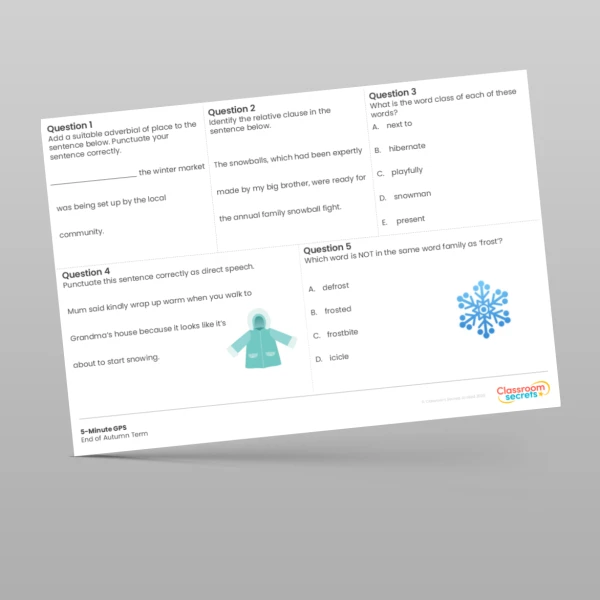
An image of the 5-Minute GPS End of Summer Term Resource


This Year 5 5-Minute GPS End of Summer Term resource features three pages of fluency questions which will help children embed their grammar, punctuation and spelling knowledge at the end of the summer term.

All topics have been covered throughout the year, meaning you can relax in the knowledge that your class will be reviewing everything they need to know as they progress through the questions.

As this is a summer resource, all questions have a summer or holiday theme, keeping it light and engaging. Answer sheets are provided for quick and easy marking.

Designed to be displayed on the interactive whiteboard for early morning work, a lesson starter or a 5-minute challenge, this colourful resource ties in with our grammar, punctuation and spelling curriculum and our ever-popular grammar assessments.

Download it today and try it out!


Curriculum Objectives

  • Develop their understanding of the concepts set out in English appendix 2 by: Using the perfect form of verbs to mark relationships of time and cause
  • Develop their understanding of the concepts set out in English appendix 2 by: Using expanded noun phrases to convey complicated information concisely
  • Develop their understanding of the concepts set out in English appendix 2 by: Using modal verbs to indicate degrees of possibility / Indicating degrees of possibility using modal verbs [for example, might, should, will, must] / Terminology for pupils: modal verb
  • Develop their understanding of the concepts set out in English appendix 2 by: Using adverbs to indicate degrees of possibility / Indicating degrees of possibility using adverbs [for example, perhaps, surely]
  • Develop their understanding of the concepts set out in English appendix 2 by: Using relative clauses beginning with who, which, where, when, whose, that or with an implied (ie omitted) relative pronoun / Relative clauses beginning with who, which, where, when, whose, that, or an omitted relative pronoun / Terminology for pupils: relative clause
  • Indicate grammatical and other features by: Using commas to clarify meaning or avoid ambiguity in writing / Use of commas to clarify meaning or avoid ambiguity / Terminology for pupils: ambiguity
  • Indicate grammatical and other features by: Using brackets, dashes or commas to indicate parenthesis / Brackets, dashes or commas to indicate parenthesis / Terminology for pupils: parenthesis / Terminology for pupils: bracket / Terminology for pupils: dash
  • Converting nouns or adjectives into verbs using suffixes [for example, –ate; –ise; –ify]
  • Verb prefixes [for example, dis–, de–, mis–, over– and re–]
  • Terminology for pupils: relative pronoun
  • Terminology for pupils: cohesion

Tags

Select a tag to view relevant resources

Summer

5G4.1b

5G3.2

5G4.1c

5G1.6

5G3.1a

5G5.6a

5G5.9

5G6.3

5G6.2

5G1.5b

5G1.5