How Do I Help My Child with Maths? Simple Ways to Support Maths at Home
16th September 2026
Written by Lee Peckover
At one time or another, most parents find themselves asking the same question: how do I help my child with maths?
The good news is that you do not need to be a maths expert or remember every method you were taught at school.
Schools will usually already have their own approach to homework and home learning. Beyond that, some of the most useful ways to support maths are surprisingly simple: talking about numbers, noticing maths in the real world, playing games, cooking, shopping and asking your child how they worked something out.
In other words, helping with maths at home does not have to mean turning your kitchen table into another classroom.
Parents want to help, but knowing how is not always easy
Most parents and carers want their child to do well at school. Most also quite often feel they aren’t doing enough or should be doing more. That parent guilt is very real and, if I’m honest, I feel it all the time myself. If you feel like you don’t have the time, energy or capacity to do as much as you think you should be doing, then you are not alone! Parentkind's 2026 National Parent Survey found that only 43% of parents actually feel happy with the amount they are doing to support learning at home.
It isn’t just about doing enough, though. Often, the tricky bit is knowing what to do! Almost 20% of parents say their school does not provide enough information on how to support learning at home. Maths can be a particularly difficult area. Recent National Numeracy research found that 23% of parents and carers feel anxious about helping with maths homework, while one in five say maths homework has caused arguments at home (National Numeracy, 2026a).
As a teacher and parent myself, I am not surprised to learn that maths can be a tricky area for parents to support. Maths can sometimes look a little different from how it did when we were at school. Your child might talk about number bonds and bar models rather than using the methods you remember. You may simply have never felt particularly confident with maths yourself.
The good news is that helping does not mean becoming your child's maths teacher.
Research reviewed by the Education Endowment Foundation (EEF) finds a positive relationship between parental engagement and learning, including in primary schools. But useful parental involvement can be much broader than directly teaching schoolwork (EEF, 2025).
For maths, some of the best opportunities are already around you.
Look for the maths that is already happening
Maths is much easier to talk about when it has a purpose.
Shopping, cooking, travelling, playing games and even working out whether you have enough time to leave the house all involve maths.
You could ask:
Which of these costs more?
If we need two tins, roughly how much will that cost?
We need to leave at 8:20. How long have we got?
The sign says 30 mph. What does that mean?
Can you divide these strawberries equally between four people?
We need 250 g of flour. Where would that be on the scales?
You're winning 7–4. How many points ahead are you?
This journey is 24 miles. We've travelled 10. How far is left?
You do not need to turn every trip to the supermarket into a maths lesson. Simply noticing and talking about the numbers children encounter helps maths become something that belongs in the real world rather than only in a school exercise book. Often, the best thing you can do to support children’s learning is to give it purpose and show an interest.
The EEF particularly recommends weaving mathematical talk into everyday activities for younger children, including mealtimes, play, stories and routines (EEF, 2020).
With younger children, count, compare and share
Some of the most important early maths can be practised with almost no equipment.
Count the steps as you climb them. Count out plates for dinner. Ask which pile has more. Share food equally. Look for shapes on buildings. Compare which stick is longer. Spot numbers on doors, buses and road signs.
You might also hear school talking about number bonds.
A number bond is simply a pair of numbers that combine to make another number. For example, 7 and 3 are a number bond to 10. So are 6 and 4, and 5 and 5.
Rather than sitting down to learn them from a sheet every time, you can occasionally turn them into a quick question:
"We've got 6 grapes here. How many more would make 10?"
Physical objects can help too. Buttons, Lego bricks, toys, pasta or pieces of fruit can all be moved, grouped, counted and shared. The EEF highlights everyday objects and manipulatives as useful ways of helping younger children make sense of mathematical ideas before connecting them to more abstract numbers and symbols (EEF, n.d.-a).
Ask your child how they would do it
One of the most useful things you can say when your child brings maths home is:
"Can you show me how you've been taught to do it?"
You do not have to know the school's method.
In fact, asking your child to explain can be useful mathematical thinking in its own right. It encourages them to put their method into words, think about each step and notice whether it makes sense.
National Numeracy recommends this approach when parents encounter methods that are unfamiliar. Rather than worrying that you may teach the "wrong" method, ask your child to teach it to you (National Numeracy, n.d.-a).
Play games
Games can provide a surprising amount of useful maths.
Dice games involve recognising quantities and counting. Card games involve comparing numbers. Board games involve counting on. Keeping score involves addition and subtraction. Games involving money, property or trading introduce another set of mathematical ideas.
For younger children, there is evidence that linear number board games, where numbered spaces run in order, can support early number understanding (EEF, n.d.-b).
That means something as ordinary as Snakes and Ladders can become useful mathematical practice without anybody announcing that it is time to "do some maths".
Ask occasionally how your child worked something out, but let the game remain a game.
Cook together
Cooking is full of mathematics.
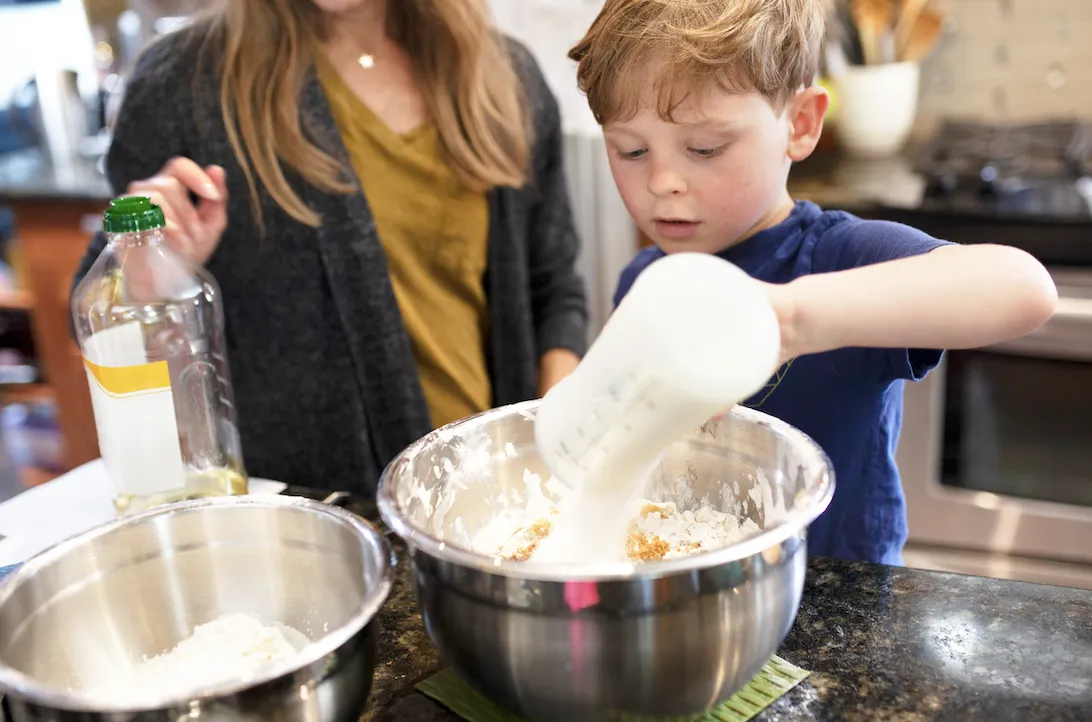
Children can weigh ingredients, read scales, measure liquids and set timers. They encounter fractions when recipes call for half a teaspoon or when food is divided into equal parts.
With older primary children, recipes also create natural opportunities for multiplication, division and proportional reasoning.
A recipe might serve four people, but six are coming for dinner. How much of each ingredient will you need?
It is a real problem with a reason for finding the answer.
Let children use money
Cash may be less visible than it once was, but children still need to understand money.
Let younger children look at coins and prices. Ask which item costs more or whether £5 will be enough.
With older children, you can compare prices, estimate the cost of several items, calculate change or work within a budget.
Supermarkets provide particularly good opportunities to discuss whether something is actually good value.
A packet is £2.40, but two are £4. Is that a saving? How much?
Again, this does not need to become a formal lesson. A question now and then is enough to show that the maths children learn has a job to do.
Be careful with "I'm rubbish at maths"
Many adults had difficult experiences of maths at school. It is perfectly reasonable not to enjoy everything you learned.
But children pick up a great deal from the way adults around them talk about subjects.
National Numeracy recommends avoiding comments such as "I was never any good at maths" or "I hated maths at school", because they can contribute to children seeing mathematical ability as something people either have or do not have (National Numeracy, n.d.-b).
You do not need to pretend you know everything.
"I'm not sure. Let's work it out." is a much more useful response.
It shows that being unsure is normal and that maths is something you can think about rather than something you should instantly know.
Read with them
This might seem like strange advice in an article about maths, but reading together remains one of the most valuable things families can do.
Maths involves language.
Children need to understand words such as difference, multiple, factor, increase, altogether, equivalent and approximately. They need to understand a problem, decide which information matters and explain their reasoning.
Reading supports children's vocabulary, language comprehension and background knowledge. The evidence for parental engagement is particularly strong around home reading, although positive effects are also found for mathematics (EEF, 2025).
You do not need to find special "maths books", either. Stories naturally create opportunities to talk about number, shape, size, order, time and comparison, particularly with younger children.
So yes, if you are wondering what useful learning you can regularly do at home, keep reading together.
Practise useful facts, but keep it manageable
There is value in children being able to recall important number facts fluently.
Knowing number bonds and multiplication facts reduces the amount children have to work out from scratch and leaves more attention available for solving the wider mathematical problem.
That does not mean every evening needs a formal test.
Five minutes recalling times tables on a journey, spotting number bonds while cooking or playing a quick number game can provide useful practice.
If practice repeatedly becomes stressful, it is unlikely to be achieving what anybody wants.
What about homework?
Homework is where many parents understandably worry that they should be doing more.
The evidence is more nuanced than either "homework is essential" or "homework doesn't work".
The EEF finds that homework has a positive effect on average, but the benefit is smaller in primary schools, at around three months' additional progress compared with five months overall. The evidence base for homework is also rated as low certainty (EEF, 2026).
Perhaps more importantly, quality appears to matter more than quantity. Homework connected to what children are learning in school, with a clear purpose and useful feedback, tends to be more effective. There is also some evidence that the benefit diminishes as the amount of time spent on homework increases (EEF, 2026).
So, if school sends home a purposeful activity, support your child with it.
But there is little reason for parents to feel they must create a second school day by finding extra worksheets every evening.
Talking about maths, playing games, reading, cooking, shopping and noticing numbers in ordinary life can all support learning, too.
Know when to stop
Sometimes homework just isn't working.
Your child is upset. You have explained it three different ways. Neither of you recognises the method on the page. What began as ten minutes of homework is heading towards a 45-minute argument.
Stop.
Tell the teacher what happened.
National Numeracy advises parents to contact school when homework is too difficult rather than worrying about teaching an unfamiliar method themselves (National Numeracy, n.d.-a).
Finding something difficult is useful information for the teacher. Completing the page after an exhausting evening of adult help may tell them much less.
You don't need to turn your home into a classroom
Supporting maths at home is less about how many extra questions a child completes and more about helping them see numbers as useful, interesting and manageable.
Notice maths when it appears.
Let children count, measure, compare, estimate and solve little problems.
Ask them how they know.
Play games.
Cook together.
Read together.
And if neither of you knows the answer, being willing to say "Let's think about it" may be one of the most useful mathematical habits you can model.
If you do a lot of the above, stop doubting yourself! If you’re the sort of parent who has read all the way to the bottom of this blog, chances are you’re also the sort who will be doubting and questioning yourself. This is you showing how much you care, and the love you give your child through shared activities is already doing a heck of a lot. So, don’t be down on yourself. Give yourself a pat on the back for caring so deeply, and remind yourself that you are already doing so, so well.
References
Education Endowment Foundation. (2020, April 22). Supporting the learning of mathematics at home. https://educationendowmentfoundation.org.uk/news/blog-supporting-the-learning-of-mathematics-at-home
Education Endowment Foundation. (2025). Parental engagement. Teaching and Learning Toolkit. https://educationendowmentfoundation.org.uk/education-evidence/teaching-learning-toolkit/parental-engagement
Education Endowment Foundation. (2026). Homework. Teaching and Learning Toolkit. https://educationendowmentfoundation.org.uk/education-evidence/teaching-learning-toolkit/homework
Education Endowment Foundation. (n.d.-a). Use manipulatives and representations to develop understanding. https://educationendowmentfoundation.org.uk/early-years/maths/use-manipulatives-and-representations-to-develop-understanding
Education Endowment Foundation. (n.d.-b). Integrating maths into everyday routines. https://educationendowmentfoundation.org.uk/early-years/maths/maths-everyday-routines
National Numeracy. (2026, September 4). Fear 'back to school' and helping with maths homework? Read on… https://www.nationalnumeracy.org.uk/news/fear-back-school-and-helping-maths-homework-read
National Numeracy. (n.d.-a). Current teaching methods & helping with homework. https://www.nationalnumeracy.org.uk/helping-children-maths/families/current-teaching-methods-homework
National Numeracy. (n.d.-b). Talking about maths with children. https://www.nationalnumeracy.org.uk/helping-children-maths/families/talking-about-maths-children
Parentkind. (2026). The National Parent Survey 2026. https://nationalparentsurvey.parentkind.org/NIfd

What should I expect when my child starts Reception in September?
2025-06-24
What Are Worked Examples in Maths and When Should You Use Them?
2026-09-02
Progress for every child: introducing Classroom Secrets Adaptive Maths
2026-08-07
What Does Good Scaffolding Look Like in a Primary Maths Lesson?
2026-09-01
What does Continuous Provision in Year 1 look like and how do I make it work?
2026-07-20
Try us today!