Ofsted Inspections from September 2026: What Primary Schools Actually Need to Know
17th September 2026
Written by Lee Peckover
Teachers wanted change. They are much less convinced by what replaced it.
When Ofsted announced that single-word judgements were going, teachers were, on the whole, pretty positive about the idea.
In January 2025, Teacher Tapp asked 9,587 teachers how they felt about replacing single-word judgements with a scorecard-style system. 56% supported the change, while 13% opposed it.
Fast forward to August 2026, with the new report cards now actually being used in schools, and the picture looks very different.
Just 21% of 8,230 teachers now support the change. Strong support has fallen from 17% to just 2%, while opposition has more than doubled to 29%. Half of teachers now say they neither support nor oppose the new approach (Teacher Tapp, 2026a).
It would be difficult to look at those figures and argue that the new system has won teachers over.
There are workload concerns too. In separate Teacher Tapp polling, 60% of teachers said their school had created documents or made operational changes in response to the new inspection framework. Among those who felt able to judge the impact of those changes, 69% said they had made no difference (Teacher Tapp, 2026b).
So, this is not going to be an article telling you why teachers should suddenly be excited about Ofsted.
What we can do is save you from wading through pages and pages of inspection documentation to work out what has actually changed for September 2026, what might affect primary schools and, perhaps just as importantly, what Ofsted says you do not need to start doing.
First, this isn't another completely new Ofsted framework
The biggest change happened last year.
The renewed Education Inspection Framework came into use on 10 November 2025. Under that framework, schools no longer receive one overall effectiveness grade. Instead, Ofsted grades different areas of the school using a five-point scale:
Exceptional
Strong standard
Expected standard
Needs attention
Urgent improvement
For schools, the main evaluation areas are inclusion, curriculum and teaching, achievement, attendance and behaviour, personal development and wellbeing, and leadership and governance. Early years and post-16 provision are also graded where relevant. Safeguarding is reported separately as either met or not met (Ofsted, 2025).
The September 2026 changes are therefore an update to that framework, not another replacement.
Ofsted says it now intends to review and update its inspection materials annually, with changes published in advance of each new academic year (Ofsted, 2026a).
So, what is actually different this year?
Schools will be compared with schools in more similar circumstances
This is one of the more significant changes.
From September 2026, Ofsted's Inspection Data Summary Reports include information comparing a school with other schools operating in similar contexts.
For primary schools, the model looks at attainment in KS2 reading and maths and uses contextual information to identify similar schools. The Department for Education's school-facing platform will identify around 50 comparison schools (DfE, 2026a).
That does not mean a school's new comparison group determines its Ofsted grade.
The DfE explicitly states that the similar-schools information will not be used to make grading decisions. It gives inspectors another piece of context when discussing achievement and progress alongside national data and the evidence gathered during the inspection itself (DfE, 2026a).
That distinction matters.
Schools serving communities with different levels of disadvantage, SEND, pupil mobility and prior attainment do not operate in identical circumstances. Ofsted says context should help inspectors interpret the evidence fairly without lowering expectations for pupils.
There is an even greater focus on inclusion
Inclusion was already a major part of the renewed framework, but the September update adds and clarifies several expectations.
Ofsted uses inclusion quite broadly. It includes pupils with SEND, disadvantaged pupils and children known to social care, but also pupils who face other barriers to their learning or wellbeing.
The updated guidance also places more emphasis on inspectors engaging with SENCos, designated teachers and other leaders with responsibilities for inclusion, as well as pupils and families (Ofsted, 2026a).
This connects with another significant change for 2026/27: the new Inclusive Mainstream Fund.
Schools receiving the fund are required to develop and publish an inclusion strategy statement by 31 December 2026. The strategy should identify the commonly occurring needs and barriers within the school and explain how provision and funding will be used to address them. It will also be available for Ofsted inspectors to consider when evaluating inclusion (DfE, 2026b).
There is an important classroom message beneath all of this.
The government's own inclusion guidance places high-quality teaching designed to meet a range of needs at the centre of inclusive provision, alongside timely, evidence-based targeted support where it is needed (DfE, 2026b).
Inclusion is not simply something that happens outside the classroom after a pupil has been identified as needing something different.
Assessment is supposed to change what happens next
One of the most useful parts of the inspection toolkit is actually quite straightforward.
At the expected standard for curriculum and teaching, Ofsted says leaders and staff should use assessment to check pupils' understanding and make changes to teaching or the curriculum when necessary.
It also expects high-quality teaching to be supplemented by targeted academic support, with adaptations and reasonable adjustments considered carefully for pupils who need them (Ofsted, 2026b).
For a classroom teacher, that is much more meaningful than trying to second-guess what an inspector might want a lesson to look like.
You teach something.
You check what pupils have understood.
If they have not understood it, you work out where the difficulty is and respond.
That might mean another explanation, returning to a representation, providing a scaffold, changing the question, giving additional practice or working briefly with a group.
If pupils are secure, it might mean taking the learning deeper rather than moving immediately onto the next objective.
That is formative assessment and adaptive teaching doing an actual job.
Achievement is about more than the headline results
Achievement has been one of the trickiest areas for schools under the new framework.
Of the first 921 full inspections under the renewed framework, 70% were graded expected standard or above for achievement, compared with 77% for curriculum and teaching, 89% for inclusion and 95% for personal development and wellbeing (Ofsted, 2026c).
However, Ofsted has explicitly warned against interpreting those figures as representative of all schools. The schools inspected during a particular period are not a representative sample of the sector, and lower-performing schools are inspected more frequently (Ofsted, 2026d).
Ofsted also says that achievement is not judged on test results alone.
Inspectors consider attainment and progress, but also what pupils know and can do, whether gaps are closing and whether pupils are ready for what comes next. Ofsted has acknowledged that improvements in leadership and teaching may take time to feed through into attainment data (Ofsted, 2026d).
For primary schools, that makes identifying and addressing gaps particularly important.
If a pupil is struggling with today's Year 5 maths, the difficulty may sit in earlier place-value knowledge.
If a pupil cannot answer questions about a text, the underlying issue might be comprehension, but it could also be fluency, vocabulary or gaps in background knowledge.
Finding the visible problem is only the start. Good assessment should help teachers work out what is sitting underneath it.
There are safeguarding changes to know about
The September update also clarifies several safeguarding expectations.
These include leaders' and governors' responsibility for a whole-school approach to safeguarding; support for pupils at risk of harm or who have already experienced harm; arrangements for pupils with medical conditions and allergy safety; the roles of SENCos and designated teachers; and requirements around particular records (Ofsted, 2026e).
An additional August update clarified that inspectors will need access to information relating to DBS records for volunteers undertaking regulated activity (Ofsted, 2026e).
For safeguarding in particular, it is worth checking the current guidance rather than relying on what somebody remembers from an inspection last year.
Learning walks have been clarified
Ofsted has also responded to feedback about learning walks.
Smaller schools in particular had raised concerns about the pressure created when leaders felt they needed enough senior staff available to accompany different inspectors around the school.
The updated guidance clarifies that a broader range of appropriate leaders can accompany inspectors and that regular reflection meetings should keep leaders informed about what inspectors have seen.
It also clarifies that learning walks will focus particularly on curriculum and teaching and achievement, based on the issues discussed with leaders during the planning call (Ofsted, 2026a).
That still does not mean an inspector is grading the individual lesson they happen to walk into.
In fact, Ofsted says explicitly that it does not grade individual teachers or lessons (Ofsted, 2026f).
Mobile phone policies are now part of the picture
This will clearly have a greater impact on secondary schools, but it applies to primary schools too.
Updated DfE guidance on mobile phones became statutory in June 2026 and schools are expected to follow it from September. Schools should have a policy prohibiting pupils from using mobile phones throughout the school day, including breaktimes and lunchtimes, subject to appropriate exceptions (DfE, 2026c).
The Ofsted toolkit has consequently been updated to reflect the new guidance (Ofsted, 2026e).
For most primary teachers, this is unlikely to be the biggest practical change in the new framework, but it is worth knowing that it is now explicitly part of the inspection landscape.
Early years has changed too
Primary schools with early years provision should also be aware of changes relating to the Early Years Foundation Stage Profile.
The updated toolkit now includes additional wording around EYFSP data, including the proportion of children reaching a good level of development compared with the national average, as well as how well children are prepared for their next stage of learning (Ofsted, 2026e).
Again, this sits within a broader evidence picture rather than becoming a single number on which the early years judgement rests.
Please don't create an 'Ofsted folder' full of things nobody needs
Given the Teacher Tapp finding that 60% of teachers say their schools have already created documents or changed processes because of the new framework, this may be the most useful section of the whole article.
Ofsted has an entire section of its guidance devoted to potential misconceptions about inspection.
It says inspectors do not expect:
written evidence against every standard in the inspection toolkit;
schools to have completed a formal written self-evaluation using the toolkit;
any particular format for lesson or curriculum planning;
individual or previous lesson plans;
a particular teaching or assessment method;
workbooks created simply to provide inspection evidence;
a particular quantity of work in books;
a specified frequency, type or volume of marking;
a specified amount of lesson observation.
Ofsted also says that individual teachers and individual lessons are not graded (Ofsted, 2026f).
That is worth remembering before somebody spends Sunday afternoon creating evidence that an inspector has explicitly said they do not require.
If a document or process helps improve teaching, inclusion or leadership, that is one thing.
Creating it purely because somebody thinks 'Ofsted might want to see it' is another.
Does Ofsted want schools to use a particular scheme or resource?
No.
Ofsted explicitly says it does not prefer a particular method of planning, teaching or assessment.
It also says schools can design their own curriculum or use commercial or locally produced schemes. Inspectors should judge the quality, ambition, sequencing and implementation of the curriculum on its own merits (Ofsted, 2026f).
So we are not going to tell you that Classroom Secrets resources are 'Ofsted approved', 'Ofsted ready' or that using them will somehow earn your school a better inspection grade.
That is not how inspection works.
There is, however, a meaningful connection between what the framework describes as good teaching and what we are trying to build into our resources.
What this means for the resources teachers use
The current toolkit expects teachers to know what pupils need, check what they have understood and respond appropriately when something is not secure.
That thinking sits at the centre of our new Adaptive Maths lessons.
The Teaching and Modelling PowerPoints include checks for understanding throughout the teaching sequence and an exit task at the end. Varied Fluency and Reasoning and Problem Solving then include Support, Core and Stretch options, alongside Scaffolded Examples and Knowledge Organisers, so the teacher has practical options when assessment reveals that a pupil needs something different.
When understanding is secure, Deeper Reasoning and Discussion Problems allow pupils to take the mathematics further without simply racing ahead to tomorrow's curriculum content (Classroom Secrets, 2026a).
It is the same principle behind our developing Adaptive Reading resources. Fluency, vocabulary and comprehension work can be selected according to what pupils actually need from a text, rather than assuming every pupil who struggles with a comprehension task has exactly the same reading difficulty (Classroom Secrets, 2026b).
That does not make either resource 'an Ofsted resource'.
It means they are designed around something that matters whether Ofsted is visiting or not: finding out what children understand and making the next teaching decision from there.
Good teaching shouldn't suddenly appear when Ofsted calls
Teacher confidence in the new inspection system is clearly not where Ofsted would want it to be.
The latest Teacher Tapp figures show that enthusiasm for the replacement of single-word judgements has fallen sharply since teachers have seen the new system operating in practice. There are also legitimate concerns about workload if schools respond by creating paperwork and processes that make little difference to children.
But there is also something useful in the September guidance.
Ofsted itself says schools do not need special lesson plans, special marking systems, piles of inspection evidence or a particular style of teaching.
The inspection framework is supposed to look at what normally happens in the school.
For teachers, perhaps that is the bit worth holding onto.
Teach the curriculum well. Know the children in front of you. Check whether they have understood it. Do something useful with what you find.
Those things mattered before the inspector called, and they will still matter when they have gone home.
References
Classroom Secrets. (2026a). Resource guide: Maths. https://classroomsecrets.co.uk/resource-guide/maths
Classroom Secrets. (2026b). Free UKS2 adaptive reading practice. https://classroomsecrets.co.uk/resource/uks2-reading-skills-builder
Department for Education. (2026a). Similar schools model for attainment: Overview. GOV.UK. https://www.gov.uk/government/publications/similar-schools-model-for-attainment/similar-schools-model-for-attainment-overview
Department for Education. (2026b). Inclusive mainstream fund for schools: Methodology 2026 to 2027. GOV.UK. https://www.gov.uk/government/publications/inclusive-mainstream-fund-2026-to-2027/inclusive-mainstream-fund-for-schools-methodology-2026-to-2027
Department for Education. (2026c). Mobile phones in schools. GOV.UK. https://www.gov.uk/government/publications/mobile-phones-in-schools/mobile-phones-in-schools
Ofsted. (2025). Education inspection framework: For use from November 2025. GOV.UK. https://www.gov.uk/government/publications/education-inspection-framework-eif/education-inspection-framework-for-use-from-november-2025
Ofsted. (2026a, June 12). What you need to know about the September 2026 updates to education inspections. https://educationinspection.blog.gov.uk/2026/06/12/what-you-need-to-know-about-the-september-2026-updates-to-education-inspections/
Ofsted. (2026b). Education inspection toolkits: Statutory and non-statutory guidance, professional standards and relevant research. GOV.UK. https://www.gov.uk/government/publications/renewed-education-inspection-framework-supporting-evidence-base/education-inspection-toolkits-statutory-and-non-statutory-guidance-professional-standards-and-relevant-research
Ofsted. (2026c). State-funded schools inspections and outcomes as at 31 March 2026. GOV.UK. https://www.gov.uk/government/statistics/state-funded-schools-inspections-and-outcomes-as-at-31-march-2026/main-findings-state-funded-schools-inspections-and-outcomes-as-at-31-march-2026
Ofsted. (2026d, May 20). The 'achievement' grade, attainment data and schools in challenging circumstances. GOV.UK. https://www.gov.uk/government/publications/school-inspections-statistical-commentaries-2025-to-2026/the-achievement-grade-attainment-data-and-schools-in-challenging-circumstances
Ofsted. (2026e). Summary of changes: School inspection toolkit, operating guide and information. GOV.UK. https://www.gov.uk/government/publications/school-inspection-toolkit-operating-guide-and-information/summary-of-changes
Ofsted. (2026f). Inspection information for state-funded schools: For use from September 2026. GOV.UK. https://www.gov.uk/government/publications/school-inspection-toolkit-operating-guide-and-information/inspection-information-for-state-funded-schools-for-use-from-september-2026
Teacher Tapp. (2026a, September 8). Ofsted grading, submitting lesson plans PLUS teacher tech. https://teachertapp.com/articles/ofsted-grading-submitting-lesson-plans-plus-teacher-tech/
Teacher Tapp. (2026b, June 16). Ofsted workload, PPA cover PLUS interview questions that cross a line. https://teachertapp.com/articles/ofsted-workload-ppa-cover-plus-interview-questions-that-cross-a-line/
What Are Ofsted Looking For During Their New Inspections?
2025-09-09
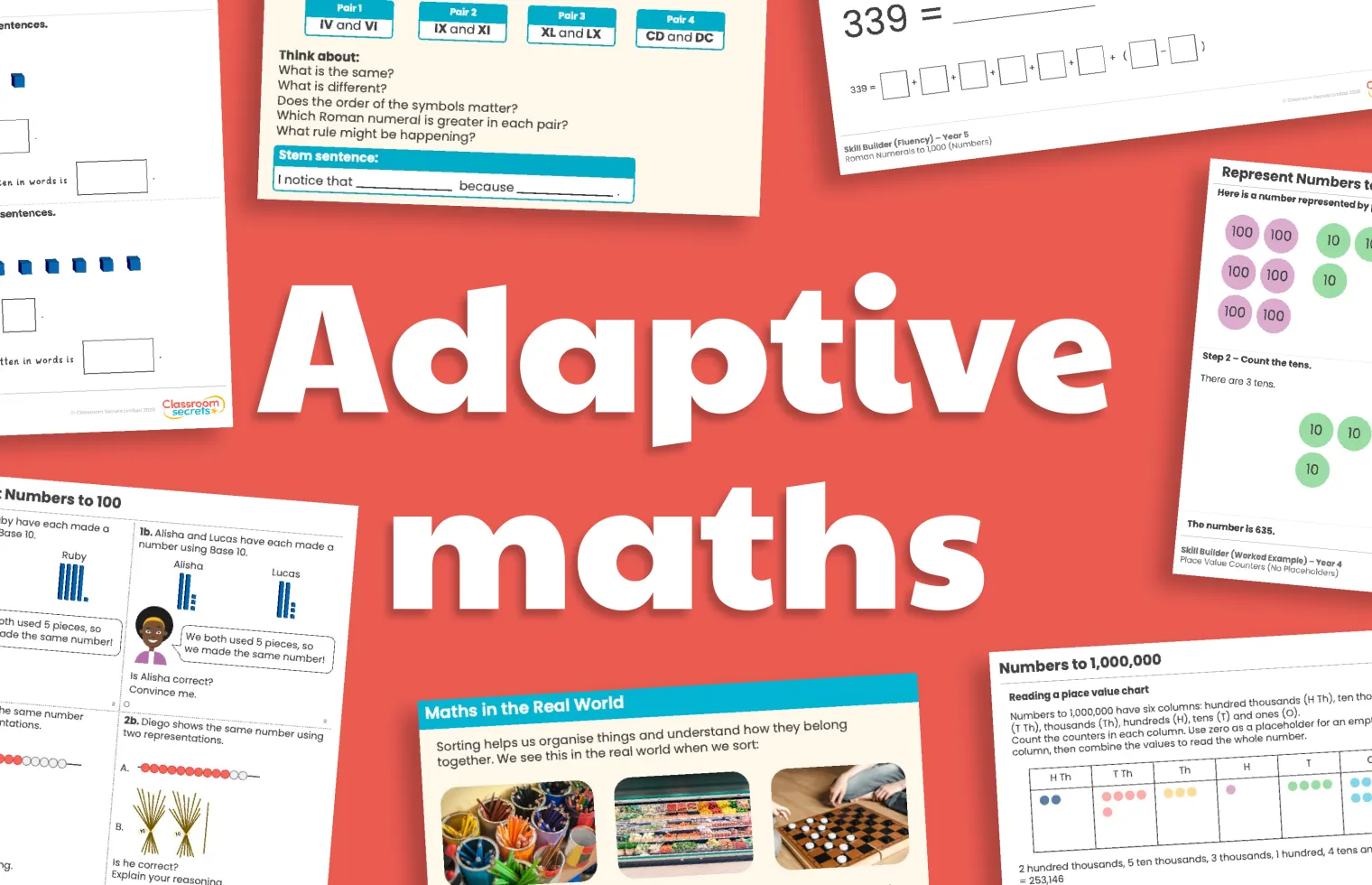
Progress for every child: introducing Classroom Secrets Adaptive Maths
2026-08-07
Adaptive Teaching vs Differentiation: Should You Still Differentiate in Primary Maths?
2026-08-21
What Does Good Scaffolding Look Like in a Primary Maths Lesson?
2026-09-01
Try us today!