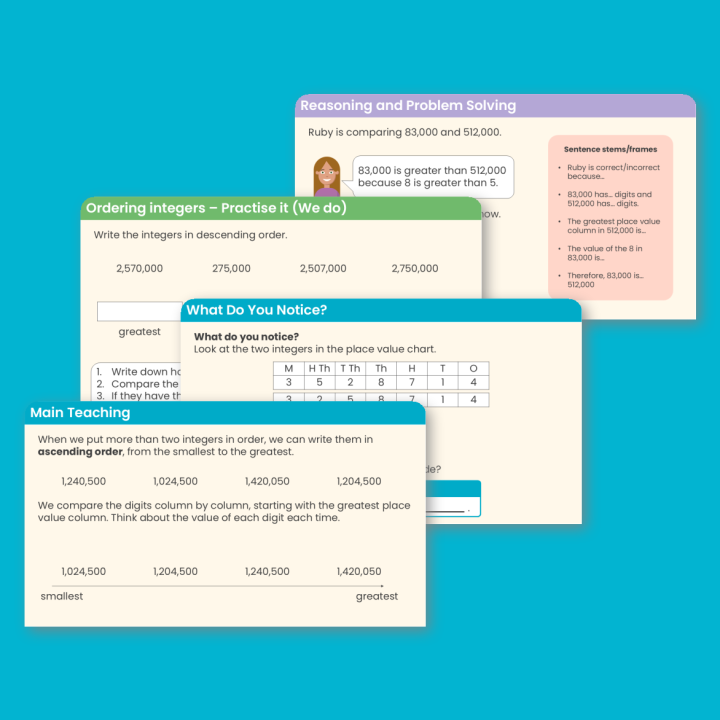
In this Year 6 Compare and Order Any Integers lesson, children order and compare numbers up to 10,000,000 and determine the value of each digit.
The Year 6 Compare and Order Any Integers PowerPoint guides both teachers and children through the lesson, including use of the varied fluency, reasoning and problem solving, deeper reasoning and scaffolded resources. Key learning information about this step:
Key Vocabulary
integers: Whole numbers that are either positive or negative.
ascending order: When values or quantities have been arranged by size from the smallest to the greatest.
descending order: When values or quantities have been arranged by size from the greatest to the smallest.
> < =: Comparison symbols used to represent more than (>), less than (<) and equal to (=).
place value chart: Used to identify the value of the digits that make up a number.
Varied Fluency
Knowledge Organiser
• Designed to support all children via key information and examples.
Scaffolded Examples
• Guided practice comparing integers using place value and comparing integers in different forms.
Support
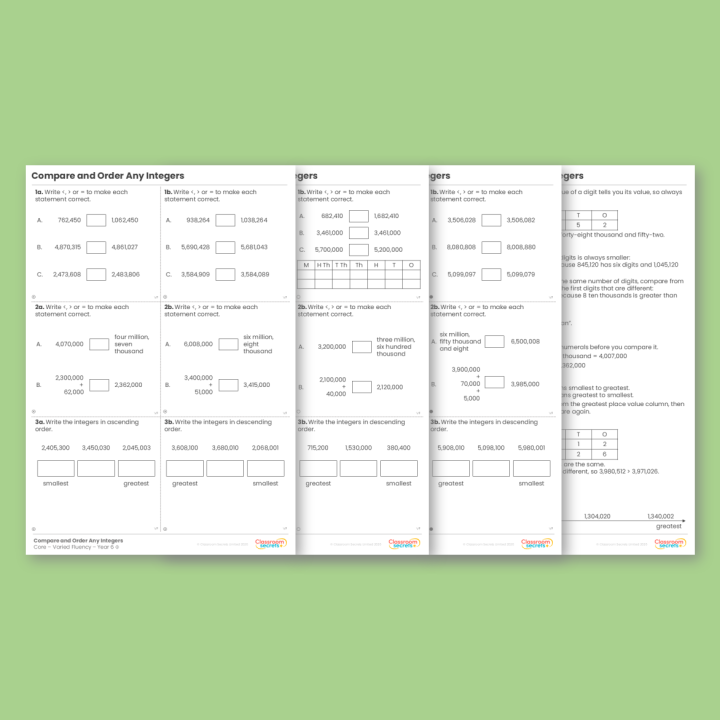
• Q1: Compare integers using <, > or =. Numbers have different number of digits or include different digits; place value chart provided for support.
• Q2: Compare an integer in numerals with one in words or as an addition.
• Q3: Order three integers. Not all numbers have same amount of digits.
Core
• Q1: Compare integers using <, > or =. Numbers have different number of digits or include different digits.
• Q2: Compare numerals with words and additions. Placeholders must be carefully considered.
• Q3: Order three seven-digit integers. One number has a different start digit.
Stretch
• Q1: Compare integers using <, > or =. Numbers use same digits in different orders.
• Q2: Compare numerals with words and three-part additions. Placeholders must be carefully considered.
• Q3: Order three seven-digit integers. All numbers use same digits in different orders.
Reasoning and Problem Solving
Support
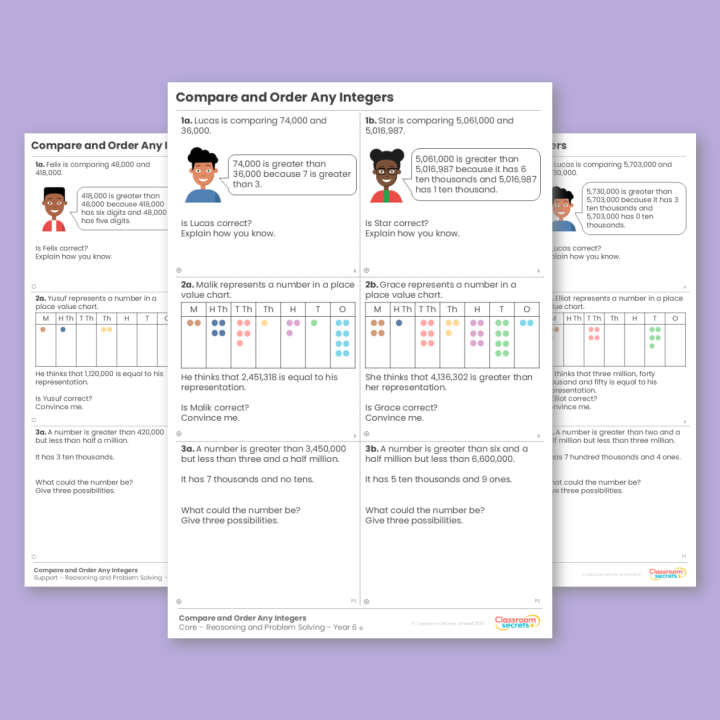
• Q1: Reasoning - explain whether a character is correct about comparing two integers with different numbers of digits.
• Q2: Reasoning – compare a number represented using place value counters with one written in numerals, and explain whether the two have been correctly compared. Multiples of 1,000 only.
• Q3: Problem Solving - find numbers inside a range where one boundary is written in words. One requirement.
Core
• Q1: Reasoning - explain whether a character is correct about comparing two integers with the same number of digits.
• Q2: Reasoning - compare a number represented using place value counters and explain whether the two have been correctly compared.
• Q3: Problem Solving - find numbers inside a range where one boundary is written in words. Two requirements.
Stretch
• Q1: Reasoning - explain whether a character is correct about comparing two integers that use the same digits in a different order.
• Q2: Reasoning - compare a number represented using place value counters with one written in words, and explain whether the two have been correctly compared.
• Q3: Problem Solving - find numbers inside a range where both boundaries are written in words. Two requirements.
Deeper Reasoning
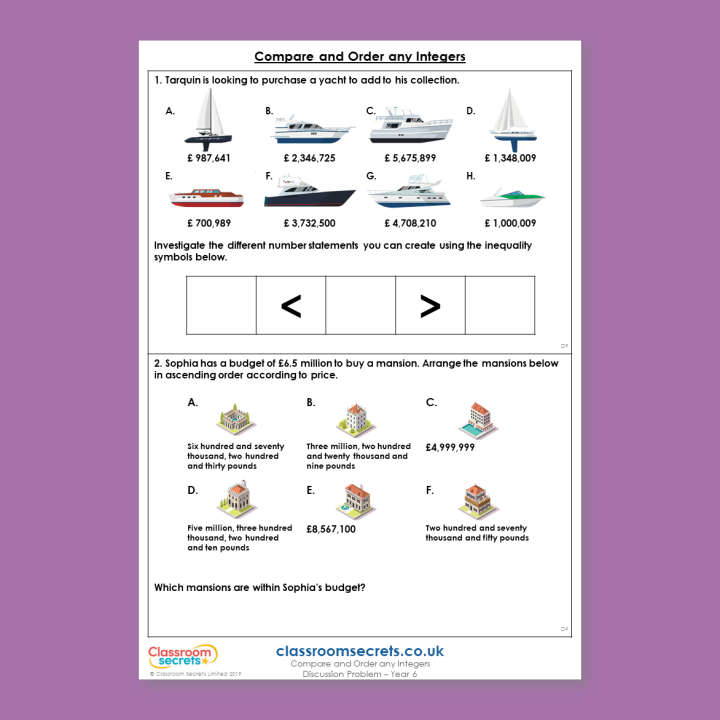
The questions in this set focus on problem solving with integers up to 10,000,000 to deepen understanding in ordering and comparing any integer up to 10,000,000 and determining the value of each digit.
This lesson is designed to align to White Rose Maths version 3. Classroom Secrets Limited is not affiliated with, endorsed by, or in any way connected to White Rose Education Limited. Our products are original to Classroom Secrets Limited and any reference to White Rose Maths is solely for the purpose of indicating compatibility and does not imply any association with White Rose Education.