x1
Select a tag to view relevant resources
Spring
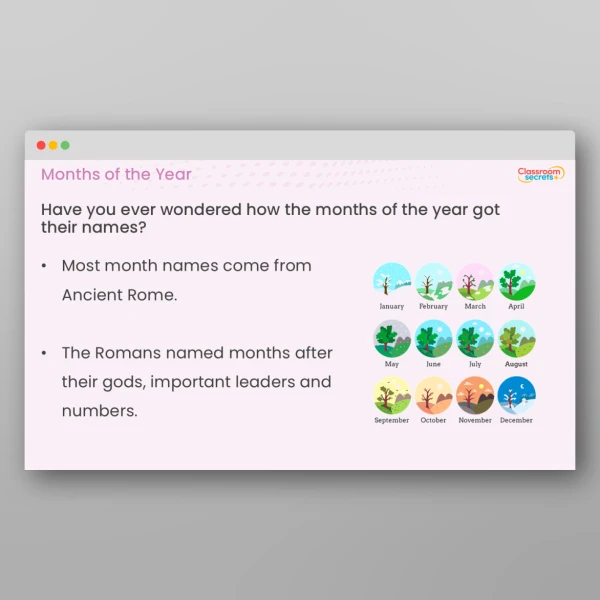
Months of the Year Whole School Assembly PowerPoint is a slideshow that explores how each month of the year got its name. The content includes 15 slides with teacher notes, covering how the Romans named the months after gods, leaders and numbers, a slide for each month from January to December and a recap quiz with answers. It links to KS2 history learning about the Romans.
How January to June got their names, from Janus, the god of beginnings and endings, to Juno, the goddess of family and protection, opening with "Have you ever wondered how the months of the year got their names?"
Why July and August are named after Julius Caesar and Augustus Caesar, and why September to December come from the Latin words for seven, eight, nine and ten.
Every month asks who was born in it, with discussion prompts in the teacher notes, and a recap quiz checks what children remember.
Our whole school assemblies are PowerPoint slideshows that follow a similar structure: an introduction, questions to get children thinking, the key points of the topic and reflection time. They're paced to suit a primary school assembly and work best on a whiteboard, projected out to the hall. You can use them:
The majority of our assemblies include teacher notes and guidance to support delivery, and because they're pacey, you can adapt them to however long your assembly lasts.
Every assembly is editable, so you can add, remove or change slides to suit the needs of your school. We cover religious events, seasonal topics, values such as kindness, friendship and tolerance, science, history, PSHE, music, significant people and sporting events, so you can choose the assemblies that fit your school year.
Families can carry the conversation on at home by asking children about their assembly: what they heard, how it made them feel and what they think about it.
You can explore more of our whole school assembly resources here.
Select a tag to view relevant resources
Spring