x1
![An image of the [object Object] Resource](https://d52m8jhkbaeog.cloudfront.net/featured-images-lq/20fd19aa15aeb935714cbd55253c1ad42585209b/20fd19aa15aeb935714cbd55253c1ad42585209b.webp)
Select a tag to view relevant resources
Autumn
1N2c
1N4
Adaptive Teaching
Place Value (within 10)
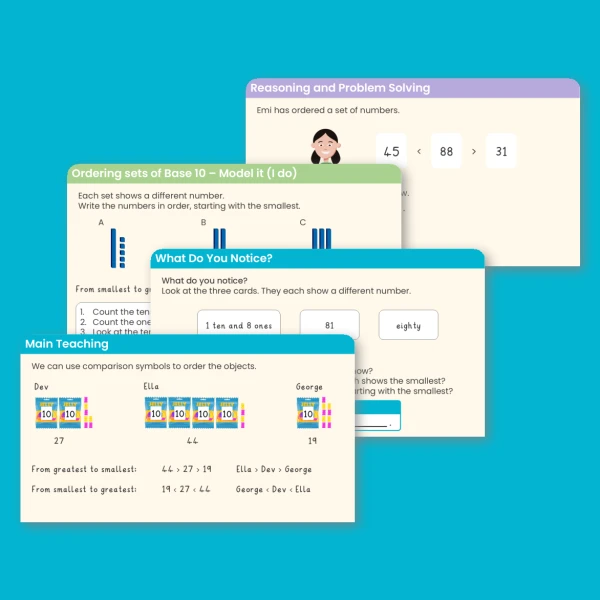
Year 1 Order Objects and Numbers Teaching PowerPoint (PPT) is designed to help you teach how to identify and represent numbers using objects and pictorial representations, and use equal to, more than, less than (fewer), most and least in small steps before pupils move on to the linked tasks. The slideshow is comprehensive and helps you to teach the step in its entirety, prompting moments to assess understanding, address misconceptions and move children onto independent tasks.
Each PowerPoint has been carefully designed, along with the Varied Fluency, Reasoning and Problem Solving worksheets, Adult-Led Practical Activities and Continuous Provision resources to help you guide children on their own journey and ensure progress for every child, not just the average child.
Our Adult-Led Practical Activities resource can also be used alongside or instead of the Teaching PowerPoint. This teacher-led resource is designed to be used as part of the main teaching input, and features question opportunities that are designed to be adaptable with Support, Core and Stretch question prompts.
Our Adaptive Maths PowerPoint slideshow resources work best alongside our other resources for Order Objects and Numbers. The PowerPoint walks you through the whole lesson in a structured way, allowing each child to make progress.
Each PowerPoint follows this structure:
• Foundations - Places the lesson within the wider learning sequence, helping pupils connect new content to what they already know.
• Maths in the Real World - Shows pupils where the maths appears beyond the lesson, helping them understand why the concept is useful and worth learning.
• What Do You Notice? - Gives pupils an early opportunity to contribute, notice patterns and experience success, while helping the teacher check initial thinking and possible misconceptions.
• Prior Learning - Revisits the essential knowledge pupils need to access the lesson, helping the teacher identify and address gaps before moving on.
• Key Vocabulary and Key Facts - Introduces the language, facts and rules pupils need so they can focus on the new learning.
• Teaches the concept explicitly through worked examples.
• Questions are introduced in the same style that pupils will encounter in the lesson’s tasks, helping pupils move from guided practice towards independent practice.
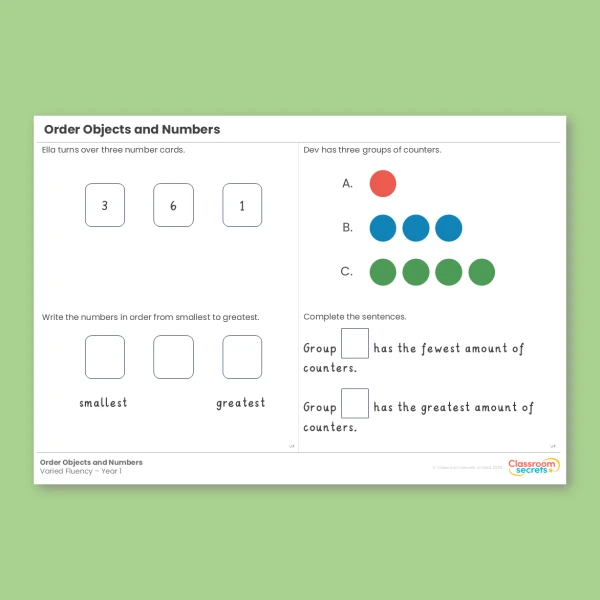
• The Varied Fluency slides guide pupils through questions as a class, in the same style as on the Varied Fluency worksheet.
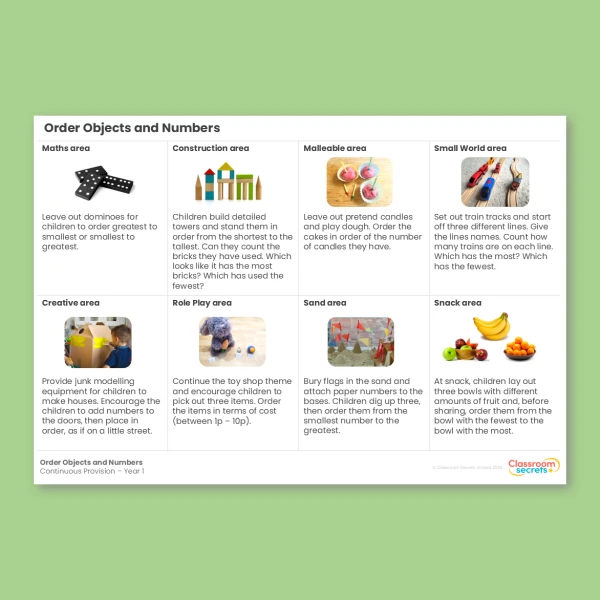
• You can consolidate this fluency flexibly through your Continuous Provision.
• The questions match the content in the Practical Activities resource.
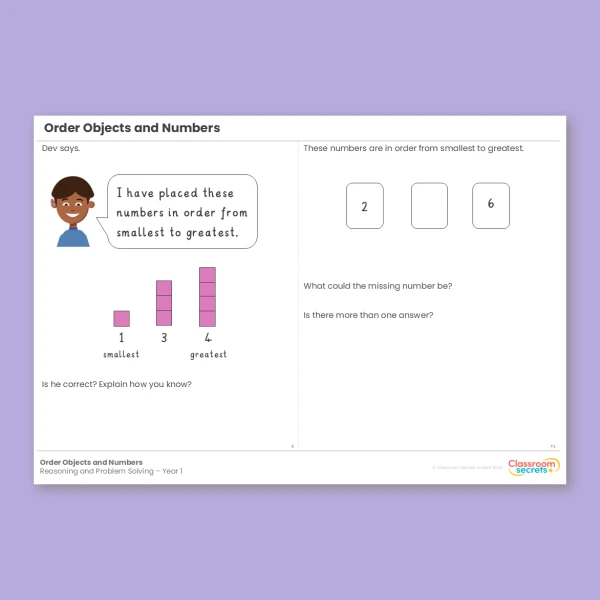
• Once pupils have completed the appropriate fluency work, or shown fluency in this area, move them on to Reasoning and Problem Solving.
• All pupils should have opportunities to reason, solve problems, explain their thinking and justify their answers.
• Children can deepen and apply their understanding within the Continuous Provision.
• A Real Life Problem is available for pupils on the final slide of the PowerPoint, to make a meaningful connection to the maths concept of ordering objects and numbers.
• This Real Life Problem provides opportunities for deeper discussion and more complex discussion.
most: The greatest number of objects in a group.
fewest: The smallest number of objects in a group.
greatest: The number that is more than all the others.
smallest: The number that is less than all the others.
This resource is designed to align to White Rose Maths version 3. Classroom Secrets Limited is not affiliated with, endorsed by, or in any way connected to White Rose Education Limited. Our products are original to Classroom Secrets Limited and any reference to White Rose Maths is solely for the purpose of indicating compatibility and does not imply any association with White Rose Education.
Select a tag to view relevant resources
Autumn
1N2c
1N4
Adaptive Teaching
Place Value (within 10)