Spring 2 Week 5 Maths in Minutes

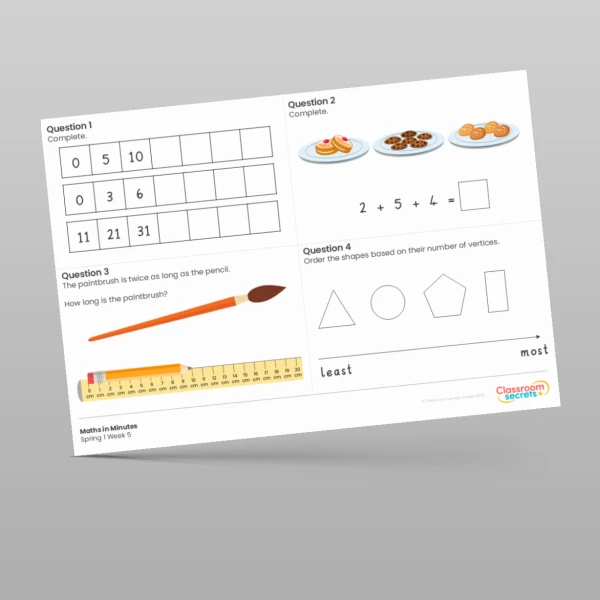
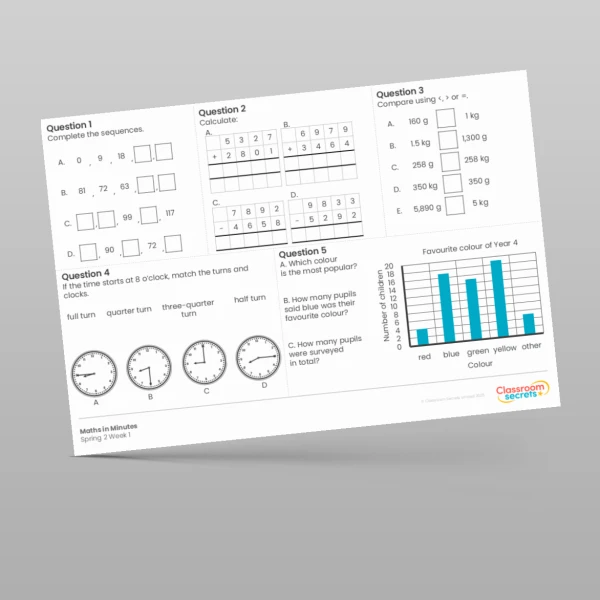
An image of the Spring 2 Week 5 Maths in Minutes Resource


This Year 5 Spring 2 Week 5 Maths in Minutes resource is designed to promote quick recall and retrieval of children's knowledge and prior learning, recapping a number of objectives from Years 4 and 5.

There are three sets of six questions that cover a variety of maths skills in the areas of number, measures, statistics and geometry. This activity is perfect to use during registration, at the start of a maths lesson or whenever you have some time to spare. We've specially designed this resource to be displayed on the interactive whiteboard to save on printing costs.


Curriculum Objectives

  • Round any number to the nearest 10, 100 or 1,000
  • Compare and classify geometric shapes, including quadrilaterals and triangles, based on their properties and sizes
  • Complete a simple symmetric figure with respect to a specific line of symmetry
  • Describe movements between positions as translations of a given unit to the left/right and up/down
  • Interpret and present discrete and continuous data using appropriate graphical methods, including bar charts and time graphs
  • Solve comparison, sum and difference problems using information presented in bar charts, pictograms, tables and other graphs
  • Determine the value of each digit in numbers up to 1,000,000
  • Read Roman numerals to 1,000 (M) and recognise years written in Roman numerals
  • Add and subtract whole numbers with more than 4 digits, including using formal written methods (columnar addition and subtraction)
  • Multiply numbers up to 4 digits by a one- or two-digit number using a formal written method, including long multiplication for two-digit numbers
  • Add and subtract fractions with the same denominator and denominators that are multiples of the same number
  • Read, write, order and compare numbers with up to three decimal places
  • Solve problems involving converting between units of time
  • Convert between different units of metric measure (for example, kilometre and metre; centimetre and metre; centimetre and millimetre; gram and kilogram; litre and millilitre)
  • Understand and use approximate equivalences between metric units and common imperial units such as inches, pounds and pints

Tags

Select a tag to view relevant resources

Spring

4N4b

4G2a

4G2c

4P2

4S1

4S2

5N3a

5N3b

5C2

5C7a

5F4

5F8

5M4

5M5

5M6

Maths in Minutes